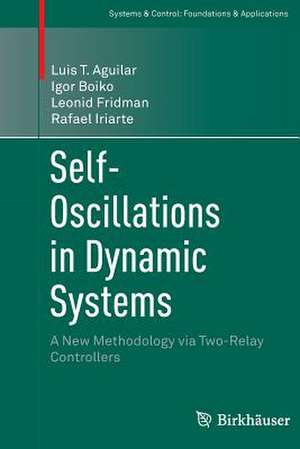
Self-Oscillations in Dynamic Systems: Systems & Control: Foundations & Applications
Autor Luis T. Aguilar, Igor Boiko, Leonid Fridman, Rafael Iriarteen Limba Engleză Paperback – 23 aug 2016
The first part of the book explains the design procedures for two-relay control using three different methodologies – the describing-function method, Poincaré maps, and the locus-of-a perturbed-relay-system method – and concludes with stability analysis of designed periodic oscillations.
Two methods to ensure the robustness of two-relay control algorithms are explored in the second part, one based on the combination of the high-order sliding mode controller and backstepping, and the other on higher-order sliding-modes-based reconstruction of uncertainties and their compensation where Lyapunov-based stability analysis of tracking error is used. Finally, the third part illustrates applications of self-oscillation generation by a two-relay control with a Furuta pendulum, wheel pendulum, 3-DOF underactuated robot, 3-DOF laboratory helicopter, and fixed-phase electronic circuits.
Self-Oscillations in Dynamic Systems will appeal to engineers, researchers, and graduate students working on the tracking and self-generation of periodic motion of electromechanical systems, including non-minimum-phase systems. It will also be of interest to mathematicians working on analysis of periodic solutions.
Din seria Systems & Control: Foundations & Applications
- 15%
 Preț: 611.27 lei
 -
 Preț: 374.54 lei
 - 18%
 Preț: 823.65 lei
 - 15%
 Preț: 661.83 lei
 -
 Preț: 408.64 lei
 - 15%
 Preț: 674.70 lei
 - 15%
 Preț: 670.12 lei
 - 15%
 Preț: 584.73 lei
 -
 Preț: 397.95 lei
 - 15%
 Preț: 651.27 lei
 - 15%
 Preț: 668.04 lei
 - 15%
 Preț: 675.82 lei
 - 15%
 Preț: 664.88 lei
 - 15%
 Preț: 657.71 lei
 -
 Preț: 399.93 lei
 - 15%
 Preț: 555.18 lei
 -
 Preț: 381.55 lei
 -
 Preț: 411.78 lei
 - 18%
 Preț: 1383.74 lei
 - 18%
 Preț: 995.59 lei
 -
 Preț: 411.23 lei
 -
 Preț: 406.37 lei
 - 18%
 Preț: 995.63 lei
 - 18%
 Preț: 966.51 lei
 - 18%
 Preț: 950.43 lei
 - 15%
 Preț: 643.87 lei
 - 18%
 Preț: 1005.14 lei
 - 15%
 Preț: 673.55 lei
 - 18%
 Preț: 987.18 lei
 - 15%
 Preț: 646.70 lei
 -
 Preț: 399.46 lei
 - 15%
 Preț: 669.86 lei
 -
 Preț: 396.88 lei
 - 18%
 Preț: 1014.46 lei
 - 15%
 Preț: 669.16 lei
Preț: 383.27 lei
Puncte Express: 575
Carte tipărită la comandă
Livrare economică 09-23 decembrie
Livrare prin curier în România Termenul estimat este afișat lângă disponibilitate.
Transport gratuit de la 400.00 lei Plată online sau ramburs, în funcție de opțiunile comenzii.
Retur gratuit în 14 zile Comandă securizată și suport în română.
Specificații
ISBN-13: 9783319365374
ISBN-10: 3319365371
Pagini: 172
Ilustrații: XIV, 158 p.
Dimensiuni: 155 x 235 x 10 mm
Greutate: 0.27 kg
Ediția:Softcover reprint of the original 1st edition 2015
Editura: birkhäuser
Colecția Systems & Control: Foundations & Applications
Seria Systems & Control: Foundations & Applications
Locul publicării:Cham, Switzerland
ISBN-10: 3319365371
Pagini: 172
Ilustrații: XIV, 158 p.
Dimensiuni: 155 x 235 x 10 mm
Greutate: 0.27 kg
Ediția:Softcover reprint of the original 1st edition 2015
Editura: birkhäuser
Colecția Systems & Control: Foundations & Applications
Seria Systems & Control: Foundations & Applications
Locul publicării:Cham, Switzerland
V-ar putea interesa
-
 Evolution of Networks: From Biological Nets to the Internet and WWWS. N. Dorogovtsev-23%Preț: 432.72 lei558.75 lei
 -
 The Computer and the BrainJohn Von NeumannPreț: 113.01 lei
 -
 Introduction to Systems TheoryNiklas LuhmannPreț: 169.40 lei
 -
 Sliding Mode Control and ObservationYuri Shtessel-54%Preț: 385.06 lei840.94 lei
 -
 Introduction ModelicaFritzson-8%Preț: 452.76 lei492.13 lei
 -
 Optimal Estimation of Dynamic SystemsJohn L. Crassidis-18%Preț: 1494.88 lei1823.02 lei
 -
 Switching in Systems and ControlDaniel Liberzon-15%Preț: 584.73 lei687.91 lei
 -
 Perturbation Analysis of Optimization ProblemsJ.Frederic Bonnans-18%Preț: 1341.26 lei1635.67 lei
 -
 Stochastic Networked Control SystemsSerdar Yüksel-18%Preț: 995.63 lei1214.17 lei
 -
 Stochastic Networked Control SystemsSerdar Yüksel-18%Preț: 909.87 lei1109.60 lei
 -
 -18%Preț: 918.59 lei1120.23 lei
 -
 Modeling and Control of Discrete-Event Dynamic SystemsBranislav Hrúz-15%Preț: 471.15 lei554.30 lei
 -
 Introducing ChaosIwona AbramsPreț: 64.56 lei
 -
 Model-Based Control of Networked SystemsEloy Garcia-15%Preț: 675.30 lei794.47 lei
 -
 Introduction to Time-Delay Systems: Analysis and ControlEmilia Fridman-46%Preț: 513.77 lei945.44 lei
Cuprins
Introduction.- Part I: Design of Self-Oscillations using Two-Relay Controller.- Describing Function-Based Design of TRC for Generation of Self-Oscillation.- Poincaré Maps Based Design.- Self-Oscillation via Locus of a Perturbed Relay System Design (LPRS).- Part II: Robustification of the Self-Oscillation Generated by Two-Relay Controller.- Robustification of the Self-Oscillation via Sliding Modes Tracking Controllers.- Output-Based Robust Generation of Self-Oscillations.- Part III: Applications.- Generating Self-Oscillations in Furuta Pendulum.- Three Link Serial Structure Underactuated Robot.- Generation of Self-Oscillations in Systems with Double Integrator.- Fixed-Phase Loop (FPL).- Appendix A: Describing Function.- Appendix B: The Locus of a Perturbed Relay System (LPRS).- Appendix C: Poincaré Map.- Appendix D: Output Feedback.- References.- Index.
Recenzii
“The book contains ten chapters presented in three parts. … The intended audience for this book consists of mechanical and control scientists and engineers, as well as graduate and Ph.D. students interested in the theory of self-oscillation generation in underactuated dynamic systems.” (Clementina D. Mladenova, Mathematical Reviews, June, 2016)
Textul de pe ultima copertă
This monograph presents a simple and efficient two-relay control algorithm for generation of self-excited oscillations of a desired amplitude and frequency in dynamic systems. Developed by the authors, the two-relay controller consists of two relays switched by the feedback received from a linear or nonlinear system, and represents a new approach to the self-generation of periodic motions in underactuated mechanical systems.
The first part of the book explains the design procedures for two-relay control using three different methodologies – the describing-function method, Poincaré maps, and the locus-of-a perturbed-relay-system method – and concludes with stability analysis of designed periodic oscillations.
Two methods to ensure the robustness of two-relay control algorithms are explored in the second part, one based on the combination of the high-order sliding mode controller and backstepping, and the other on higher-order sliding-modes-based reconstruction ofuncertainties and their compensation where Lyapunov-based stability analysis of tracking error is used. Finally, the third part illustrates applications of self-oscillation generation by a two-relay control with a Furuta pendulum, wheel pendulum, 3-DOF underactuated robot, 3-DOF laboratory helicopter, and fixed-phase electronic circuits.
Self-Oscillations in Dynamic Systems will appeal to engineers, researchers, and graduate students working on the tracking and self-generation of periodic motion of electromechanical systems, including non-minimum-phase systems. It will also be of interest to mathematicians working on analysis of periodic solutions.
The first part of the book explains the design procedures for two-relay control using three different methodologies – the describing-function method, Poincaré maps, and the locus-of-a perturbed-relay-system method – and concludes with stability analysis of designed periodic oscillations.
Two methods to ensure the robustness of two-relay control algorithms are explored in the second part, one based on the combination of the high-order sliding mode controller and backstepping, and the other on higher-order sliding-modes-based reconstruction ofuncertainties and their compensation where Lyapunov-based stability analysis of tracking error is used. Finally, the third part illustrates applications of self-oscillation generation by a two-relay control with a Furuta pendulum, wheel pendulum, 3-DOF underactuated robot, 3-DOF laboratory helicopter, and fixed-phase electronic circuits.
Self-Oscillations in Dynamic Systems will appeal to engineers, researchers, and graduate students working on the tracking and self-generation of periodic motion of electromechanical systems, including non-minimum-phase systems. It will also be of interest to mathematicians working on analysis of periodic solutions.
Caracteristici
Describes a quick and efficient method of control synthesis for generating periodic motions Demonstrates applications to non-minimum-phase systems, including underactuated mechanisms Provides a rigorous theoretical background for the development of two-relay controllers supported by experimental results