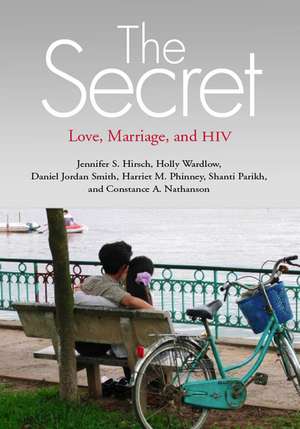
Secret: Love, Marriage, and HIV
Autor Jennifer S. Hirsch, Constance A. Nathanson, Shanti Parikh, Harriet M. Phinney, Daniel Jordan Smith, Holly Wardlowen Limba Engleză Paperback – 14 feb 2010
Notăm cu interes apariția volumului Secret, o lucrare de o rigoare academică excepțională care se adresează în primul rând specialiștilor din sănătate publică și studenților la antropologie, rămânând totodată accesibilă prin claritatea expunerii. Subliniem faptul că, pentru multe femei la nivel global, cel mai mare risc de infectare cu HIV nu provine din comportamente marginale, ci din cadrul propriei căsătorii. Autorii propun o perspectivă provocatoare: infidelitatea masculină nu este tratată ca un act individual impulsiv, ci ca un element structural al organizării sociale în comunități din Mexic până în Vietnam.
Remarcăm modul în care autorii integrează datele etnografice vii cu o analiză teoretică sofisticată a „geografiilor sexuale” și a structurilor de oportunitate extramaritală. Fanii lucrării Risky Marriage de Melissa Browning vor recunoaște aceeași atenție metodică acordată experiențelor trăite de femei, aplicată aici într-un context comparativ mult mai larg, ce cuprinde cinci culturi diferite. În timp ce Melissa Browning se concentrează pe Tanzania, Secret extinde analiza la nivel global, evidențiind tensiunea dintre practicile tradiționale și idealul modern al căsătoriei de tip partenerial.
Această lucrare continuă explorarea temelor intimității în era globalizării, o direcție începută de Jennifer S. Hirsch în Love and Globalization. Dacă în lucrările anterioare accentul cădea pe modul în care procesele economice ne modelează viața privată, în volumul de față Jennifer S. Hirsch și echipa sa demonstrează cum normele sociale despre gen și „secretele” acceptate colectiv devin factori determinanți în dinamica unei pandemii. Este o analiză lucidă a modului în care cultura dictează riscul, dincolo de modelele raționale de prevenție.
Preț: 311.26 lei
Carte tipărită la comandă
Livrare economică 18 iunie-02 iulie
Specificații
ISBN-10: 0826516831
Pagini: 320
Dimensiuni: 178 x 254 x 23 mm
Greutate: 0.66 kg
Editura: Vanderbilt University Press
Colecția Vanderbilt University Press
V-ar putea interesa
-
 The Invisible CureHelen EpsteinPreț: 110.78 lei
 -
 AIDS in the UK: The Making of Policy, 1981-1994Virginia Berridge-26%Preț: 407.59 lei553.36 lei
 -
 The HIV Pandemic: Local and global implicationsEduard J Beck-31%Preț: 1215.58 lei1752.78 lei
 -
 HIV & AIDS: A Very Short IntroductionAlan Whiteside-25%Preț: 54.33 lei72.87 lei
 -
 HIV and AIDS, Testing, Screening, and ConfidentialityRebecca Bennett-19%Preț: 331.49 lei409.70 lei
 -
 HIV Prevention With Latinos: Theory, Research, and PracticeKurt C. Organista-34%Preț: 521.93 lei787.47 lei
 -
 Preț: 250.21 lei
 -
 Preț: 373.56 lei
 -
 Preț: 402.35 lei
 -
 Feminisms, HIV and AIDSV. TallisPreț: 375.41 lei
 -
 Saturday Is for FuneralsUnity DowPreț: 189.32 lei
 -
 Reframing BodiesRoger HallasPreț: 244.08 lei
 -
 -27%Preț: 54.86 lei75.52 lei
 -
 -30%Preț: 1144.94 lei1643.50 lei
 -
 Witness to AidsEdwin Cameron-29%Preț: 179.76 lei252.60 lei
De ce să citești această carte
Recomandăm această carte cercetătorilor care doresc să înțeleagă de ce strategiile standard de prevenție HIV eșuează adesea în context marital. Cititorul câștigă o perspectivă profundă asupra modului în care normele de gen și structurile sociale influențează sănătatea publică. Este o lectură esențială pentru a înțelege complexitatea relațiilor intime moderne și riscurile ascunse în spatele convențiilor sociale acceptate.
Despre autor
Jennifer S. Hirsch este profesor de sănătate publică și antropologie la Emory University. Expertiza sa se concentrează pe intersecția dintre sexualitate, gen și sănătate reproductivă, fiind o voce recunoscută în studiul modului în care procesele globale influențează cele mai intime aspecte ale vieții umane. Alături de o echipă internațională de antropologi, precum Daniel Jordan Smith și Shanti Parikh, Hirsch a contribuit fundamental la dezvoltarea metodologiilor de cercetare colaborativă, transformând observația etnografică într-un instrument vital pentru politicile de sănătate globală.
Descriere scurtă
For many women around the world, their greatest risk of HIV infection comes from having sex with the very person with whom they are supposed to have sex: their spouse. The Secret situates marital HIV risk within a broader exploration of marital and extramarital sexuality in five diverse settings: Mexico, Nigeria, Uganda, Vietnam, and Papua New Guinea. In these settings, the authors write, men's extramarital sex is an officially secret but actually widespread (and widely acknowledged) social practice, rather than something men do because their bodies demand it and women can't stop them.
Drawing on research conducted as part of an innovative comparative ethnographic study, and modeling a novel approach to collaborative anthropological scholarship, the authors show men's extramarital sex to be a fundamental aspect of gendered social organization. Through theoretically sophisticated yet lucid writing and vivid ethnographic description, drawing on rich data from the marital case studies conducted by research teams in each country, they trace how extramarital opportunity structures, sexual geographies, and concerns about social risk facilitate men's participation in extramarital sex. Also documented throughout is the collision between traditional ways and the new practices of romantic companionate marriage.
Notă biografică
Holly Wardlow, Associate Professor of Anthropology at the University of Toronto, is the author of Wayward Women: Sexuality and Agency in a New Guinea Society.
Daniel Jordan Smith, Associate Professor of Anthropology and Associate Director of the Population Studies and Training Center at Brown University, is the author of A Culture of Corruption: Everyday Deception and Popular Discontent in Nigeria.
Harriet Phinney is a lecturer at Seattle University.
Shanti Parikh is Assistant Professor of Anthropology, Washington University in St. Louis.
Constance A. Nathanson, Professor of Clinical Sociomedical Sciences and Professor of Population and Family Health in the Mailman School of Public Health at Columbia University, is the author of Disease Prevention as Social Change and Dangerous Passage: The Social Control of Sexuality in Women's Adolescence.
Recenzii
—Global Public Health
"In prose that is mercifully clear and easy to understand, the five case studies in this fascinating collection focus on the social and economic forces that encourage husbands to have extramarital affairs, exposing their wives to the risk of contracting HIV. These authors, each of whom had experience in the locale discussed, describe the spaces conducive to extramarital sex and the social encouragements to indulge. They explore men's subjectivity rather than depicting them as victims of emotions or sexual drives. 'Modernization,' in the form of people's increasing need for cash, is one of the culprits. It requires husbands to migrate in search of jobs, exposing them to establishments catering to migrating men that offer sexual services, even as peer pressure to appear wealthy encourages even reluctant husbands to indulge. Wives, confined at home with children and needing a husband's cash to care for them, usually keep "the secret," sometimes to the extent of refusing to 'know.' The initial and final chapters describe the authors' theoretical framework and methods, providing useful information for scholars contemplating collaborative, comparative research, or interested in curbing the spread of HIV."
—Jane F. Collier, Stanford University
"The book is impressive in substance and method."
—Contemporary Sociology
"This book is a treasure trove of good theory and critical case studies of contemporary marriage and extra marital sex globally. It begins where many prior studies have stopped: Investigation of the public secret of sex in extra-marital affairs. From Mexico to Vietnam and Uganda and beyond, marriage involves the dreadful challenge of women's exposure to HIV through their husbands or long time partners. Here is a new approach to the social organization of extra-marital sex that combines love with the sexual geography of desire in unique and disturbing ways that will be of interest to all students of these issues in the social sciences."
—Gilbert Herdt, San Francisco State University
"This very-well-written book is a great addition to the existing literature on sexuality, marriage, extramarital opportunities, and HIV risk and a pleasure to read. Highly recommended."
—Choice
"While this is a book mainly for scholars and students, its conclusions will be enlightening for those who are concerned with HIV prevention in the international arena."
—A U: America's AIDS Magazine