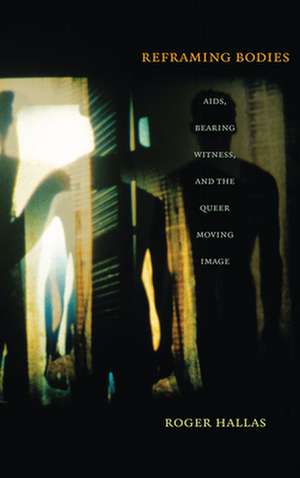
Reframing Bodies
Autor Roger Hallasen Limba Engleză Paperback – 2 dec 2009
Descoperim în Reframing Bodies o perspectivă asupra crizei AIDS care depășește simpla documentare politică, oferindu-ne acces la o arhivă senzorială a rezilienței. Roger Hallas ne invită să privim dincolo de imaginile clinice sau de victimizare, explorând modul în care media queer a transformat trauma în mărturie estetică. Considerăm că forța acestui volum rezidă în capacitatea de a analiza cum suportul material — de la granulația filmului de 16mm la estetica video-activismului — devine un vehicul al memoriei colective. Cele 63 de fotografii alb-negru incluse nu sunt simple ilustrații, ci puncte de ancorare vizuală care ne permit să percepem textura unei epoci marcate de urgență. Autorul Roger Hallas continuă aici preocupările sale fundamentale despre etica imaginii și rolul martorului, teme centrale și în lucrarea sa The Image and the Witness – Trauma, Memory, and. Dacă în Documenting the Visual Arts se concentra pe diversitatea documentarului de artă, în volumul de față aplică această rigoare analitică asupra unor opere hibride, de la musicaluri la instalații multimedia. Ca și AIDS TV, lucrarea pune în valoare puterea tehnologiilor accesibile în mâinile comunităților marginalizate, dar cu un accent deosebit pe experimentul estetic și pe modul în care interacțiunea dintre subiect și cameră redefinește vizibilitatea queer. În comparație cu The Queer Biopic in the AIDS Era, care se concentrează pe genul biografic, Reframing Bodies lărgește cadrul analitic către logica bazei de date și a remixului, demonstrând cum aceste imagini continuă să „vorbească” într-un context digital contemporan.
Preț: 253.75 lei
Carte tipărită la comandă
Livrare economică 09-23 decembrie
Specificații
ISBN-10: 082234601X
Pagini: 336
Ilustrații: 63 b&w photographs
Dimensiuni: 159 x 235 x 23 mm
Greutate: 0.49 kg
Editura: Duke University Press
Locul publicării:United States
V-ar putea interesa
-
 -5%Preț: 152.57 lei160.59 lei
 -
 Preț: 402.86 lei
 -
 Lessons from the Damned: Queers, Whores and Junkies Respond to AIDSNancy E. Stoller-15%Preț: 416.38 lei489.87 lei
 -
 -5%Preț: 1606.55 lei1691.11 lei
 -
 -5%Preț: 691.72 lei728.13 lei
 -
 Contemporary Research on Sex WorkJeffrey T. Parsons-15%Preț: 484.74 lei570.27 lei
 -
 Preț: 494.89 lei
 -
 The AIDS Pandemic in Latin AmericaShawn C. Smallman-5%Preț: 321.64 lei338.57 lei
 -
 Infectious IdeasJennifer BrierPreț: 264.06 lei
 -
 AIDS, Culture, and Gay MenDouglas A. FeldmanPreț: 193.15 lei
 -
 -5%Preț: 289.09 lei304.31 lei
 -
 The Republic of TherapyVinh-Kim NguyenPreț: 248.48 lei
 -
 The Secret: Love, Marriage, and HIVJennifer S. HirschPreț: 325.73 lei
 -
 -5%Preț: 318.89 lei335.68 lei
 -
 Modernizing Medicine in Zimbabwe: HIV/AIDS and Traditional HealersDavid S. Simmons-23%Preț: 610.67 lei793.07 lei
 -
 Fragments: My Journey with SchizophreniaDaniel-James F. ClarkePreț: 70.53 lei
 -
 -18%Preț: 1255.33 lei1530.89 lei
 -
 Mobilizing New YorkTamar W. CarrollPreț: 338.22 lei
 -
 AIDS and the Distribution of CrisesJih-Fei ChengPreț: 298.62 lei
De ce să citești această carte
Recomandăm această carte cercetătorilor în studii vizuale și istorie culturală, dar și oricărui cititor interesat de modul în care arta poate procesa traume colective. Veți câștiga o înțelegere profundă a modului în care cinematografia experimentală a modelat identitatea queer în momente de criză. Este o resursă esențială despre puterea imaginii de a servi drept martor atunci când discursul oficial eșuează.