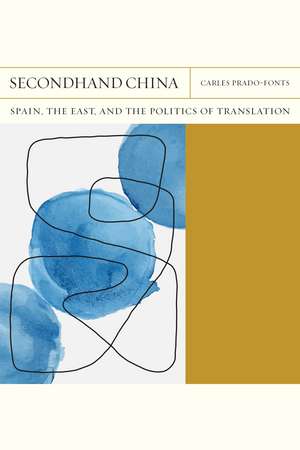
Secondhand China: Spain, the East, and the Politics of Translation: FlashPoints, cartea 39
Autor Carles Prado-Fontsen Limba Engleză Hardback – 15 iun 2022 – vârsta ani
Uncovering an eclectic and surprising archive, Prado-Fonts draws on diverse cultural artifacts from popular literature, journalism, and early cinema to offer a rich account of how China was seen across the West between 1880 and 1930. Enrique Gaspar, Luis de Oteyza, Vicente Blasco Ibáñez, and lesser-known authors writing in Spanish and Catalan put themselves in dialogue with Leo Tolstoy, John Dewey, W. Somerset Maugham, Bertrand Russell, Pearl Buck, and André Malraux, as well as stereotypical figures from popular culture like Fu Manchu and Charlie Chan. Throughout, Prado-Fonts exposes translation as a technology of cultural hegemony and China as an appealing object for representation. A timely contribution to our understanding of how we create and consume knowledge about the world, Secondhand China is essential reading for scholars and students of Orientalism, postcolonial studies, translation studies, comparative literature, and cultural studies.
Din seria FlashPoints
-
 Preț: 350.23 lei
 -
 Preț: 264.68 lei
 -
 Preț: 410.73 lei
 -
 Preț: 311.99 lei
 -
 Preț: 266.29 lei
 -
 Preț: 264.79 lei
 - 23%
 Preț: 675.67 lei
 -
 Preț: 233.39 lei
 -
 Preț: 253.86 lei
 -
 Preț: 232.16 lei
 - 23%
 Preț: 687.61 lei
 -
 Preț: 268.71 lei
 -
 Preț: 270.25 lei
 -
 Preț: 271.20 lei
 - 23%
 Preț: 689.72 lei
 - 23%
 Preț: 688.23 lei
 - 18%
 Preț: 754.60 lei
 - 23%
 Preț: 687.61 lei
 -
 Preț: 266.39 lei
 -
 Preț: 298.20 lei
 -
 Preț: 267.55 lei
 -
 Preț: 258.95 lei
 -
 Preț: 258.17 lei
 - 18%
 Preț: 818.05 lei
Preț: 704.76 lei
Preț vechi: 915.27 lei
-23%
Puncte Express: 1057
Carte tipărită la comandă
Livrare economică 01-15 decembrie
Livrare prin curier în România Termenul estimat este afișat lângă disponibilitate.
Transport gratuit pentru acest produs Plată online sau ramburs, în funcție de opțiunile comenzii.
Retur gratuit în 14 zile Comandă securizată și suport în română.
Specificații
ISBN-13: 9780810144774
ISBN-10: 0810144778
Pagini: 272
Dimensiuni: 152 x 229 x 23 mm
Greutate: 0.51 kg
Editura: Northwestern University Press
Colecția Northwestern University Press
Seria FlashPoints
ISBN-10: 0810144778
Pagini: 272
Dimensiuni: 152 x 229 x 23 mm
Greutate: 0.51 kg
Editura: Northwestern University Press
Colecția Northwestern University Press
Seria FlashPoints
Notă biografică
CARLES PRADO-FONTS is an associate professor of Chinese literature, Sinophone cultures, and translation studies at the Universitat Oberta de Catalunya.
Cuprins
Acknowledgments
Introduction: Writing the East from the Rest of the West
1. Illusion Is More Beautiful that Reality
2. To Show the Real Truth
3. My Pride as a White Man Fully Woke Up
4. As it Has Not Been Made Known by Chinese Writers Themselves
Conclusion: The Lure of Translation
Notes
Index
Introduction: Writing the East from the Rest of the West
1. Illusion Is More Beautiful that Reality
2. To Show the Real Truth
3. My Pride as a White Man Fully Woke Up
4. As it Has Not Been Made Known by Chinese Writers Themselves
Conclusion: The Lure of Translation
Notes
Index
Recenzii
“An excellent study that adds greatly to our understanding of China in Spain, and it will serve as a valuable reference to scholars seeking a sophisticated and penetrating account of how the (in)visibility of translation affects the very structures of cross-cultural representation.” —Comparative Literature Studies
“This book not only reveals the mechanism behind Spain’s secondhand perception of China, but also raises important questions about the role of translation and cultural hegemony in cross-cultural understanding. For scholars interested in the “cross-cultural hegemonies”, “the politics of languages and cultures”, and “China and the Sinophone world”, it is a valuable academic resource.” —Journal of Cultural Interaction in East Asia
“From a methodological perspective, the trialectical approach in Secondhand China (China through Western discourses in a Spanish context) encourages challenging the conventionally assumed East-West binary, while the combined use of fiction, non-fiction, and media, both translated, not-translated and reported as translations, is an inspiration to ‘diversify our archives and challenge our epistemologies.’” —Perspectives
“An in-depth examination of the complex relationships between East and West, Spain and Europe, and Catalonia and other parts of Spain between the late nineteenth century and the 1930s. Carles Prado-Fonts analyzes Spanish and Catalan cultural texts about China produced during this period, providing a unique perspective on the cultural and political dynamics at play in these relationships as well as on the politics of translation.” —Modern Chinese Literature and Culture
“Combining nonexistent authors, taboo topics, imaginary journeys, Borgesian paradoxes, Bakhtinian phantom dialogues, dime novels, and journalistic forgeries, this account of reflections on an empire in crisis from another empire in crisis has nothing shopworn about it. Carles Prado-Fonts’s ingenious book twists the ‘East-West’ topic formidably out of shape.” —Haun Saussy, author of Translation as Citation: Zhuangzi Inside Out
“A valuable contribution to several fields, Secondhand China will be consulted for many years to come. Its nuanced readings of Spanish- and Catalan-language materials reveal significant but often overlooked transnational dimensions of those literatures, but also bring new insight and ideas to broader debates about translation studies, Orientalism, and world literature.” —Christopher Bush, author of Ideographic Modernism: China, Writing, Media
“Secondhand China tells the fascinating story of how Spain, a minor European country and thus part of the ‘rest of the West,’ wrote about China in the nineteenth and early twentieth centuries. Through this new lens, Prado-Fonts proposes a more capacious scope for the working of translation and more complex scenarios for mapping intercultural connections. This is a welcome challenge to key concepts in the fields of comparative literature, European studies, translation studies, and beyond.” —Andrea Bachner, author of Beyond Sinology: Chinese Writing and the Scripts of Culture
“Secondhand China is a remarkably original examination of how originality itself is created out of second-handedness, and specifically the way that late nineteenth- and early twentieth-century Spanish and Catalan authors perceived (and celebrated) their own mediated relationship to China. Part literary analysis, part intellectual history, and part translation theory, Secondhand China offers an exciting new model for doing cross-cultural studies.” —Carlos Rojas, author of Homesickness: Culture, Contagion, and National Transformation in Modern China
“This book not only reveals the mechanism behind Spain’s secondhand perception of China, but also raises important questions about the role of translation and cultural hegemony in cross-cultural understanding. For scholars interested in the “cross-cultural hegemonies”, “the politics of languages and cultures”, and “China and the Sinophone world”, it is a valuable academic resource.” —Journal of Cultural Interaction in East Asia
“From a methodological perspective, the trialectical approach in Secondhand China (China through Western discourses in a Spanish context) encourages challenging the conventionally assumed East-West binary, while the combined use of fiction, non-fiction, and media, both translated, not-translated and reported as translations, is an inspiration to ‘diversify our archives and challenge our epistemologies.’” —Perspectives
“An in-depth examination of the complex relationships between East and West, Spain and Europe, and Catalonia and other parts of Spain between the late nineteenth century and the 1930s. Carles Prado-Fonts analyzes Spanish and Catalan cultural texts about China produced during this period, providing a unique perspective on the cultural and political dynamics at play in these relationships as well as on the politics of translation.” —Modern Chinese Literature and Culture
“Combining nonexistent authors, taboo topics, imaginary journeys, Borgesian paradoxes, Bakhtinian phantom dialogues, dime novels, and journalistic forgeries, this account of reflections on an empire in crisis from another empire in crisis has nothing shopworn about it. Carles Prado-Fonts’s ingenious book twists the ‘East-West’ topic formidably out of shape.” —Haun Saussy, author of Translation as Citation: Zhuangzi Inside Out
“A valuable contribution to several fields, Secondhand China will be consulted for many years to come. Its nuanced readings of Spanish- and Catalan-language materials reveal significant but often overlooked transnational dimensions of those literatures, but also bring new insight and ideas to broader debates about translation studies, Orientalism, and world literature.” —Christopher Bush, author of Ideographic Modernism: China, Writing, Media
“Secondhand China tells the fascinating story of how Spain, a minor European country and thus part of the ‘rest of the West,’ wrote about China in the nineteenth and early twentieth centuries. Through this new lens, Prado-Fonts proposes a more capacious scope for the working of translation and more complex scenarios for mapping intercultural connections. This is a welcome challenge to key concepts in the fields of comparative literature, European studies, translation studies, and beyond.” —Andrea Bachner, author of Beyond Sinology: Chinese Writing and the Scripts of Culture
“Secondhand China is a remarkably original examination of how originality itself is created out of second-handedness, and specifically the way that late nineteenth- and early twentieth-century Spanish and Catalan authors perceived (and celebrated) their own mediated relationship to China. Part literary analysis, part intellectual history, and part translation theory, Secondhand China offers an exciting new model for doing cross-cultural studies.” —Carlos Rojas, author of Homesickness: Culture, Contagion, and National Transformation in Modern China
Descriere
This book brings to light the ways Spanish writers relied on English- and French-language sources to imagine China and how this dependence on translation created the illusion of a homogeneous West.