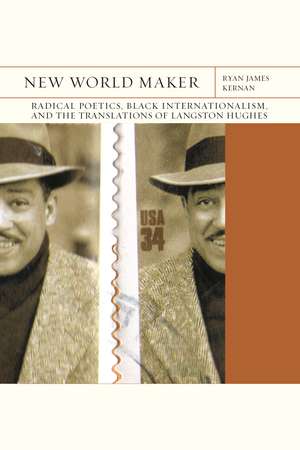
New World Maker: Radical Poetics, Black Internationalism, and the Translations of Langston Hughes: FlashPoints, cartea 40
Autor Ryan James Kernan Cuvânt înainte de Robin D. G. Kelleyen Limba Engleză Paperback – 15 iul 2022
Remarcăm în lucrarea de față o restructurare ambițioasă a moștenirii literare lăsate de Langston Hughes, bazată pe o metodologie ce îmbină cercetarea de arhivă cu analiza comparativă a traducerilor. Ryan James Kernan organizează materialul nu doar cronologic, ci și geografic, investigând modul în care identitatea radicală a poetului a fost modelată prin dialogul cu avangarda internațională. Structura volumului, de la introducerea semnată de Robin D. G. Kelley până la concluzia despre „tapițeria cuvintelor”, reflectă o progresie de la discursul rasial din Cuba spre estetica revoltei dialectice inspirate de autorii sovietici și francezi.
Descoperim aici o perspectivă care contestă abordările tradiționale ale New Criticism, demonstrând că poezia politică a lui Hughes nu poate fi înțeleasă pe deplin fără a examina rolul de „poet-traducător”. Kernan urmărește cum Hughes a extras elemente din prosodia străină a lui Vladimir Maiakovski sau Federico García Lorca pentru a-și construi propria poetică a diasporei negre. Această abordare completează perspectiva oferită de The Worlds of Langston Hughes – Modernism and Translation in the Americas, adăugând o dimensiune politică explicită și o analiză a modului în care traducerile au servit drept instrumente de rezistență internaționalistă.
Spre deosebire de alte studii contextuale, New World Maker pune accent pe colaborările transnaționale, arătând cum versurile lui Hughes au fost receptate și recalibrate în metropolele stângii mondiale. Ritmul argumentației este unul academic, riguros, oferind cititorului o hartă detaliată a modului în care modernismul american s-a intersectat cu mișcările de eliberare globale prin intermediul limbajului.
Din seria FlashPoints
-
 Preț: 350.23 lei
 -
 Preț: 311.99 lei
 -
 Preț: 276.85 lei
 -
 Preț: 264.79 lei
 - 23%
 Preț: 704.76 lei
 - 23%
 Preț: 675.67 lei
 -
 Preț: 233.39 lei
 -
 Preț: 253.86 lei
 -
 Preț: 232.16 lei
 - 23%
 Preț: 687.61 lei
 -
 Preț: 268.71 lei
 -
 Preț: 270.25 lei
 -
 Preț: 271.20 lei
 - 23%
 Preț: 689.72 lei
 - 23%
 Preț: 688.23 lei
 -
 Preț: 269.40 lei
 - 18%
 Preț: 754.60 lei
 - 23%
 Preț: 687.61 lei
 -
 Preț: 266.39 lei
 -
 Preț: 298.20 lei
 -
 Preț: 267.55 lei
 -
 Preț: 258.95 lei
 -
 Preț: 258.17 lei
 - 18%
 Preț: 818.05 lei
Preț: 410.73 lei
Carte disponibilă
Livrare economică 17 noiembrie-01 decembrie
Livrare express 31 octombrie-06 noiembrie pentru 46.29 lei
Specificații
ISBN-10: 0810144425
Pagini: 432
Ilustrații: 12 b-w images
Dimensiuni: 152 x 229 x 30 mm
Greutate: 0.63 kg
Editura: Northwestern University Press
Colecția Northwestern University Press
Seria FlashPoints
De ce să citești această carte
Recomandăm această carte cercetătorilor și studenților interesați de literatura diasporei africane și de studiile de traducere. Cititorul câștigă o înțelegere profundă a modului în care Langston Hughes a utilizat traducerea ca act politic și creativ. Este o lectură esențială pentru a descoperi legăturile dintre modernismul american și rețelele literare radicale din Cuba, Rusia sau Spania, oferind o perspectivă nouă asupra unui autor canonic.
Despre autor
Ryan James Kernan este un cercetător specializat în literatură comparată și studiile diasporei africane. Prin lucrarea de față, el aduce o contribuție semnificativă la înțelegerea modernismului transnațional, valorificând documente de arhivă care fuseseră anterior ignorate. Expertiza sa se concentrează pe intersecția dintre politică, poezie și actul traducerii, oferind o nouă rigoare analitică studiilor dedicate lui Langston Hughes. Volumul său a fost publicat de Northwestern University Press, o editură recunoscută pentru lucrările academice de înaltă ținută în domeniul criticii literare.
Descriere scurtă
Through original research and close readings alert to the foreign prosody underlying Hughes’s work, New World Maker recuperates his political writing, which had been widely maligned by Cold War detractors and adherents of New Criticism, and affirms his place as a progenitor of African diasporic literature and within the pantheon of US modernists. Demonstrating the integral part translation played in Hughes’s creative process, this book challenges a number of common assumptions about this canonical thinker and offers important insights for scholars of African diasporic literature, comparative literature, and American, Caribbean, and translation studies.
Notă biografică
Cuprins
Introduction: Langston Hughes: Poet-Translator and Black Radical Internationalist
1. Writer's Block: Unmuzzling Racial Discourse in Cuba
2. Reborn in Translation: Conversing with a Hughes Born Abroad
3. Talk about Mothers: Translating the Modernist Folk
4. Hughes Translates Pedroso: Proletarian and Social Lyrics
5. Moscow, Martinique and Me: Freedom Dreaming and World Making
6. Translating Mayakovsky and Aragon: The Poetics of Dialectical Revolt and Intertextual Subjectivity
7. Langston and Lorca: Envisioning a New Pan-Africanism
Conclusion: A Tapestry of Words
Notes
Bibliography
Recenzii
“New World Maker presents an alternative and innovative lens through which to explore the complexities and interconnectedness of the African Diaspora. Not only does Kernan provide insight into Hughes’s oft-ignored and largely unpublished translation work, but he also forces scholars to image translation as another building block of Black internationalist thought.” —Ethnic and Third World Literatures
“By arguing that translation is central to the origins and reception of Langston Hughes’s poetry, Ryan Kernan’s monumental study travels where no one has gone before—not only across national boundaries but also into geopolitical movements. Examined as both translator and translated, Hughes emerges as the focal point of a Black left internationalism encompassing Europe and Latin America, as well as the US. Kernan’s incisive reliance on translation studies shows quite clearly that the cost of neglecting translation is at once scholarly and ideological.” —Lawrence Venuti, author of Contra Instrumentalism: A Translation Polemic
“In this tour de force, Kernan demonstrates the crucial role that international translation networks played in Hughes’s career as well as in the emergence of African diasporic modernist literature more broadly. New World Maker not only gives us the most comprehensive analysis available of translations of Hughes’s work into Spanish, French, and Russian, but also demonstrates through a series of dazzling close readings that Hughes’s work as a translator (of poems by Nicolás Guillén, Regino Pedroso, Vladimir Mayakovsky, and Federico García Lorca, among others) was instrumental in the development of his own poetics.” —Brent Hayes Edwards, author of The Practice of Diaspora: Literature, Translation, and the Rise of Black Internationalism
“New World Maker is a brilliant account of Langston Hughes’s complex transnational literary engagements and the significance of translation in understanding his poetry. Based on extensive and original archival research, situating Hughes in a variety of international literary and political conversations moving from Havana to the Soviet Union to Spain to Haiti, it constitutes a major rethinking of Hughes’s poetic career. By the end of Kernan’s study, one comes to realize that Langston Hughes may very well be the most widely translated American poet of the twentieth century. New World Maker offers a fascinating reevaluation of this major figure, the history of African American literature and radicalism, and the importance of translation in Black diaspora aesthetics.” —Michelle Stephens, author of Skin Acts: Race, Psychoanalysis, and the Black Male Performer