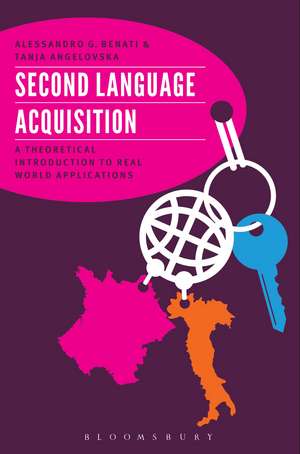
Second Language Acquisition: A Theoretical Introduction To Real World Applications
Autor Professor Alessandro G. Benati, Tanja Angelovskaen Limba Engleză Paperback – 25 feb 2016
Considerăm că Second Language Acquisition reprezintă o resursă fundamentală prin modul în care integrează interdisciplinaritatea, reunind perspective din lingvistică, psihologie, sociologie și științele educației pentru a explica mecanismele învățării unei limbi străine. Volumul reușește să evite complexitatea excesivă a textelor teoretice tradiționale, concentrându-se pe interacțiunea crucială dintre procesul de învățare și eficiența metodelor de predare. Găsim în această lucrare o structură logică, organizată în șase capitole care ghidează cititorul de la diferențele dintre achiziția primei limbi și a celei de-a doua, până la modul în care sistemul intern al cursantului se dezvoltă pentru a permite comunicarea eficientă.
Acoperă aceeași arie tematică precum Introducing Second Language Acquisition de Kirsten M. Hummel, dar cu o abordare mai orientată spre aplicații practice imediate, integrând activități de tip matching și întrebări de reflecție care transformă teoria în instrumente de lucru la clasă. În contextul operei autorului Professor Alessandro G. Benati, această carte rafinează temele explorate în Key Terms in Second Language Acquisition și Second Language Teacher Education, făcând trecerea de la definirea terminologiei la aplicarea ei sistemică în formarea pedagogică.
Merită menționat că textul este conceput special pentru nivelul universitar (licență), oferind o progresie clară: capitolul introductiv stabilește fundamentele, în timp ce capitolele centrale analizează procesarea informației și dezvoltarea competențelor comunicaționale. Această ediție publicată de Bloomsbury Academic se distinge prin rigoarea academică dublată de o dorință explicită de a face cercetarea accesibilă viitorilor educatori.
Preț: 262.18 lei
Preț vechi: 340.33 lei
-23%
Carte tipărită la comandă
Livrare economică 08-22 decembrie
Specificații
ISBN-10: 0567200191
Pagini: 200
Dimensiuni: 154 x 232 x 14 mm
Greutate: 0.32 kg
Editura: Bloomsbury Publishing
Colecția Bloomsbury Academic
Locul publicării:London, United Kingdom
V-ar putea interesa
-
 Specifiers: Minimalist ApproachesDavid Adger-18%Preț: 382.13 lei464.12 lei
 -
 Bilingual Acquisition: Theoretical Implications of a Case StudyMargaret Deuchar-18%Preț: 338.06 lei413.85 lei
 -
 Dynamical GrammarPeter W. Culicover-17%Preț: 367.05 lei442.81 lei
 -
 -9%Preț: 357.01 lei391.43 lei
 -
 The Linguistic Cycle: Language Change and the Language FacultyElly van Gelderen-24%Preț: 470.38 lei621.18 lei
 -
 Children Learning Second LanguagesAnnamaria Pinter-18%Preț: 803.55 lei979.94 lei
 -
 Understanding Second Language AcquisitionLourdes OrtegaPreț: 422.04 lei
 -
 Preț: 448.14 lei
 -
 The Think-Aloud Controversy in Second Language ResearchMelissa A. Bowles-15%Preț: 415.55 lei488.89 lei
 -
 -35%Preț: 405.64 lei626.13 lei
 -
 Preț: 404.73 lei
 -
 Teaching and Researching: MotivationZoltán DörnyeiPreț: 446.97 lei
 -
 A Spanish Learning GrammarMike ThackerPreț: 416.42 lei
 -
 Research Methods in Second Language AcquisitionAlison MackeyPreț: 343.53 lei
 -
 English Language Teaching MattersMichael P BermanPreț: 133.27 lei
 -
 Learning to Read and Write in the Multilingual FamilyXiao-Lei WangPreț: 192.50 lei
De ce să citești această carte
Această carte este ideală pentru studenții la filologie și profesorii aflați la început de drum care doresc să înțeleagă nu doar 'cum' se învață o limbă, ci și 'de ce' anumite metode de predare funcționează. Cititorul câștigă o bază teoretică solidă, dublată de exerciții practice care facilitează aplicarea cercetării SLA direct în sala de clasă, oferind un avantaj competitiv în proiectarea lecțiilor.
Despre autor
Professor Alessandro G. Benati este Director al CAROLE la Universitatea din Greenwich, fiind un expert recunoscut în pedagogia limbilor străine și procesarea inputului. Lucrările sale, precum Processing Instruction and Discourse, au influențat modul în care este predată gramatica la nivel internațional. Tanja Angelovska este profesor asistent de lingvistică engleză la Universitatea din Salzburg. Împreună, autorii combină expertiza în cercetarea teoretică cu experiența didactică, oferind o perspectivă echilibrată asupra achiziției limbii secunde (SLA).
Descriere
The overall purpose of this book is to provide an overview of second language acquisition research and theories by identifying the main key issues in this field and by highlighting the relevance of this research for classroom implications. The study of second language acquisition is a rich and varied enterprise, carried out by researchers, whose interests and training often lie in broader disciplines of linguistics, psychology, sociology, and education.
Readers will be encouraged to critically reflect on the presented content through self-engaging thinking activities in the form of questions, matching activities, choices and conclusions about the implications of SLA theories to the real world applications.
Cuprins
2. Similarities and differences between first and second language acquisition
3. How learners process information in second language acquisition
4. How the internal system develops in a second language
5. How learners learn to communicate in a second language
6. What we know in SLA
Bibliography
Index
Recenzii
As promised, this book provides an overview of SLA that is beginner-friendly. This is in contrast to other introductory texts that focus more on analyzing theories and their originating studies (e.g. VanPatten & Williams, 2015). What this allows for is gaining a general understanding that can aid teachers in thinking through both the rationale underpinning what they do in the classroom and the progression of the field informing their work. Moreover, the text gives clear suggestions for the classroom, such as meaningful, task-based activities. The inclusion in this text of information regarding multilinguals and heritage speakers is especially welcome, since these types of students are increasingly common and have different needs than the traditional L2 learner who only has speaks one L1.
This book demonstrates that knowing how languages learned help language instructors to develop a more innovative and effective way to teach foreign languages and to create the necessary conditions for students to learn more efficiently and appropriately.
Readers searching for an introductory text that explores how second languages are learned alongside effective teaching practices need not look further. Second Language Acquisition: A Theoretical Introduction to Real World Applications is sure to please undergraduate students and future educators who will highly benefit from the down-to-earth foundation that it provides. The text not only reviews key theories and findings that are essential to becoming familiar with innovative language pedagogies, but it also encourages readers to reflect on how to further improve these teaching techniques.