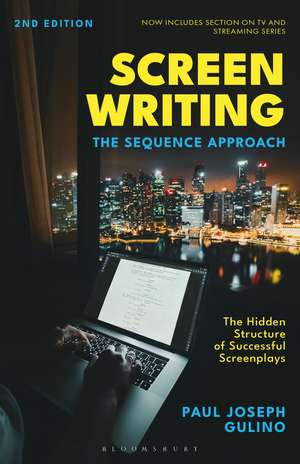
Screenwriting: The Sequence Approach
Autor Professor Paul Joseph Gulinoen Limba Engleză Paperback – 22 feb 2024
A proven screenwriting method in emotionally engaging an audience, the sequence approach emphasises the underlying motives of each story plot to better convey its relation to the work as a whole. In this expanded second edition, Paul Gulino includes analyses of recent noteworthy films and serial dramas, such as Parasite, Barry and Breaking Bad, with an eye to how they manage audience attention, convey vital information and deliver their emotional payloads. The aim of the book is to help writers move readily from the feature film to the serial form, mastering both. It is perfect for both beginning writers and those with experience in the feature screenplay form.
Preț: 134.96 lei
Puncte Express: 202
Carte disponibilă
Livrare economică 05-19 noiembrie
Livrare express 21-27 octombrie pentru 28.22 lei
Livrare prin curier în România Termenul estimat este afișat lângă disponibilitate.
Transport gratuit de la 400.00 lei Plată online sau ramburs, în funcție de opțiunile comenzii.
Retur gratuit în 14 zile Comandă securizată și suport în română.
Specificații
ISBN-13: 9798765104613
Pagini: 296
Dimensiuni: 138 x 214 x 16 mm
Greutate: 0.38 kg
Ediția:2nd edition
Editura: Bloomsbury Publishing
Colecția Bloomsbury Academic
Locul publicării:New York, United States
Pagini: 296
Dimensiuni: 138 x 214 x 16 mm
Greutate: 0.38 kg
Ediția:2nd edition
Editura: Bloomsbury Publishing
Colecția Bloomsbury Academic
Locul publicării:New York, United States
V-ar putea interesa
-
 Preț: 165.79 lei
 -
 Voice & Vision: A Creative Approach to Narrative FilmmakingMick Hurbis-Cherrier-8%Preț: 520.17 lei565.40 leiRecomandat
 -
 Preț: 115.57 lei
 -
 Preț: 114.41 lei
 -
 StoryRobert McKeePreț: 206.85 lei
 -
 Four ScreenplaysSyd Field-20%Preț: 79.75 lei99.16 lei
 -
 -20%Preț: 306.39 lei384.90 lei
 -
 ScriptnotesCraig MazinPreț: 159.74 lei
 -
 Anatomy of StoryJohn TrubyPreț: 120.44 lei
 -
 Screenwriting For DummiesLaura SchellhardtPreț: 153.30 lei
 -
 Writing Movies: A practical guide from New York's acclaimed creative writing schoolGotham Writers' Workshop-16%Preț: 111.10 lei132.31 lei
 -
 -37%Preț: 137.55 lei216.92 lei
 -
 The Bloomsbury Handbook of Global Screenplay TheoryAndrew Kenneth Gay-29%Preț: 973.93 lei1378.74 lei
 -
 Between the ScenesJeffrey Michael BaysPreț: 191.76 lei
 -
 -10%Preț: 161.12 lei179.35 lei
 -
 Short Films: Writing the ScreenplayPatrick Nash-21%Preț: 111.04 lei139.96 lei
 -
 Preț: 88.82 lei
 -
 Preț: 132.66 lei
 -
 Film as Argument: The Secret to Feature Film StorytellingDarren Paul FisherPreț: 206.47 lei
 -
 -19%Preț: 116.21 lei143.43 leiRecomandat
Cuprins
Acknowledgements
Preface
Foreword
Author's Note
PART I: FEATURE FILMS
1. An Introduction to Sequences
Why Sequences?
The Origin of Sequences
How A Screenplay Works
2. Toy Story: Firing on All Eight
3. The Shop Around the Corner: Fractured Symmetry
4. Double Indemnity: Flashback to the Future
5. The Nights of Cabiria: Nocturnal Episodes
6. North By Northwest: 1,700 Miles in Nine Sequences
7. Lawrence of Arabia: Sixteen Sequences and an Intermission
8. The Graduate: Passive Main Character
9. One Flew Over the Cuckoo's Nest: Midpoint Reversal
10. The Fellowship of the Ring: The Shotgun Approach
11. Mustang: Five Sisters and Their Subplots
12. Parasite: The Goal-Oriented Ensemble
PART II: SERIES
13. An Introduction to Series
Why Series?
The Storytelling Challenge of the Serial
The Sequence and the Serial
The Serial and the Three-Act Structure
14. Breaking Bad Pilot: The Garlic in the Coffee
15. Insecure Pilot: Three Subplots in Thirty Minutes
16. Barry Pilot: Comic Incongruity
Bibliography
Index
Preface
Foreword
Author's Note
PART I: FEATURE FILMS
1. An Introduction to Sequences
Why Sequences?
The Origin of Sequences
How A Screenplay Works
2. Toy Story: Firing on All Eight
3. The Shop Around the Corner: Fractured Symmetry
4. Double Indemnity: Flashback to the Future
5. The Nights of Cabiria: Nocturnal Episodes
6. North By Northwest: 1,700 Miles in Nine Sequences
7. Lawrence of Arabia: Sixteen Sequences and an Intermission
8. The Graduate: Passive Main Character
9. One Flew Over the Cuckoo's Nest: Midpoint Reversal
10. The Fellowship of the Ring: The Shotgun Approach
11. Mustang: Five Sisters and Their Subplots
12. Parasite: The Goal-Oriented Ensemble
PART II: SERIES
13. An Introduction to Series
Why Series?
The Storytelling Challenge of the Serial
The Sequence and the Serial
The Serial and the Three-Act Structure
14. Breaking Bad Pilot: The Garlic in the Coffee
15. Insecure Pilot: Three Subplots in Thirty Minutes
16. Barry Pilot: Comic Incongruity
Bibliography
Index
Recenzii
Every screenplay and every pilot is so vastly different. Paul Gulino is expertly aware of this, and manages to comprehensively teach the craft, not by imposing boiler plate rules, but by exposing the qualities and commonalities that make stories for the screen work, through a clear and nuanced exploration of structure. When it comes to learning, or reminding yourself, how to effectively build your narrative for the screen, I truly believe Screenwriting: The Sequence Approach is the only book you'll need.
Gulino's The Sequence Approach is my most often recommended screenwriting book and the reference I use to teach sequences. The new edition adds compelling contemporary material - Parasite and Insecure among others - and reveals how both film and television rely on smaller story units to build larger cinematic narratives.
A very welcome update of the previous edition! Screenwriting: The Sequence Approach analyses the most recent feature films and adds a whole section about prominent television series. In this expanded second edition, Paul Gulino includes a very relevant analysis of both recent films and very popular serial dramas to reveal how they strategically manage audience attention while delivering emotional payoffs. The book helps writers apply the sequence approach to film and serial screenwriting alike. Brilliant!
In this book, Paul Gulino moves the film audience center stage and explains the techniques you can use to enthrall them with your storytelling. Every insight is striking.
The book demystifies a process that too often seems cumbersome and overly complex.
With additional film analyses and a new section on television series, the 2nd edition of Screenwriting remains a highly relevant guide for writers to manage the macro and micro structure necessary for successful screenplays. Gulino's addition of television illuminates how sequencing is as viable a tool for screens of all sizes. This extension of Frank Daniel's fundamental pedagogy will continue to be central in my work with emerging writers.
Gulino's The Sequence Approach is my most often recommended screenwriting book and the reference I use to teach sequences. The new edition adds compelling contemporary material - Parasite and Insecure among others - and reveals how both film and television rely on smaller story units to build larger cinematic narratives.
A very welcome update of the previous edition! Screenwriting: The Sequence Approach analyses the most recent feature films and adds a whole section about prominent television series. In this expanded second edition, Paul Gulino includes a very relevant analysis of both recent films and very popular serial dramas to reveal how they strategically manage audience attention while delivering emotional payoffs. The book helps writers apply the sequence approach to film and serial screenwriting alike. Brilliant!
In this book, Paul Gulino moves the film audience center stage and explains the techniques you can use to enthrall them with your storytelling. Every insight is striking.
The book demystifies a process that too often seems cumbersome and overly complex.
With additional film analyses and a new section on television series, the 2nd edition of Screenwriting remains a highly relevant guide for writers to manage the macro and micro structure necessary for successful screenplays. Gulino's addition of television illuminates how sequencing is as viable a tool for screens of all sizes. This extension of Frank Daniel's fundamental pedagogy will continue to be central in my work with emerging writers.