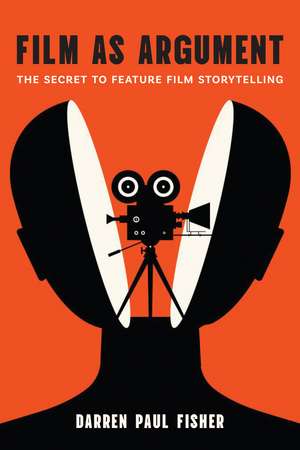
Film as Argument: The Secret to Feature Film Storytelling
Autor Darren Paul Fisheren Limba Engleză Paperback – 9 sep 2025 – vârsta ani
Is it to entertain? To move and audience? To tell a powerful story? For fame and fortune?
You may have answered yes to each, but those answers don’t account for the practice overall. Most books about screenwriting and directing are primarily concerned with craft and technique, but how can you truly understand filmmaking – or make the best films - unless you know what purpose it really serves.
So what’s the secret? As the title of this book suggests, making feature films is fundamentally the practice of making a very specific type of argument. To see how this works, we will deep-dive into how filmmakers are trained and taught to think about filmmaking, and what traditions they knowingly or unknowingly follow. We will look at hundreds of films and some major case studies, including Toy Story 3, Schindler’s List, Raiders of the Lost Ark, Amour, and mother!, to explore how and what films argue, and why knowing this can both unlock both a greater appreciation of the form, and improve the impact your films make.
Preț: 206.47 lei
Puncte Express: 310
Carte disponibilă
Livrare economică 18 noiembrie-02 decembrie
Livrare express 03-07 noiembrie pentru 23.14 lei
Livrare prin curier în România Termenul estimat este afișat lângă disponibilitate.
Transport gratuit de la 400.00 lei Plată online sau ramburs, în funcție de opțiunile comenzii.
Retur gratuit în 14 zile Comandă securizată și suport în română.
Specificații
ISBN-13: 9781978841130
ISBN-10: 1978841132
Pagini: 234
Ilustrații: 1 table image
Dimensiuni: 152 x 229 x 10 mm
Greutate: 0.29 kg
Editura: Rutgers University Press
Colecția Rutgers University Press
ISBN-10: 1978841132
Pagini: 234
Ilustrații: 1 table image
Dimensiuni: 152 x 229 x 10 mm
Greutate: 0.29 kg
Editura: Rutgers University Press
Colecția Rutgers University Press
V-ar putea interesa
-
 Preț: 165.79 lei
 -
 Reading the Silver ScreenThomas C FosterPreț: 112.45 lei
 -
 -19%Preț: 219.06 lei270.78 lei
 -
 Voice & Vision: A Creative Approach to Narrative FilmmakingMick Hurbis-Cherrier-8%Preț: 543.81 lei591.10 leiRecomandat
 -
 Something Like an AutobiographyAkira KurosawaPreț: 87.70 lei
 -
 StoryRobert McKeePreț: 206.85 lei
 -
 The Grip of FilmRichard AyoadePreț: 77.26 lei
 -
 Suddenly Something ClickedWalter MurchPreț: 238.95 lei
 -
 -23%Preț: 146.55 lei191.06 lei
 -
 ScriptnotesCraig MazinPreț: 159.74 lei
 -
 Film Directing Fundamentals: See Your Film Before ShootingNicholas T. Proferes-8%Preț: 446.51 lei485.34 lei
 -
 -15%Preț: 340.37 lei402.12 lei
 -
 50 Film Ideas You Really Need to KnowHelen O’Hara-28%Preț: 50.70 lei70.25 lei
 -
 Writing for the CutGreg Loftin-19%Preț: 128.57 lei159.64 lei
 -
 This Is How You Make a MovieTim Grierson-23%Preț: 114.42 lei148.10 lei
 -
 -24%Preț: 106.63 lei139.46 lei
 -
 Grammar of the Film LanguageDaniel Arijon-18%Preț: 225.47 lei275.59 lei
 -
 Cinematic StorytellingJennifer van Sijll-23%Preț: 155.13 lei200.43 lei
 -
 -18%Preț: 117.44 lei143.43 leiRecomandat
 -
 Screenwriting: The Sequence ApproachProfessor Paul Joseph GulinoPreț: 135.59 lei
Notă biografică
DARREN PAUL FISHER is an international multi-award-winning screenwriter, director, producer, and head of Film, Screen and Creative Media at Bond University, Australia.
Cuprins
NOTE ON SCREEN REFERENCES
PART I: THE ELEPHANT IN THE SCREENING ROOM
1 WHAT’S THE BIG SECRET?
2 THE OTHER HALF OF THE STORY
A Brief History of Film as Argument
3 WHAT AND HOW FILMS ARGUE
4 ALTERNATE CONCEPTIONS
PART II: THE CASE STUDIES
GENERAL NOTES ON THE CASE STUDIES
5 THE EXEMPLAR
Toy Story 3
6 THE COUNTEREXAMPLE
Mulholland Drive
7 THREE APPROACHES
Brave, Frozen and Barbie
PART III: NOW ON RELEASE AND COMING ATTRACTIONS
8 WHY FAILURES SUCCEED
The Cinema of Compensation
9 THE END
ACKNOWLEDGMENTS
NOTES
FILMOGRAPHY
BIBLIOGRAPHY
INDEX
PART I: THE ELEPHANT IN THE SCREENING ROOM
1 WHAT’S THE BIG SECRET?
2 THE OTHER HALF OF THE STORY
A Brief History of Film as Argument
3 WHAT AND HOW FILMS ARGUE
4 ALTERNATE CONCEPTIONS
PART II: THE CASE STUDIES
GENERAL NOTES ON THE CASE STUDIES
5 THE EXEMPLAR
Toy Story 3
6 THE COUNTEREXAMPLE
Mulholland Drive
7 THREE APPROACHES
Brave, Frozen and Barbie
PART III: NOW ON RELEASE AND COMING ATTRACTIONS
8 WHY FAILURES SUCCEED
The Cinema of Compensation
9 THE END
ACKNOWLEDGMENTS
NOTES
FILMOGRAPHY
BIBLIOGRAPHY
INDEX
Recenzii
"Every filmmaker should read this book."
"A clear step-by-step book on how and why we make films. I loved reading it. I could not put it down."
"Entertaining and accessible, Film as Argument delivers a powerful message: To move an audience a narrative film must be truly convincing. By redefining the characteristics of a successful film and with fresh insights into the how and why of creative practice, this book will revolutionize your understanding of filmmaking."
"A thorough exploration of cinematic storytelling, its purpose, and to some degree its responsibility. The book identifies narrative strategies that will undoubtedly be of value to both creative practitioners and anyone interested in the past, present, and future of feature filmmaking."
"A clear step-by-step book on how and why we make films. I loved reading it. I could not put it down."
"Entertaining and accessible, Film as Argument delivers a powerful message: To move an audience a narrative film must be truly convincing. By redefining the characteristics of a successful film and with fresh insights into the how and why of creative practice, this book will revolutionize your understanding of filmmaking."
"A thorough exploration of cinematic storytelling, its purpose, and to some degree its responsibility. The book identifies narrative strategies that will undoubtedly be of value to both creative practitioners and anyone interested in the past, present, and future of feature filmmaking."
Descriere
This book makes the case that the secret to feature filmmaking is that it is fundamentally the practice of making a very specific type of argument. It deep dives into how filmmakers are trained and taught to think about filmmaking, looking at hundreds of films to explore why knowing this can both unlock a greater appreciation of the form and improve a filmmaker’s technique.