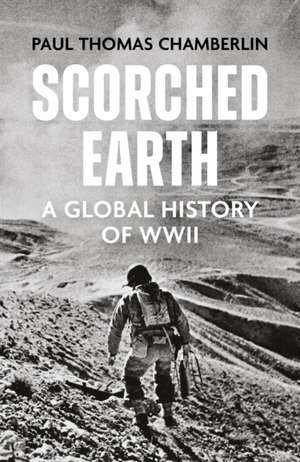
Scorched Earth: A Global History of World War II
Autor Paul Thomas Chamberlinen Limba Engleză Hardback – 8 mai 2025
Observăm în literatura academică recentă o tendință de reevaluare a celui de-al Doilea Război Mondial, însă Scorched Earth vine să completeze o lacună majoră: demitizarea ideii de „război bun” prin plasarea conflictului într-un context global de continuitate a violenței imperiale. Paul Thomas Chamberlin, profesor la Columbia University, propune o perspectivă radicală în care victoria Aliaților nu este prezentată ca un triumf idealist al democrației, ci ca un rezultat al tacticilor brutale, de la bombardamentele sistematice asupra populației civile până la sacrificiul imens de vieți omenești pe frontul de est. Remarcăm modul în care autorul integrează atrocitățile rasiale din Asia și Europa într-o narațiune unitară a supraviețuirii imperiale. Cititorii familiarizați cu Blood and Ruins de Richard Overy vor aprecia modul în care Scorched Earth extinde analiza asupra originilor coloniale ale conflictului, oferind o viziune care transcende dihotomia clasică dintre fascism și libertate. Dacă în The Global Offensive, Paul Thomas Chamberlin explora dinamica mișcărilor de gherilă, în acest volum el își lărgește spectrul de analiză, examinând modul în care prăbușirea vechilor ordini imperiale a pavat drumul către un „război permanent” între noile superputeri, SUA și URSS. Ediția de față, publicată de Basic Books, este structurată riguros pe parcursul a peste 600 de pagini și include 30 de ilustrații alb-negru care susțin argumentația vizuală a distrugerii. Tonul este unul sobru și argumentat, evitând clișeele eroice în favoarea unei analize reci a mecanismelor puterii și militarizării globale, fiind un instrument esențial pentru înțelegerea rădăcinilor ordinii mondiale contemporane.
Preț: 174.65 lei
Preț vechi: 231.46 lei
-25%
Carte disponibilă
Livrare economică 13-27 noiembrie
Livrare express 30 octombrie-05 noiembrie pentru 114.87 lei
Specificații
ISBN-10: 1529333849
Pagini: 656
Ilustrații: x30 B&W images, inset
Dimensiuni: 166 x 236 x 54 mm
Greutate: 0.98 kg
Editura: John Murray Press
Colecția Basic Books
Locul publicării:London, United Kingdom
V-ar putea interesa
-
 The Bombing WarRichard Overy-17%Preț: 122.22 lei146.96 lei
 -
 Savage ContinentKeith Lowe-18%Preț: 89.92 lei109.17 lei
 -
 Stalin's WarSean McMeekin-18%Preț: 118.86 lei144.12 lei
 -
 The Second World War: A Short HistoryR. A. C. Parker-20%Preț: 90.42 lei112.88 lei
 -
 Blood and RuinsRichard Overy-17%Preț: 117.53 lei140.79 lei
 -
 Preț: 252.28 lei
 -
 The Second World WarsVictor Davis HansonPreț: 281.26 lei
 -
 The Killing AgeClifton CraisPreț: 142.17 lei
 -
 Voices of VictoryGeraint JonesPreț: 123.77 lei
 -
 Rain of RuinRichard OveryPreț: 163.58 lei
 -
 The Second World WarAntony Beevor-23%Preț: 110.09 lei142.12 lei
 -
 -25%Preț: 92.00 lei122.69 lei
 -
 Preț: 192.77 lei
 -
 -17%Preț: 191.28 lei231.28 lei
 -
 The People's WarJohn WillisPreț: 228.83 lei
 -
 The Fiery Pillars of WarJane HawkingPreț: 75.09 lei
 -
 Allies at WarTim BouveriePreț: 188.57 lei
 -
 The Second World WarAmmonite PressPreț: 61.80 lei
 -
 Emergency ExitsCarl WarnerPreț: 95.07 lei
De ce să citești această carte
Recomandăm această lucrare studenților și profesioniștilor din domeniul istoriei care caută o perspectivă critică, dincolo de manualele tradiționale. Paul Thomas Chamberlin oferă o sinteză magistrală a modului în care cel mai mare conflict al omenirii a fost de fapt o luptă pentru dominație imperială. Cititorul câștigă o înțelegere profundă a tranziției de la colonialismul clasic la Războiul Rece, totul documentat cu rigoare academică de un expert de la Columbia University.
Descriere
'Powerful, absorbing and endlessly thought-provoking' SINCLAIR MCKAY
A radical new history of history's most brutal struggle for survival between imperial powers.
In popular memory, World War II was an unalloyed victory for freedom over totalitarianism, and democratic order over the age of empires. Scorched Earth dispatches the myth of World War II as a 'good' war. Instead, it reveals the conflict as a massive battle beset by vicious racial atrocities, fought between rival empires across huge stretches of Asia and Europe. The war was sparked by German and Japanese invasions that threatened the old powers' dominance, not by Allied opposition to fascism. The Allies achieved victory not through pluck and democratic idealism but through savage firebombing raids on civilian targets and the slaughter of millions of Soviet soldiers. The Soviet Union and the United States emerged as hyper-militarized new imperial powers, each laying claim to former Axis holdings across the globe before turning on one another and triggering a new forever war.
Dramatically rendered and persuasively argued, Scorched Earth shows that World War II marked the culmination of centuries of colonial violence and ushered in a new era of imperial struggle.
Recenzii
A well written, balanced, and provocative account of the twentieth century's greatest and most destructive war. Paul Thomas Chamberlin covers all the major theaters of the war, smoothly integrating political and military developments. The author's unorthodox interpretation of the Second World War will challenge historians to reexamine long-standing assumptions and beliefs about the origins and nature of this critical conflict
What more is there left to say about World War II? A lot, it turns out, as Paul Chamberlin shows in his brilliant, panoramic new history of the most colossal, catastrophic war in human history. New insights leap from every page, introducing even seasoned readers to fresh perspectives on the war . . . Chamberlin provides a breathtakingly new interpretation of World War II. A truly remarkable book
In a sweeping and vivid narrative, Scorched Earth challenges us to abandon the simplistic hero myths that have blinded us to World War II's devastating and continuing impact on our own time
The most up-to-date and enlightening global history of World War II. Paul Thomas Chamberlin's briskly written Scorched Earth is an unflinching account of the role played by racism and colonial aspirations in the conflict's origins, brutal unfolding, and less than heroic outcomes
A dauntingly ambitious reinterpretation of the Second World War. In coldly lucid prose, it challenges the standard - and comforting - European and American clichés about the war's meaning. Its sweeping vision will ensure that it will be devoured by students of post-1945 world history
Challenges "orthodox" interpretations of the war as a battle between democracy and fascism
Conveyed in accessible, succinct prose that makes the book easy to read, even if the content is sometimes hard to stomach. Chamberlin's vivid descriptions and quotations resonate