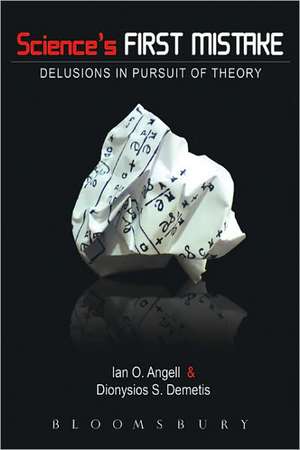
Science's First Mistake: Delusions in Pursuit of Theory
Autor Professor Ian O. Angell, Dionysios Demetisen Limba Engleză Hardback – 25 iul 2010
How do we humans know what we know?
Can there ever be knowing about knowing?
This ambitious book is written in reaction to the so-called 'rigour' that pervades much of today's scientific research and practice. Taking examples from across the natural and social sciences, the authors examine the deep-seated assumptions that underpin the discovery of knowledge. They claim that all scientific methods are delusions in pursuit of theory. Their controversial argument uses Systems Theory, and in particular the concept of self-reference. For them, the very process of observing must mask the underlying delusions, tricking the human mind into developing a self-consistent description of itself. This opens up a belief in the certainty of a causal 'reality'. However, our esoteric descriptions, our theories, our ways of thinking, in fact all the abstractions we use to examine the world around us, are distinct from the 'reality' being observed.
This fresh and audacious work makes an important contribution to the study of scientific method, and takes readers out of the comfort zone of their perceived scientific certainty.
Preț: 643.76 lei
Preț vechi: 957.12 lei
-33%
Puncte Express: 966
Carte tipărită la comandă
Livrare economică 17 noiembrie-01 decembrie
Livrare prin curier în România Termenul estimat este afișat lângă disponibilitate.
Transport gratuit pentru acest produs Plată online sau ramburs, în funcție de opțiunile comenzii.
Retur gratuit în 14 zile Comandă securizată și suport în română.
Specificații
ISBN-13: 9781849660648
ISBN-10: 1849660646
Pagini: 256
Ilustrații: None
Dimensiuni: 156 x 234 x 23 mm
Greutate: 0.5 kg
Editura: Bloomsbury Publishing
Colecția Bloomsbury Academic
Locul publicării:London, United Kingdom
ISBN-10: 1849660646
Pagini: 256
Ilustrații: None
Dimensiuni: 156 x 234 x 23 mm
Greutate: 0.5 kg
Editura: Bloomsbury Publishing
Colecția Bloomsbury Academic
Locul publicării:London, United Kingdom
V-ar putea interesa
-
 The Infinite BookJohn D. Barrow-19%Preț: 74.60 lei92.25 lei
 -
 The Varieties of Scientific ExperienceCarl SaganPreț: 141.35 lei
 -
 Only a TheoryKenneth R. MillerPreț: 146.52 lei
 -
 Emergence: From Chaos to OrderJohn H. Holland-17%Preț: 162.67 lei195.99 lei
 -
 Studies in the Philosophy of the Scottish EnlightenmentM. A. Stewart-28%Preț: 360.88 lei501.92 lei
 -
 The Scenes of Inquiry: On the Reality of Questions in the SciencesNicholas Jardine-28%Preț: 424.97 lei593.79 lei
 -
 The Essential TuringB. Jack. Copeland-9%Preț: 255.91 lei280.24 lei
 -
 Philosophy of Science TodayPeter Clark-20%Preț: 288.93 lei362.54 lei
 -
 -12%Preț: 275.55 lei314.40 lei
 -
 Evidence, Explanation, and Realism: Essays in Philosophy of SciencePeter Achinstein-28%Preț: 507.84 lei707.53 lei
 -
 Broca's BrainCarl SaganPreț: 58.41 lei
 -
 Billions & BillionsCarl SaganPreț: 111.61 lei
 -
 The Demon-Haunted WorldCarl SaganPreț: 123.32 lei
 -
 Does Santa Exist?Eric Kaplan-28%Preț: 66.18 lei91.32 lei
 -
 Preț: 435.46 lei
 -
 Understanding Philosophy of ScienceJames LadymanPreț: 357.58 lei
 -
 Inference to the Best ExplanationPeter LiptonPreț: 380.36 lei
 -
 The Logic of Scientific DiscoveryKarl PopperPreț: 233.98 lei
 -
 Preț: 221.51 lei
 -
 Problems of EmpiricismPaul K. FeyerabendPreț: 246.29 lei
 -
 Realism, Rationalism and Scientific MethodPaul K. FeyerabendPreț: 216.75 lei
 -
 The Cambridge Companion to the Philosophy of BiologyMichael RusePreț: 337.64 lei
 -
 Science and Ultimate RealityJohn. D. Barrow-9%Preț: 780.25 lei857.42 lei
 -
 Re-Thinking ScienceHelga NowotnyPreț: 266.39 lei
 -
 -45%Preț: 130.87 lei236.37 lei
 -
 Science in a Free SocietyPaul FeyerabendPreț: 112.58 lei
 -
 -16%Preț: 196.36 lei233.92 lei
 -
 Philosophical Chemistry: Genealogy of a Scientific FieldProfessor Manuel DeLanda-23%Preț: 367.29 lei474.53 lei
Cuprins
List of Figures
Preface
1. Introduction
2. Divination and Theory Construction
3. Delusion
4.Individual Allusions Contra Sensory Overload
5. Patterns of Categorical Delusions
6. Tidy Minds, Technology, and the Myth of Control
7. Systems Theory
8. On the Premises of Observation
9. The Frame of Observation & the Functional Differentiation of Science
10. Higher Order Observations
11. Asymmetry and Self-Reference
12. Collapsing Systems
13. The 'Reality' of the Real
Epilogue: Science's First Mistake
Notes
References
Index
Preface
1. Introduction
2. Divination and Theory Construction
3. Delusion
4.Individual Allusions Contra Sensory Overload
5. Patterns of Categorical Delusions
6. Tidy Minds, Technology, and the Myth of Control
7. Systems Theory
8. On the Premises of Observation
9. The Frame of Observation & the Functional Differentiation of Science
10. Higher Order Observations
11. Asymmetry and Self-Reference
12. Collapsing Systems
13. The 'Reality' of the Real
Epilogue: Science's First Mistake
Notes
References
Index
Recenzii
Overall, I think this is potentially a very interesting and important book, and the authors are probably two of the very few who would attempt this and that might just succeed. It is clearly somewhat of a risky book for a publisher but as in all such risks the rewards are potentially high.
Excellent and ground breaking. Very well written. Engaging in reading. It is a much needed and original contribution, which will become a key reference in contemporary academic social sciences thinking.
The questions posed by the authors in their book are important. They are also a good reminder to constantly consider the dialectic between knowledge, authority, and its relationship with certainty.
Excellent and ground breaking. Very well written. Engaging in reading. It is a much needed and original contribution, which will become a key reference in contemporary academic social sciences thinking.
The questions posed by the authors in their book are important. They are also a good reminder to constantly consider the dialectic between knowledge, authority, and its relationship with certainty.