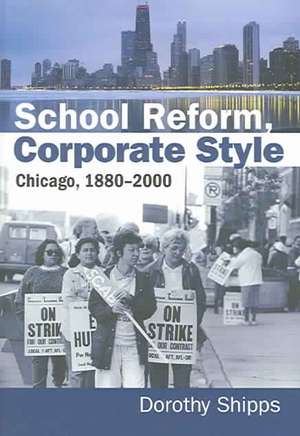
School Reform, Corporate Style: Chicago, 1880-2000: Studies in Government & Public Policy
Autor Dorothy Shippsen Limba Engleză Paperback – 31 mar 2006
Structura acestei lucrări este riguros organizată cronologic, urmărind evoluția sistemului educațional din Chicago prin patru ere politice definitorii, de la perioada formativă (1880-1930) până la descentralizarea și parteneriatele public-private de la finele secolului XX. Metodologia utilizată de Dorothy Shipps se bazează pe o analiză critică a influenței sectorului de business asupra politicilor publice, demonstrând cum reorganizările manageriale repetate au prioritizat structurile de guvernare în detrimentul procesului pedagogic direct. Considerăm că această abordare oferă o perspectivă necesară asupra eșecului reformelor care ignoră dinamica puterii locale.
School Reform, Corporate Style reprezintă o alternativă solidă la City Schools and City Politics pentru cursurile de politici educaționale și sociologie urbană, având avantajul unei focalizări stricte pe mecanismele prin care interesele corporatiste au „aglomerat” și marginalizat alte modele de reformă mai promițătoare. În timp ce alte studii din seria Studies in Government & Public Policy analizează capacitatea civică generală, Shipps izolează variabila puterii economice pentru a explica de ce discrepanțele dintre elevii majoritari și cei minoritari au persistat în ciuda „reformelor” constante.
În contextul operei sale, volumul de față aprofundează temele explorate în Shaping Education Policy, unde autoarea analiza procesele sociale și dinamica puterii în democrație. Dacă în Reconstructing the Common Good in Education accentul era pus pe idealul moral și social al școlii publice, aici Shipps documentează pragmatic cum acest „bine comun” a fost subordonat eficienței corporative. Textul este unul dens, academic, dar esențial pentru înțelegerea modului în care sindicatele și mediul de afaceri au modelat sala de clasă americană.
Din seria Studies in Government & Public Policy
-
 Preț: 287.46 lei
 -
 Preț: 294.26 lei
 -
 Preț: 226.30 lei
 -
 Preț: 291.33 lei
 -
 Preț: 223.69 lei
 -
 Preț: 426.45 lei
 -
 Preț: 287.03 lei
 -
 Preț: 228.13 lei
 -
 Preț: 229.80 lei
 -
 Preț: 227.93 lei
 -
 Preț: 193.78 lei
 -
 Preț: 230.91 lei
 -
 Preț: 227.77 lei
 -
 Preț: 231.11 lei
 -
 Preț: 236.66 lei
 -
 Preț: 286.52 lei
 -
 Preț: 292.04 lei
 -
 Preț: 227.57 lei
 -
 Preț: 233.52 lei
 -
 Preț: 228.13 lei
 -
 Preț: 227.04 lei
 -
 Preț: 226.82 lei
 -
 Preț: 228.87 lei
 -
 Preț: 225.16 lei
Preț: 287.99 lei
Carte disponibilă
Livrare economică 20 mai-03 iunie
Specificații
ISBN-10: 0700614508
Pagini: 294
Dimensiuni: 169 x 225 x 24 mm
Greutate: 0.46 kg
Editura: University Press of Kansas
Seria Studies in Government & Public Policy
V-ar putea interesa
-
 Practice Tests for Cambridge English: First: FCEPeter TravisPreț: 124.46 lei
 -
 -11%Preț: 420.53 lei472.50 lei
 -
 Emotionally Intelligent Leadership for StudentsMarcy Levy ShankmanPreț: 128.80 lei
 -
 Assessment EssentialsTrudy W BantaPreț: 354.37 lei
 -
 Preț: 300.13 lei
 -
 Preț: 124.76 lei
 -
 Common Core Math for Parents for Dummies with Videos OnlineChristopher DanielsonPreț: 76.52 lei
De ce să citești această carte
Această carte este indispensabilă specialiștilor în politici publice și management educațional care doresc să înțeleagă rădăcinile politice ale reformelor școlare. Cititorul câștigă o perspectivă istorică documentată asupra motivelor pentru care modelele de business eșuează adesea în educație. Este o recomandare fermă pentru cei care caută argumente teoretice și empirice pentru o reformă condusă de educatori, nu de manageri, oferind o critică constructivă a sistemului actual.
Descriere scurtă
Dorothy Shipps reappraises the tumultuous history of educational progress in Chicago, revealing that the persistent lack of improvement is due not to the extent but rather the type of reform. Throughout the twentieth century, managerial reorganizations initiated by the business community repeatedly altered the governance structure of schools as well as the relationships of teachers to children and parents but brought little improvement, while other more promising reform models were either resisted or crowded out.
Shipps chronicles how Chicago's corporate actors led, abetted, or restrained nearly every attempt to transform the city's school system, then asks whether schools might be better reformed by others. To show why city schools have failed urban children so badly, she traces Chicago's reform history over four political eras, revealing how corporate power was instrumental in designing and revamping the system. Her narrative encompasses the formative era of 1880-1930, when teachers' unions moderated business plans; previously unexplored business activism from 1930 to 1980, when civil rights dominated school reform, and the decentralization of the 1980s. She also covers the uneasy cooperation among business associations in the 1990s to install the mayor as head of the school system, a governing regime now challenged by privatization advocates.
Business people may be too wedded to a stunted view of educators to forge a productive partnership for change. Unionized teachers bridle at the second-class status accorded them by managers. If reform is to reach deeply into classrooms, Shipps concludes, it might well require a new coalition of teachers' unions and parents to create a fresh agenda that supersedes corporate interests.
This study clearly shows that, in Chicago as elsewhere, urban schooling is intertwined with politics and power. By reviewing more than a century of corporate efforts to make education work, Shipps makes a strong case that it's high time to look elsewhere perhaps to educators themselves for new leadership."