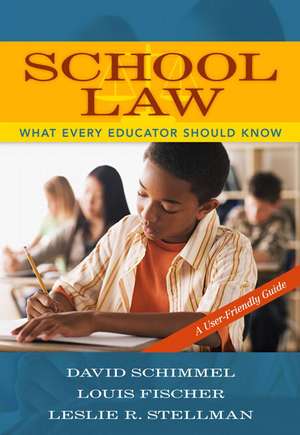
School Law
Autor David Schimmel, Louis Fischer, Leslie Stellmanen Limba Engleză Paperback – iun 2007
Preț: 398.42 lei
Puncte Express: 598
Carte tipărită la comandă
Livrare economică 28 mai-11 iunie
Specificații
ISBN-13: 9780205484058
ISBN-10: 0205484050
Pagini: 192
Dimensiuni: 138 x 238 x 9 mm
Greutate: 0.22 kg
Ediția:1
Editura: Pearson Education
Locul publicării:Boston, United States
ISBN-10: 0205484050
Pagini: 192
Dimensiuni: 138 x 238 x 9 mm
Greutate: 0.22 kg
Ediția:1
Editura: Pearson Education
Locul publicării:Boston, United States
V-ar putea interesa
-
 Making Words Fourth GradePatricia CunninghamPreț: 387.35 lei
 -
 Improving Schools Through Teacher LeadershipAlma Harris-30%Preț: 156.41 lei223.48 lei
 -
 The Ethical TeacherElizabeth Campbell-28%Preț: 191.08 lei264.76 lei
 -
 Learning without LimitsSusan Hart-27%Preț: 187.61 lei257.86 lei
 -
 Raising Boys' Achievement in Secondary SchoolsMike Younger-30%Preț: 163.44 lei232.58 lei
 -
 -28%Preț: 185.93 lei256.94 lei
 -
 The Teaching PortfolioPeter SeldinPreț: 297.82 lei
 -
 Preț: 296.05 lei
 -
 The Life of Mahatma GandhiLouis Fischer-19%Preț: 84.20 lei104.05 lei
 -
 Preț: 173.84 lei
Cuprins
Topic Overviews
Preface
About the Authors
1. Teachers and the Legal System
2.Teacher Contracts, Tenure and Collective Bargaining
3. Responsibilities and Liabilities: Student Injuries, Defamation, and Abuse and Neglect
4. Teacher Freedom of Expression: Academic Freedom, Association, Appearance, and Copyright
5. Student Freedom of Expression: Speech, Press, Association, and Appearance
6. Due Process Rights of Teachers and Students
7. Religion and Public Education
8. Discrimination and Equal Protection: Race, Gender, Age, Language, and Special Education
9. Teachers’ Personal Life
10. Parents’ Rights in Educating Their Children and Controlling Their School Records
11. The No Child Left Behind Act and Other Current Controversies
Appendix A: Selected Provisions of the U.S. Constitution
Appendix B: Major Federal Laws Affecting Education
Glossary
Index
Preface
About the Authors
1. Teachers and the Legal System
2.Teacher Contracts, Tenure and Collective Bargaining
3. Responsibilities and Liabilities: Student Injuries, Defamation, and Abuse and Neglect
4. Teacher Freedom of Expression: Academic Freedom, Association, Appearance, and Copyright
5. Student Freedom of Expression: Speech, Press, Association, and Appearance
6. Due Process Rights of Teachers and Students
7. Religion and Public Education
8. Discrimination and Equal Protection: Race, Gender, Age, Language, and Special Education
9. Teachers’ Personal Life
10. Parents’ Rights in Educating Their Children and Controlling Their School Records
11. The No Child Left Behind Act and Other Current Controversies
Appendix A: Selected Provisions of the U.S. Constitution
Appendix B: Major Federal Laws Affecting Education
Glossary
Index
Notă biografică
Louis Fischer (J.D. and Ph.D., Stanford University) is Professor Emeritus and former dean of the School of Education at the University of Massachusetts Amherst.
David Schimmel (J.D., Yale University) is Professor of Education in the Department of Educational Policy, Research, and Administration at the University of Massachusetts Amherst, and Visiting Professor at Harvard University’s Graduate School of Education.
Leslie R. Stellman (J.D., Syracuse University) is chairman of the Education Law Practice-Group of the Towson, Maryland, firm of Hodes, Ulman, Pessin & Katz, P.A., as well as an Adjunct Professor of Education Law at Johns Hopkins University, Morgan State University Graduate School of Education, and the University of Baltimore School of Law.
David Schimmel (J.D., Yale University) is Professor of Education in the Department of Educational Policy, Research, and Administration at the University of Massachusetts Amherst, and Visiting Professor at Harvard University’s Graduate School of Education.
Leslie R. Stellman (J.D., Syracuse University) is chairman of the Education Law Practice-Group of the Towson, Maryland, firm of Hodes, Ulman, Pessin & Katz, P.A., as well as an Adjunct Professor of Education Law at Johns Hopkins University, Morgan State University Graduate School of Education, and the University of Baltimore School of Law.
Textul de pe ultima copertă
Do teachers have a right to dress as they wish?
Can Social Studies Teachers be prohibited from discussing controversial issues?
When can copyrighted works be copied without permission?
If you’ve ever pondered these or other questions of law, you need to know the right answers! In School Law: What Every Educator Should Know, A User-Friendly Guide, David Schimmel, Louis Fischer, and Leslie Stellman demystify educational law one question at a time and provide clarity to hundreds of topics that affect teachers today–NCLB, Vouchers, School Choice, Discipline, Academic Freedom, Liability for Student Injuries, Due Process, Search and Seizure, Dress and Grooming, to Harassment and Child Abuse–encompassing law established by state and federal statutes, constitutions, and court decisions. The authors offer friendly translations of legal jargon into everyday English, empowering educators to take the law constructively into their own hands and use it as a source of guidance and protection to improve their schools and classrooms.
School Law: What Every Educator Should Know, A User-Friendly Guide is a powerful reference every educator can use and is a perfect resource for seminars and courses in Education Foundations, Introduction to Educational Psychology, School Counseling, Field Experience, Student Teaching Practicum, and Classroom Management, where knowledge of core legal concepts is important.
Make the law work for you…
“With its question/answer format, [this] book provides a general overview of how the legal system applies to the practice of education, considering many questions one might not think to ask.”
–Meghan M. Reilly, Andover High School, Andover, MA
“There is an excellent balance of legal citations in contrast with specific examples that almost every instructor can relate to in their experience as a classroom teacher.”
–Thomas J. Little Jr., Kokomo-Center Schools, Kokomo, IN
Can Social Studies Teachers be prohibited from discussing controversial issues?
When can copyrighted works be copied without permission?
If you’ve ever pondered these or other questions of law, you need to know the right answers! In School Law: What Every Educator Should Know, A User-Friendly Guide, David Schimmel, Louis Fischer, and Leslie Stellman demystify educational law one question at a time and provide clarity to hundreds of topics that affect teachers today–NCLB, Vouchers, School Choice, Discipline, Academic Freedom, Liability for Student Injuries, Due Process, Search and Seizure, Dress and Grooming, to Harassment and Child Abuse–encompassing law established by state and federal statutes, constitutions, and court decisions. The authors offer friendly translations of legal jargon into everyday English, empowering educators to take the law constructively into their own hands and use it as a source of guidance and protection to improve their schools and classrooms.
School Law: What Every Educator Should Know, A User-Friendly Guide is a powerful reference every educator can use and is a perfect resource for seminars and courses in Education Foundations, Introduction to Educational Psychology, School Counseling, Field Experience, Student Teaching Practicum, and Classroom Management, where knowledge of core legal concepts is important.
Make the law work for you…
“With its question/answer format, [this] book provides a general overview of how the legal system applies to the practice of education, considering many questions one might not think to ask.”
–Meghan M. Reilly, Andover High School, Andover, MA
“There is an excellent balance of legal citations in contrast with specific examples that almost every instructor can relate to in their experience as a classroom teacher.”
–Thomas J. Little Jr., Kokomo-Center Schools, Kokomo, IN
Caracteristici
- A unique School Law book focused on what teachers need to know and designed so that they can easily find answers to critical questions.
- This book clarifies legal issues that confront classroom teachers every day and is illustrated with actual cases.
- Conversational tone makes it easy for readers to understand critical concepts.
- This book can be used in courses such as Education Foundations, Introduction to Educational Psychology, School Counseling, Field Experience, Student Teaching Practicum, and Classroom Management where knowledge of core legal concepts is important.
- This book will be very useful for in-service teachers, administrators, and anyone interested in today's schools.
- Critical areas such as NCLB, Vouchers, School Choice, Discipline, Academic Freedom, Liability for Student Injuries, Due Process, Search and Seizure, Dress and Grooming, and Harassment and Child Abuse are highlighted.