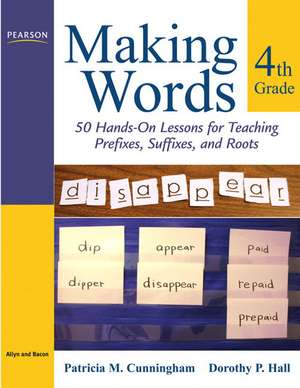
Making Words Fourth Grade
Autor Patricia Cunningham, Dorothy Hallen Limba Engleză Paperback – mai 2008
- Features 50 fun andinteractive lessons for building decoding and spelling skills.
- Presents a concise method for involving students in the process of identifying common contractions and compound words and more complex vowel patterns within words.
- Promotes student awareness of similarities in words that helpsdevelop writing skills.
- Includes reproducible take-home record sheets to help students build their vocabularies.
Preț: 387.35 lei
Puncte Express: 581
Carte tipărită la comandă
Livrare economică 28 mai-11 iunie
Specificații
ISBN-13: 9780205580927
ISBN-10: 0205580920
Pagini: 120
Dimensiuni: 216 x 275 x 7 mm
Greutate: 0.3 kg
Ediția:1
Editura: Pearson Education
Locul publicării:Boston, United States
ISBN-10: 0205580920
Pagini: 120
Dimensiuni: 216 x 275 x 7 mm
Greutate: 0.3 kg
Ediția:1
Editura: Pearson Education
Locul publicării:Boston, United States
V-ar putea interesa
-
 Paraprofessionals in the ClassroomBetty Ashbaker-15%Preț: 456.01 lei536.49 lei
 -
 Classrooms That Work They Can All Read and WritePatricia Cunningham-15%Preț: 455.52 lei535.91 lei
 -
 Developing Readers and Writers in Content Areas K-12David W. Moore-23%Preț: 1159.33 lei1505.63 lei
 -
 School LawDavid SchimmelPreț: 398.42 lei
 -
 Reading ScienceJennifer L AltieriPreț: 219.23 lei
 -
 Routines for ReasoningGrace KelemanikPreț: 258.37 lei
 -
 Issues in MentoringTrevor KerryPreț: 331.47 lei
 -
 Teacher Appraisal ObservedG. HaynesPreț: 217.06 lei
 -
 Inside the Primary Classroom: 20 Years OnChris Comber-15%Preț: 403.10 lei474.23 lei
 -
 Failing Teachers?R.P. Chamberlin-15%Preț: 402.12 lei473.08 lei
 -
 Preț: 325.06 lei
 -
 The Ethnography Of Empowerment: The Transformative Power Of Classroom interactionHelja Antola RobinsonPreț: 348.34 lei
 -
 Teacher Development: A Model From Science EducationBeverley Bell-18%Preț: 1353.20 lei1650.25 lei
 -
 Teacher Development: A Model From Science EducationBeverley BellPreț: 458.47 lei
 -
 Evaluating Teacher Quality in Higher EducationRobert Aylett-15%Preț: 570.81 lei671.54 lei
 -
 Don't Run Naked Through the OfficeFred W StawitzPreț: 132.93 lei
 -
 Preț: 230.18 lei
 -
 C.H.A.O.S.Randy PippinPreț: 227.62 lei
 -
 Preț: 171.93 lei
Descriere
An active and innovative approach to making words that teachers and their students have grown to love is finally here!
Based on its highly successful parent text, Phonics They Use, this new grade-level series Making Words offers teachers a fresh multi-level activity and lesson series written for the kindergarten through fifth grade classroom. Pat Cunningham and Dottie Hall present classroom teachers with effective tools for strengthening phonics and spelling skills that encourage students to move beyond learning and into a world of word discovery. Each research-based volume includes a wealth of friendly, hands-on, manipulative activities that guide teachers in teaching the development of words--from phonemic awareness to spelling.
In Making Words Fourth Grade, Pat and Dottie introduce fourth grade teachers to 50 lessons that teach all the prefixes, suffixes, and root skills included in most fourth grade curriculums. Each Making Words activity leads children through a systematic and sequential spelling curriculum. All lessons include practice with prefixes and suffixes as children stretch out words they are making and blend the letters to make new words. Because teaching children letter-sound relationships is easier than teaching children to actually use these letter-sound relationships, all lessons include a transfer step in which children apply the sounds they are learning to spelling new words.
Making Words Fourth Grade is the best resource you can have on hand for motivating your students to learn words!
Based on its highly successful parent text, Phonics They Use, this new grade-level series Making Words offers teachers a fresh multi-level activity and lesson series written for the kindergarten through fifth grade classroom. Pat Cunningham and Dottie Hall present classroom teachers with effective tools for strengthening phonics and spelling skills that encourage students to move beyond learning and into a world of word discovery. Each research-based volume includes a wealth of friendly, hands-on, manipulative activities that guide teachers in teaching the development of words--from phonemic awareness to spelling.
In Making Words Fourth Grade, Pat and Dottie introduce fourth grade teachers to 50 lessons that teach all the prefixes, suffixes, and root skills included in most fourth grade curriculums. Each Making Words activity leads children through a systematic and sequential spelling curriculum. All lessons include practice with prefixes and suffixes as children stretch out words they are making and blend the letters to make new words. Because teaching children letter-sound relationships is easier than teaching children to actually use these letter-sound relationships, all lessons include a transfer step in which children apply the sounds they are learning to spelling new words.
Making Words Fourth Grade is the best resource you can have on hand for motivating your students to learn words!
- Features 50 fun and interactive lessons for building decoding and spelling skills.
- Presents a concise method for involving students in the process of identifying common contractions and compound words and more complex vowel patterns within words.
- Promotes student awareness of similarities in words that helps develop writing skills.
- Includes reproducible take-home record sheets to help students build their vocabularies.
Cuprins
Introduction 1
Lesson 1 l fireplaces 000
Lesson Focus: rhyming patterns ape, ace, ice
re, meaning back or again
Lesson 2 l treasures 000
Lesson Focus: rhyming patterns at, eat, ate, ue
er/est, meaning more/most
re, meaning back or again
Lesson 3 l rattlesnake 000
Lesson Focus: rhyming patterns eat, east, ake
er/est, meaning more/most
Lesson 4 l teachers/cheaters (2 secret words)
Lesson Focus: rhyming patterns eat, each
er, meaning person or thing
re, meaning back or again
Lesson 5 l fireworks
Lesson Focus: rhyming patterns ir, ire, ise, isk
er, meaning more
er, meaning person or thing
re, meaning back or again
Lesson 6 l workbench
Lesson Focus: rhyming patterns oke, eck, ench
er, meaning person or thing
en, changing part of speech
Lesson 7 l repainted 000
Lesson Focus: rhyming patterns aid, ied, ain
er, meaning person or thing
re, meaning back or again
Lesson 8 l unpleasant 000
Lesson Focus: rhyming patterns at, ast, ent, est, eal
un, meaning not or opposite
Lesson 9 l friendly 000
Lesson Focus: rhyming patterns y, ine, ield
er, meaning person or thing
ly, changing part of speech
Lesson 10 l perfectly 000
Lesson Focus: rhyming patterns y, ee, eel
re, meaning back or again
ly, changing part of speech
y, changing part of speech
Lesson 11 l playground 000
Lesson Focus: rhyming patterns ay, oad, oud, ound
un, meaning not or opposite
ly, changing part of speech
Lesson 12 l underground 000
Lesson Focus: rhyming patterns un, ude, ound
er, meaning person or thing
re, meaning back or again
un, meaning not or opposite
under, meaning under or less
Lesson 13 l overtime 000
Lesson Focus: rhyming patterns et, im, ore
er, meaning person or thing
re, meaning back or again
over, meaning over or more
Lesson 14 l overweight 000
Lesson Focus: rhyming patterns ow, ew, ee, ive
over, meaning over or more
re, meaning back or again
er, meaning person or thing
Lesson 15 l overnight 000
Lesson Focus: rhyming patterns orn, ote, ight
er, meaning person or thing
en, changing part of speech
over, meaning over or more
Lesson 16 l inventors 000
Lesson Focus: rhyming patterns et, ot, ote, ose, ore, ine
er, meaning person or thing
or, meaning person or thing
Lesson 17 l unfortunate 000
Lesson Focus: rhyming patterns at, ot
un, meaning not or opposite
en, changing part of speech
er, meaning more
Lesson 18 l carefully 000
Lesson Focus: rhyming patterns ar, ear, all
ful, meaning full or with
er, meaning person or thing
re, meaning back or again
ly, changing part of speech
Lesson 19 l powerfully 000
Lesson Focus: rhyming patterns owl, ow, ew, ull, ower
ful, meaning full or with
er, meaning more
ly, changing part of speech
Lesson 20 l powerless 000
Lesson Focus: rhyming patterns eep, owl, ow (2 sounds)
less, meaning less or without
er, meaning more
er, meaning person or thing
Lesson 21 l weightless 000
Lesson Focus: rhyming patterns eel, ile, eet, ight
less, meaning less or without
Lesson 22 l defenseless 000
Lesson Focus: rhyming patterns ed, end, eed, ee, ense
less, meaning less or without
Lesson 23 l recyclable 000
Lesson Focus: rhyming patterns all, ell, able
re, meaning back or again
er, meaning person or thing
able, meaning able to
ly, changing part of speech
Lesson 24 l motorcycles 000
Lesson Focus: rhyming patterns oot, ool
er/est, meaning more/most
er, meaning person or thing
y, changing part of speech
Lesson 25 l treatments 000
Lesson Focus: rhyming patterns art, eat, ame
er/est, meaning more/most
ment, changing part of speech
Lesson 26 l measurement 000
Lesson Focus: rhyming patterns art, eat, eam, ent
er/est, meaning more/most
ment, changing part of speech
Lesson 27 l experiments 000
Lesson Focus: rhyming patterns ix, ipe, ime, eep
er/est, meaning more/most
er, meaning person or thing
en, changing part of speech
Lesson 28 l dishonesty 000
Lesson Focus: rhyming patterns ide, ine, ose
dis, meaning not or opposite
est, meaning most
y, changing part of speech
Lesson 29 l disappear 000
Lesson Focus: rhyming patterns ip, air, aid, aise, ide
dis, meaning not or opposite
pre, meaning before
re, meaning back or again
er, meaning person or thing
Lesson 30 l disapprove 000
Lesson Focus: rhyming patterns ide, ine, ose
dis, meaning not or opposite
er, meaning person or thing
re, meaning back or again
pre, meaning before
over, meaning over or more
Lesson 31 l disconnect 000
Lesson Focus: rhyming patterns end, ent, ice
dis, meaning not or opposite
est, meaning most
Lesson 32 l independent 000
Lesson Focus: rhyming patterns end, ent, eed
in, meaning not or opposite
en, changing part of speech
Lesson 33 l incorrectly 000
Lesson Focus: rhyming patterns oy, oil, one, orn, ice
in, meaning not or opposite
y, changing part of speech
ly, changing part of speech
Lesson 34 l impatiently 000
Lesson Focus: rhyming patterns ay, ean, ime, ame
im, meaning not or opposite
ment, changing part of speech
ly, changing part of speech
Lesson 35 l comfortable 000
Lesson Focus: rhyming patterns ace, are, oat, oom, ame
able, meaning able to
or, meaning person or thing
Lesson 36 l undesirable 000
Lesson Focus: rhyming patterns end, ead
able, meaning able to
er, meaning person or thing
re, meaning back or again
un, meaning not or opposite
Lesson 37 l inflexible 000
Lesson Focus: rhyming patterns ine, ile, ill, ell
ible, meaning able to
in, meaning not or opposite
Lesson 38 l personal 000
Lesson Focus: rhyming patterns our, ound, age, ear
al, changing part of speech
Lesson 39 l electrical 000
Lesson Focus: rhyming patterns ice, ace, all, ell, ate
re, meaning back or again
er, meaning person or thing
er, meaning more
al, changing part of speech
Lesson 40 l predictable 000
Lesson Focus: rhyming patterns ace, ade, ate, ide
able, meaning able to
pre, meaning before
re, meaning back or agin
al, changing part of speech
Lesson 41 l dangerous 000
Lesson Focus: rhyming patterns our, ound, age, ear
un, meaning not or opposite
ous, changing part of speech
Lesson 42 l mysteriously 000
Lesson Focus: rhyming patterns ue, ess, ile, ime
ous, changing part of speech
ly, changing part of speech
y, changing part of speech
Lesson 43 l subtraction 000
Lesson Focus: rhyming patterns an, oat, oast
or, meaning person
tion, changing part of speech
Lesson 44 l celebrations 000
Lesson Focus: rhyming patterns ice, ean
er/est, meaning more/most
or, meaning person
re, meaning back or again
tion, changing part of speech
Lesson 45 l impression/permission (2 secret words) 000
Lesson Focus: rhyming patterns in, ine, ess
er/est, meaning more/most
sion, changing part of speech
en, changing part of speech
Lesson 46 l politicians 000
Lesson Focus: rhyming patterns oil, ail, ain
tion, changing part of speech
Lesson 47 l thickness 000
Lesson Focus: rhyming patterns ice, iss, ink, ick
est, meaning most
en, changing part of speech
ness, changing part of speech
Lesson 48 l wilderness 000
Lesson Focus: rhyming patterns ed, id, end, ew
re, meaning back or again
less, meaning less or without
ness, changing part of speech
Lesson 49 l sweatshirt 000
Lesson Focus: rhyming patterns aw, eat, it
er, meaning person or thing
Lesson 50 l thunderstorm 000
Lesson Focus: rhyming patterns ot, ort, ound, outh
re, meaning back or again
under, meaning under or without
un, meaning not or opposite
en, changing part of speech
l Reproducible Letter Strips 000
l Reproducible Making Words Take-Home Sheet 000
Lesson 1 l fireplaces 000
Lesson Focus: rhyming patterns ape, ace, ice
re, meaning back or again
Lesson 2 l treasures 000
Lesson Focus: rhyming patterns at, eat, ate, ue
er/est, meaning more/most
re, meaning back or again
Lesson 3 l rattlesnake 000
Lesson Focus: rhyming patterns eat, east, ake
er/est, meaning more/most
Lesson 4 l teachers/cheaters (2 secret words)
Lesson Focus: rhyming patterns eat, each
er, meaning person or thing
re, meaning back or again
Lesson 5 l fireworks
Lesson Focus: rhyming patterns ir, ire, ise, isk
er, meaning more
er, meaning person or thing
re, meaning back or again
Lesson 6 l workbench
Lesson Focus: rhyming patterns oke, eck, ench
er, meaning person or thing
en, changing part of speech
Lesson 7 l repainted 000
Lesson Focus: rhyming patterns aid, ied, ain
er, meaning person or thing
re, meaning back or again
Lesson 8 l unpleasant 000
Lesson Focus: rhyming patterns at, ast, ent, est, eal
un, meaning not or opposite
Lesson 9 l friendly 000
Lesson Focus: rhyming patterns y, ine, ield
er, meaning person or thing
ly, changing part of speech
Lesson 10 l perfectly 000
Lesson Focus: rhyming patterns y, ee, eel
re, meaning back or again
ly, changing part of speech
y, changing part of speech
Lesson 11 l playground 000
Lesson Focus: rhyming patterns ay, oad, oud, ound
un, meaning not or opposite
ly, changing part of speech
Lesson 12 l underground 000
Lesson Focus: rhyming patterns un, ude, ound
er, meaning person or thing
re, meaning back or again
un, meaning not or opposite
under, meaning under or less
Lesson 13 l overtime 000
Lesson Focus: rhyming patterns et, im, ore
er, meaning person or thing
re, meaning back or again
over, meaning over or more
Lesson 14 l overweight 000
Lesson Focus: rhyming patterns ow, ew, ee, ive
over, meaning over or more
re, meaning back or again
er, meaning person or thing
Lesson 15 l overnight 000
Lesson Focus: rhyming patterns orn, ote, ight
er, meaning person or thing
en, changing part of speech
over, meaning over or more
Lesson 16 l inventors 000
Lesson Focus: rhyming patterns et, ot, ote, ose, ore, ine
er, meaning person or thing
or, meaning person or thing
Lesson 17 l unfortunate 000
Lesson Focus: rhyming patterns at, ot
un, meaning not or opposite
en, changing part of speech
er, meaning more
Lesson 18 l carefully 000
Lesson Focus: rhyming patterns ar, ear, all
ful, meaning full or with
er, meaning person or thing
re, meaning back or again
ly, changing part of speech
Lesson 19 l powerfully 000
Lesson Focus: rhyming patterns owl, ow, ew, ull, ower
ful, meaning full or with
er, meaning more
ly, changing part of speech
Lesson 20 l powerless 000
Lesson Focus: rhyming patterns eep, owl, ow (2 sounds)
less, meaning less or without
er, meaning more
er, meaning person or thing
Lesson 21 l weightless 000
Lesson Focus: rhyming patterns eel, ile, eet, ight
less, meaning less or without
Lesson 22 l defenseless 000
Lesson Focus: rhyming patterns ed, end, eed, ee, ense
less, meaning less or without
Lesson 23 l recyclable 000
Lesson Focus: rhyming patterns all, ell, able
re, meaning back or again
er, meaning person or thing
able, meaning able to
ly, changing part of speech
Lesson 24 l motorcycles 000
Lesson Focus: rhyming patterns oot, ool
er/est, meaning more/most
er, meaning person or thing
y, changing part of speech
Lesson 25 l treatments 000
Lesson Focus: rhyming patterns art, eat, ame
er/est, meaning more/most
ment, changing part of speech
Lesson 26 l measurement 000
Lesson Focus: rhyming patterns art, eat, eam, ent
er/est, meaning more/most
ment, changing part of speech
Lesson 27 l experiments 000
Lesson Focus: rhyming patterns ix, ipe, ime, eep
er/est, meaning more/most
er, meaning person or thing
en, changing part of speech
Lesson 28 l dishonesty 000
Lesson Focus: rhyming patterns ide, ine, ose
dis, meaning not or opposite
est, meaning most
y, changing part of speech
Lesson 29 l disappear 000
Lesson Focus: rhyming patterns ip, air, aid, aise, ide
dis, meaning not or opposite
pre, meaning before
re, meaning back or again
er, meaning person or thing
Lesson 30 l disapprove 000
Lesson Focus: rhyming patterns ide, ine, ose
dis, meaning not or opposite
er, meaning person or thing
re, meaning back or again
pre, meaning before
over, meaning over or more
Lesson 31 l disconnect 000
Lesson Focus: rhyming patterns end, ent, ice
dis, meaning not or opposite
est, meaning most
Lesson 32 l independent 000
Lesson Focus: rhyming patterns end, ent, eed
in, meaning not or opposite
en, changing part of speech
Lesson 33 l incorrectly 000
Lesson Focus: rhyming patterns oy, oil, one, orn, ice
in, meaning not or opposite
y, changing part of speech
ly, changing part of speech
Lesson 34 l impatiently 000
Lesson Focus: rhyming patterns ay, ean, ime, ame
im, meaning not or opposite
ment, changing part of speech
ly, changing part of speech
Lesson 35 l comfortable 000
Lesson Focus: rhyming patterns ace, are, oat, oom, ame
able, meaning able to
or, meaning person or thing
Lesson 36 l undesirable 000
Lesson Focus: rhyming patterns end, ead
able, meaning able to
er, meaning person or thing
re, meaning back or again
un, meaning not or opposite
Lesson 37 l inflexible 000
Lesson Focus: rhyming patterns ine, ile, ill, ell
ible, meaning able to
in, meaning not or opposite
Lesson 38 l personal 000
Lesson Focus: rhyming patterns our, ound, age, ear
al, changing part of speech
Lesson 39 l electrical 000
Lesson Focus: rhyming patterns ice, ace, all, ell, ate
re, meaning back or again
er, meaning person or thing
er, meaning more
al, changing part of speech
Lesson 40 l predictable 000
Lesson Focus: rhyming patterns ace, ade, ate, ide
able, meaning able to
pre, meaning before
re, meaning back or agin
al, changing part of speech
Lesson 41 l dangerous 000
Lesson Focus: rhyming patterns our, ound, age, ear
un, meaning not or opposite
ous, changing part of speech
Lesson 42 l mysteriously 000
Lesson Focus: rhyming patterns ue, ess, ile, ime
ous, changing part of speech
ly, changing part of speech
y, changing part of speech
Lesson 43 l subtraction 000
Lesson Focus: rhyming patterns an, oat, oast
or, meaning person
tion, changing part of speech
Lesson 44 l celebrations 000
Lesson Focus: rhyming patterns ice, ean
er/est, meaning more/most
or, meaning person
re, meaning back or again
tion, changing part of speech
Lesson 45 l impression/permission (2 secret words) 000
Lesson Focus: rhyming patterns in, ine, ess
er/est, meaning more/most
sion, changing part of speech
en, changing part of speech
Lesson 46 l politicians 000
Lesson Focus: rhyming patterns oil, ail, ain
tion, changing part of speech
Lesson 47 l thickness 000
Lesson Focus: rhyming patterns ice, iss, ink, ick
est, meaning most
en, changing part of speech
ness, changing part of speech
Lesson 48 l wilderness 000
Lesson Focus: rhyming patterns ed, id, end, ew
re, meaning back or again
less, meaning less or without
ness, changing part of speech
Lesson 49 l sweatshirt 000
Lesson Focus: rhyming patterns aw, eat, it
er, meaning person or thing
Lesson 50 l thunderstorm 000
Lesson Focus: rhyming patterns ot, ort, ound, outh
re, meaning back or again
under, meaning under or without
un, meaning not or opposite
en, changing part of speech
l Reproducible Letter Strips 000
l Reproducible Making Words Take-Home Sheet 000
Notă biografică
Patricia M. Cunningham
The day I entered first grade, I decided I wanted to teach first grade. In 1965, I graduated from the University of Rhode Island and began my teaching career teaching first grade in Key West, Florida. For the next several years, I taught a variety of grades and worked as a curriculum coordinator and special reading teacher in Florida and Indiana.
From the very beginning, I worried about children who struggled learning to read and devised a variety of alternative strategies to teach them to read. In 1974, I received my Ph. D. in Reading Education from the University of Georgia. I developed the Making Words activity while working with Title One teachers in North Carolina where I was the Director of Reading for Alamance County Schools. I have been the Director of Elementary Education at Wake Forest University in Winston Salem, North Carolina since 1980 and have worked with numerous teachers to develop hands-on engaging ways to teach phonics and spelling. In 1991, I published Phonics they Use: Words for Reading and Writing, which is currently available in its fourth edition. Along with Richard Allington, I published Classrooms that Work and Schools that Work.
Dottie Hall and I have worked together on many projects. In 1989, we began developing the Four Blocks Framework, a comprehensive approach to literacy which is used in many schools in the United States and Canada. Dottie Hall and I have worked together to produce many books, including the first Making Words books and the Month by Month Phonics Books. These Making Words by Grade Level books are in response to requests by teachers across the years to have making words lessons with a scope and sequence tailored to their grade level. We hope you and your students will enjoy these making words lessons and we would love to hear your comments and suggestions.
Dorothy P. Hall
I always wanted to teach young children too! After graduating from Worcester State College in Massachusetts I taught first and second grade. After two years, I moved to North Carolina where I continued teaching in the primary grades. Many children I worked with struggled to learn to read in the newly integrated schools. I wanted to learn more and received my M ED and Ed D in Reading from the University of North Carolina at Greensboro.
I also worked at Wake Forest University where I met and began to work with Pat Cunningham. After three years teaching at the college level I returned to the public schools and taught third and fourth grade as well being a reading and curriculum coordinator for my school district. At this time Pat Cunningham and I began to collaborate on a number of projects. In 1989, we developed the Four Blocks Framework, a comprehensive approach to literacy in grades one, two, and three which we later expanded to kindergarten, calling it Building Blocks, and the upper grades, calling it Big Blocks. By 1999 Pat and I had written four Making Words books, a series of Month by Month Phonics Books, and The Teacher’s Guided to Four Blocks and I retired from the school system to devote more time to consulting and writing. I also went back to work at Wake Forest University where I taught courses in Reading, Children’s Literature, and Language Arts Instruction for elementary education students. I am now Director of the Four Blocks Center at Wake Forest University and enjoy working with teachers and administrators around the country presenting workshops on Four Blocks, Building Blocks, Guided Reading Strategies, and Phonics Instruction. I have also written several books with teachers. One request Pat and I have had for a number of years is to revise the Making Words by grade level and include a scope and sequence for the phonics instruction taught. Here it is–Enjoy!
The day I entered first grade, I decided I wanted to teach first grade. In 1965, I graduated from the University of Rhode Island and began my teaching career teaching first grade in Key West, Florida. For the next several years, I taught a variety of grades and worked as a curriculum coordinator and special reading teacher in Florida and Indiana.
From the very beginning, I worried about children who struggled learning to read and devised a variety of alternative strategies to teach them to read. In 1974, I received my Ph. D. in Reading Education from the University of Georgia. I developed the Making Words activity while working with Title One teachers in North Carolina where I was the Director of Reading for Alamance County Schools. I have been the Director of Elementary Education at Wake Forest University in Winston Salem, North Carolina since 1980 and have worked with numerous teachers to develop hands-on engaging ways to teach phonics and spelling. In 1991, I published Phonics they Use: Words for Reading and Writing, which is currently available in its fourth edition. Along with Richard Allington, I published Classrooms that Work and Schools that Work.
Dottie Hall and I have worked together on many projects. In 1989, we began developing the Four Blocks Framework, a comprehensive approach to literacy which is used in many schools in the United States and Canada. Dottie Hall and I have worked together to produce many books, including the first Making Words books and the Month by Month Phonics Books. These Making Words by Grade Level books are in response to requests by teachers across the years to have making words lessons with a scope and sequence tailored to their grade level. We hope you and your students will enjoy these making words lessons and we would love to hear your comments and suggestions.
Dorothy P. Hall
I always wanted to teach young children too! After graduating from Worcester State College in Massachusetts I taught first and second grade. After two years, I moved to North Carolina where I continued teaching in the primary grades. Many children I worked with struggled to learn to read in the newly integrated schools. I wanted to learn more and received my M ED and Ed D in Reading from the University of North Carolina at Greensboro.
I also worked at Wake Forest University where I met and began to work with Pat Cunningham. After three years teaching at the college level I returned to the public schools and taught third and fourth grade as well being a reading and curriculum coordinator for my school district. At this time Pat Cunningham and I began to collaborate on a number of projects. In 1989, we developed the Four Blocks Framework, a comprehensive approach to literacy in grades one, two, and three which we later expanded to kindergarten, calling it Building Blocks, and the upper grades, calling it Big Blocks. By 1999 Pat and I had written four Making Words books, a series of Month by Month Phonics Books, and The Teacher’s Guided to Four Blocks and I retired from the school system to devote more time to consulting and writing. I also went back to work at Wake Forest University where I taught courses in Reading, Children’s Literature, and Language Arts Instruction for elementary education students. I am now Director of the Four Blocks Center at Wake Forest University and enjoy working with teachers and administrators around the country presenting workshops on Four Blocks, Building Blocks, Guided Reading Strategies, and Phonics Instruction. I have also written several books with teachers. One request Pat and I have had for a number of years is to revise the Making Words by grade level and include a scope and sequence for the phonics instruction taught. Here it is–Enjoy!
Textul de pe ultima copertă
Patricia M. Cunningham - Dorothy P. Hall
Making Words Fourth Grade: 50 Hands-On Lessons for Teaching Prefixes, Suffixes, and Roots, 1/e
Based on the best-selling book Phonics They Use: Words for Reading and Writing, this new grade level series offers a fresh pairing of lessons and activities for kindergarten through fifth grade. In Making Words Fourth Grade, Pat and Dottie introduce teachers to 50 Making Words lessons that cover key literacy skills included in most fourth-grade curricula. The activities progress through a systematic process that includes ample practice manipulating letters to make words, sorting words, and using prefixes, suffixes, and roots to explore patterns in related or rhyming words–skills all fourth-grade readers need. Each lesson includes 15-20 words including a secret word that can be made with all the letters. After students gain experience working with prefixes, suffixes and roots, all lessons include a transfer step to help them apply what they learn to the spelling of new words.
“I love the fact that [this book] builds on root words, prefixes, and suffixes. If students can learn this, they will be better spellers and better readers … this word work will help them decipher vocabulary words too!” –Cheryl Dick, Nixa School District, Nixa, Missouri
“I enjoy teaching Making Words lessons almost as much as my children love participating in them!” –Amy Martindale Kelly, Grantham School, Goldsboro, North Carolina
Patricia M. Cunningham is the author of Beyond Retelling, Classrooms That Work, Schools That Work, and Phonics They Use, all published by Allyn & Bacon, as well as a professor of education at Wake Forest University. She has over 30 years of experience in various elementary grades and with remedial reading and has served as a curriculum coordinator and director of reading. Pat promotes literacy for all children through her Four Blocks® workshops and staff development sessions with educators.
Dorothy P. Hall is the co-developer of the Four Blocks® framework and the director of the Four Blocks® Center at Wake Forest University. A former elementary teacher and education professor, she also presents workshops around the country on Four Blocks®, Building Blocks, guided reading strategies, and phonics instruction.
Making Words Fourth Grade: 50 Hands-On Lessons for Teaching Prefixes, Suffixes, and Roots, 1/e
Based on the best-selling book Phonics They Use: Words for Reading and Writing, this new grade level series offers a fresh pairing of lessons and activities for kindergarten through fifth grade. In Making Words Fourth Grade, Pat and Dottie introduce teachers to 50 Making Words lessons that cover key literacy skills included in most fourth-grade curricula. The activities progress through a systematic process that includes ample practice manipulating letters to make words, sorting words, and using prefixes, suffixes, and roots to explore patterns in related or rhyming words–skills all fourth-grade readers need. Each lesson includes 15-20 words including a secret word that can be made with all the letters. After students gain experience working with prefixes, suffixes and roots, all lessons include a transfer step to help them apply what they learn to the spelling of new words.
“I love the fact that [this book] builds on root words, prefixes, and suffixes. If students can learn this, they will be better spellers and better readers … this word work will help them decipher vocabulary words too!” –Cheryl Dick, Nixa School District, Nixa, Missouri
“I enjoy teaching Making Words lessons almost as much as my children love participating in them!” –Amy Martindale Kelly, Grantham School, Goldsboro, North Carolina
Patricia M. Cunningham is the author of Beyond Retelling, Classrooms That Work, Schools That Work, and Phonics They Use, all published by Allyn & Bacon, as well as a professor of education at Wake Forest University. She has over 30 years of experience in various elementary grades and with remedial reading and has served as a curriculum coordinator and director of reading. Pat promotes literacy for all children through her Four Blocks® workshops and staff development sessions with educators.
Dorothy P. Hall is the co-developer of the Four Blocks® framework and the director of the Four Blocks® Center at Wake Forest University. A former elementary teacher and education professor, she also presents workshops around the country on Four Blocks®, Building Blocks, guided reading strategies, and phonics instruction.
Caracteristici
- Features 50 fun and interactive lessons for building decoding and spelling skills.
- Presents a concise method for involving students in the process of identifying common contractions and compound words and more complex vowel patterns within words.
- Promotes student awareness of similarities in words that helps develop writing skills.
- Includes reproducible letter tiles, record sheets for each lesson, and take-home sheets to copy, cut, and/or laminate.
- Highlights a list of useful children's books to extend the Making Words lesson.