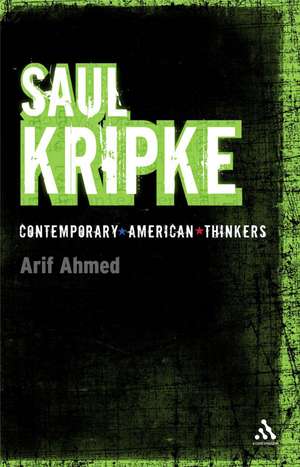
Saul Kripke: Continuum Contemporary American Thinkers
Autor Arif Ahmeden Limba Engleză Paperback – 9 iun 2007
Preț: 204.85 lei
Puncte Express: 307
Carte tipărită la comandă
Livrare economică 01-15 decembrie
Livrare prin curier în România Termenul estimat este afișat lângă disponibilitate.
Transport gratuit de la 400.00 lei Plată online sau ramburs, în funcție de opțiunile comenzii.
Retur gratuit în 14 zile Comandă securizată și suport în română.
Specificații
ISBN-13: 9780826492623
ISBN-10: 0826492622
Pagini: 192
Dimensiuni: 138 x 216 x 15 mm
Greutate: 0.25 kg
Editura: Bloomsbury Publishing
Colecția Continuum
Seria Continuum Contemporary American Thinkers
Locul publicării:London, United Kingdom
ISBN-10: 0826492622
Pagini: 192
Dimensiuni: 138 x 216 x 15 mm
Greutate: 0.25 kg
Editura: Bloomsbury Publishing
Colecția Continuum
Seria Continuum Contemporary American Thinkers
Locul publicării:London, United Kingdom
V-ar putea interesa
-
 Philosophy and the Historical PerspectiveMarcel van Ackeren-31%Preț: 430.84 lei621.30 lei
 -
 Reading Frege's GrundgesetzeRichard G. Heck, Jr.-18%Preț: 301.83 lei369.59 lei
 -
 The Construction of Logical SpaceAgustín Rayo-19%Preț: 283.46 lei349.65 lei
 -
 The Rules of ThoughtJonathan Jenkins Ichikawa-17%Preț: 254.76 lei307.17 lei
 -
 New Essays on the Knowability ParadoxJoe Salerno-31%Preț: 759.17 lei1096.69 lei
 -
 Visual Thinking in MathematicsMarcus Giaquinto-12%Preț: 375.34 lei424.60 lei
 -
 How to Think LogicallyGary Seay-19%Preț: 579.42 lei715.33 lei
 -
 The Varieties of PragmatismDr. Douglas McDermid-25%Preț: 280.71 lei374.45 lei
 -
 The Continuum Companion to PragmatismProfessor Sami PihlströmPreț: 1028.64 lei
 -
 Frege: A Guide for the PerplexedDr Edward Kanterian-24%Preț: 644.62 lei852.42 lei
 -
 -30%Preț: 536.76 lei768.48 lei
 -
 On Truth and Meaning: Language, Logic and the Grounds of BeliefProfessor Christopher Norris-11%Preț: 329.00 lei371.53 lei
 -
 -25%Preț: 611.29 lei809.84 lei
 -
 -17%Preț: 180.94 lei216.76 lei
 -
 Pragmatism without Foundations 2nd ed: Reconciling Realism and RelativismProfessor Joseph Margolis-30%Preț: 504.40 lei721.24 lei
 -
 Pragmatism: A Guide for the PerplexedProfessor Robert B. Talisse-24%Preț: 622.47 lei823.78 lei
 -
 -14%Preț: 710.86 lei826.57 lei
 -
 Civilized Oppression and Moral RelationsJ. HarveyPreț: 401.48 lei
 -
 -15%Preț: 422.92 lei497.56 lei
 -
 American Pragmatism and Communication ResearchDavid K. PerryPreț: 486.67 lei
 -
 Newcomb's ProblemArif AhmedPreț: 260.22 lei
 -
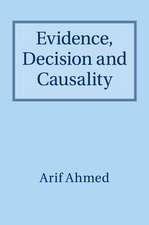 Evidence, Decision and CausalityArif AhmedPreț: 298.82 lei
 -
 The Continuum Companion to Philosophical LogicProfessor Leon Horsten-39%Preț: 1019.89 lei1659.08 lei
 -
 Diagrammatic ImmanenceRocco Gangle-24%Preț: 695.12 lei911.49 lei
 -
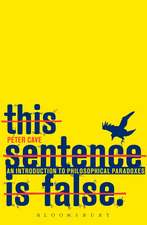 -41%Preț: 101.81 lei173.79 lei
 -
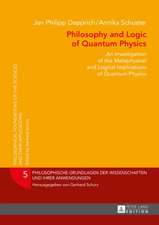 Philosophy and Logic of Quantum PhysicsAnnika SchusterPreț: 403.42 lei
 -
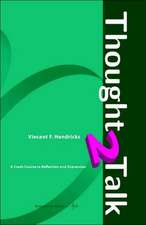 Thought 2 TalkVincent F. HendricksPreț: 113.30 lei
Cuprins
1. Introduction
2. Names
3. Necessity
4. Rule-Following
5. Private Language
Bibliography
2. Names
3. Necessity
4. Rule-Following
5. Private Language
Bibliography
Recenzii
"This is a lovely book - crystal clear exposition, concise lucid criticism." - Laurence Goldstein, University of Kent, UK.
"This book is an insightful and thorough analysis of Kripke's major contributions to philosophy...Arif Ahmed's book is a good example of analytical work which combines critical analysis of Kripe's arguments from Naming and Necessity with more discursive analysis of his skeptical argument, and a more interpretive treatment of the skeptical solution. As Ahmed admits, his aim was not to refute Kripke's views, only to present objections to them. Without a doubt, this aim has been fully accomplished." -Anton Petrenko, Philosophy in Review
"This book is an insightful and thorough analysis of Kripke's major contributions to philosophy...Arif Ahmed's book is a good example of analytical work which combines critical analysis of Kripe's arguments from Naming and Necessity with more discursive analysis of his skeptical argument, and a more interpretive treatment of the skeptical solution. As Ahmed admits, his aim was not to refute Kripke's views, only to present objections to them. Without a doubt, this aim has been fully accomplished." -Anton Petrenko, Philosophy in Review
Notă biografică
Arif Ahmed is Lecturer in Philosophy at the University of Cambridge, UK.