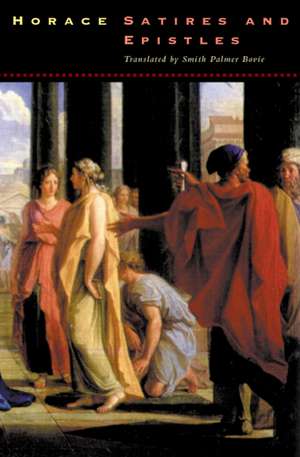
Satires and Epistles
Autor Horace Traducere de Smith Palmer Bovieen Limba Engleză Paperback – 15 apr 2002
În capitolul dedicat „Artei de a trăi” (Epistolele), observăm cum Horace reușește să transforme forma epistolară într-un instrument de explorare filozofică, oferind sfaturi care rămân surprinzător de actuale după două milenii. Găsim în această ediție din seria Oxford World's Classics o abordare riguroasă a celor mai importante lucrări de critică socială și literară ale poetului, într-o traducere nouă în proză semnată de John Davie. Volumul structurează progresiv evoluția gândirii autorului, de la tonul tăios și autoironic al Satires, unde sunt taxate lăcomia și ipocrizia societății augustane, până la maturitatea reflexivă din Epistles și normele estetice din Ars Poetica. Apreciem în mod deosebit modul în care notele și introducerea semnate de Robert Cowan clarifică referințele istorice complexe, precum episodul cinei lui Nasidienus sau fabula șoarecelui de oraș și a celui de câmp. Comparabil cu Epistles Book I din seria Cambridge în ceea ce privește precizia academică, acest volum de la OUP OXFORD este actualizat pentru un public contemporan prin fluența limbajului și aparatul critic modern. Față de Horace Odes and Epodes, unde accentul cade pe lirism și teme publice, această colecție se concentrează pe sfera privată, pe conduita morală și pe mecanismele literare ale satirei, oferind o perspectivă completă asupra modului în care autorul și-a construit propria voce poetică în contextul tranziției către Imperiul Roman.
Preț: 171.77 lei
Preț vechi: 224.12 lei
-23%
Carte indisponibilă temporar
Specificații
ISBN-10: 0226067777
Pagini: 326
Dimensiuni: 133 x 203 x 18 mm
Greutate: 0.34 kg
Editura: University of Chicago Press
Colecția University of Chicago Press
V-ar putea interesa
-
 Selected Works (Cicero, Marcus Tullius)Marcus Tullius Cicero-31%Preț: 63.86 lei92.71 lei
 -
 Letters from a StoicSeneca-18%Preț: 59.88 lei72.66 lei
 -
 -31%Preț: 63.83 lei92.64 lei
 -
 Horace: A Very Short IntroductionLlewelyn Morgan-20%Preț: 57.00 lei71.03 lei
 -
 Alexander Pope: The Major WorksHenry Power-32%Preț: 897.61 lei1311.48 lei
 -
 The SatiresJuvenal-19%Preț: 64.11 lei78.92 lei
 -
 The Complete Odes and EpodesHorace-19%Preț: 68.96 lei85.53 lei
 -
 -19%Preț: 69.97 lei86.16 lei
 -
 Horace: Poet on a VolcanoPeter StothardPreț: 161.47 lei
 -
 MeditationsMarcus AureliusPreț: 34.00 lei
 -
 A. E. HousmanA. E. HousmanPreț: 68.99 lei
 -
 Julian, Volume IIJulianPreț: 230.49 lei
 -
 Preț: 230.21 lei
 -
 Preț: 233.75 lei
 -
 Preț: 234.14 lei
 -
 Horace Odes And EpodesHoracePreț: 192.47 lei
 -
 Rape of the LockAlexander PopePreț: 26.70 lei
 -
 SatiresHorace-18%Preț: 107.00 lei129.90 lei
 -
 HoraceHorace-19%Preț: 58.29 lei71.64 lei
De ce să citești această carte
Această ediție este esențială pentru studenții de filologie clasică și pentru cititorii interesați de originile satirei europene. Veți câștiga o înțelegere profundă a valorilor romane și a modului în care umorul poate fi folosit pentru a transmite adevăruri morale incomode. Este un volum care transformă textele antice în lecții de viață accesibile, păstrând în același timp rigoarea academică specifică Oxford.
Despre autor
Horace (65 î.Hr. – 8 î.Hr.) a fost unul dintre cei mai influenți poeți ai epocii de aur a literaturii latine, martor direct al transformării Republicii în Imperiu sub Augustus. Opera sa, care include odes, epodes, satire și epistole, reflectă o sinteză între filozofia stoică și cea epicureică, fiind definită de umanitate și un spirit critic rafinat. Prieten cu Virgiliu și protejat al lui Maecenas, Horace a stabilit standarde în estetica literară care au influențat scriitorii europeni timp de secole, de la Ben Jonson la W. H. Auden.
Descriere scurtă
The Satires and Epistles spans the poet's career as a satirist, critic, and master of lyric poetry, as man of the world, friend of the great, and relentless enemy of the mediocre. "Horace," writes translator Smith Palmer Bovie, "is the best antidote in the world for anxiety. His Satires and Epistles demonstrate the good-humored freedom of a man who has cheerfully assumed the responsibility for making his own life not so much a 'success' as the occasion for a true enjoyment of virtue and knowledge." Bovie's impeccable translation, along with Clancy's edition of the Odes and Epodes, offers the reader a complete and modern Horace.
Notă biografică
Cuprins
Satires
Introduction to Book One
1. Don't go overboard
2. Adultery is childish
3. But no one asked you to sing
4. And when I have time, I put something down on paper
5. From Rome to Brindisi, with stops
6. I am only a freedman's son
7. King Rex: off with his head
8. A little Walpurgisnacht music
9. Bored to distraction
10. The fine art of criticism
Introduction to Book Two
1. To write or not to write? (A talk with my lawyer)
2. Plain living and high thinking
3. A Stoic sermon
4. Gourmet à la mode
5. How to recoup your losses
6. The town mouse and the country mouse
7. My slave is free to speak up for himself
8. Nasidienus has some friend in for dinner
Epistles
Introduction to Book One
1. To Maecenas (20 B.C.): Philosophy has clipped my wings
2. To Lollius Maximus (22 B.C.): Homer teaches us all how to live, but we have to do it ourselves
3. To Julius Florus, campaigning with Tiberius (20 B.C.): How are you out there with all those officers? What are you doing with your spare time?
4. To Albius Tibullus (24 B.C.): Don't be depressed, my friend. I'm not!
5. To Torquatus (22 B.C.): Come to dinner tonight, the twenty-second
6. To Numicius (no date): Nil admirari
7. To Maecenas (no date): I won't be coming to town this winter. Sorry!
8. To Celsus Albinovanus, campaigning with Tiberius (20 B.C.): I'm depressed. Hope you aren't
9. To Tiberius (20 B.C.): Recommending to you my friend Septimius
10. To Aristius Fuscus (21 B.C.): You can leave the city. I'll take the country
11. To Bullatius (no date): How was your trip?
12. To Iccius, in Sicily (20 B.C.): Hope you are doing well in your work for the Department of External Revenue. But do look up Pompeius Grosphus. Here's the latest news from Rome
13. To Vinius Asina (23 B.C.): Please give these does to Augustus, and watch what you're doing!
14. To the foreman on my farm (no date): You can have the city; I'll take the country
15. To Numonius Vala (22 B.C.): I'm planning to come south for the winter. What's it like down there?
16. To Quinctius (25 B.C.): Virtue is wisdom
17. To Scaeva (no date): How to win friends and influence patrons
18. To Lollius Maximus (20 B.C.): How to influence patrons: be yourself!
19. To Maecenas (20 B.C.): My lyric poetry is not derivative, it's contributive
20. To my first book of epistles (20 B.C.): I guess it's up to you to make your own way in the world
Introduction to Book Two
1. The Epistle to Augustus: The literary tradition, and the role of our Roman writers
2. To Julius Florus, still campaigning with Tiberius: Literary ambitions, and how to survive them
3. The art of poetry
Notes
Descriere
'What's the harm in using humour to put across what is true?'Gluttony, lust, and hypocrisy are just a few of the targets of Horace's Satires. Writing in the 30s BC, Horace exposes the vices and follies of his Roman contemporaries, while still finding time to reflect on how to write good satire and along the way revealing his own persona to be as flawed and bigoted as the people he attacks. Alongside famous episodes such as the fable of the town mouse and the country mouse, the explosive fart of Priapus, and the grotesque dinner party given by the nouveau-riche Nasidienus, these poems are stuffed full of comic vignettes, moral insights, and Horace's pervasive humanity. They influenced not only Persius and Juvenal but the long tradition of English satire, from Ben Jonson to W. H. Auden. These new prose translations by John Davie perfectly capture the ribald style of the original.In the Epistles, Horace uses the form of letters to his friends, acquaintances, foremen, and even the emperor to explore questions of philosophy and how to live a good life; and in 'The Art of Poetry' (the Ars poetica), he gives advice on poetic style that informed the work of writers and dramatists for centuries. ABOUT THE SERIES: For over 100 years Oxford World's Classics has made available the widest range of literature from around the globe. Each affordable volume reflects Oxford's commitment to scholarship, providing the most accurate text plus a wealth of other valuable features, including expert introductions by leading authorities, helpful notes to clarify the text, up-to-date bibliographies for further study, and much more.