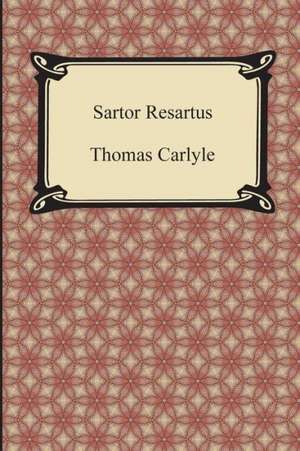
Sartor Resartus
Autor Thomas Carlyleen Limba Engleză Paperback – 31 dec 2013
Preț: 70.64 lei
Puncte Express: 106
Carte indisponibilă temporar
Livrare prin curier în România Termenul estimat este afișat lângă disponibilitate.
Transport gratuit de la 400.00 lei Plată online sau ramburs, în funcție de opțiunile comenzii.
Retur gratuit în 14 zile Comandă securizată și suport în română.
Specificații
ISBN-13: 9781420949698
ISBN-10: 1420949691
Pagini: 132
Dimensiuni: 152 x 229 x 8 mm
Greutate: 0.2 kg
Editura: Digireads.com
ISBN-10: 1420949691
Pagini: 132
Dimensiuni: 152 x 229 x 8 mm
Greutate: 0.2 kg
Editura: Digireads.com
V-ar putea interesa
-
 Selected WritingsThomas CarlylePreț: 96.30 lei
 -
 The French RevolutionThomas Carlyle-14%Preț: 95.98 lei112.19 lei
 -
 Past and PresentThomas Carlyle-13%Preț: 46.26 lei53.20 lei
 -
 Culture and AnarchyMatthew Arnold-18%Preț: 58.71 lei71.69 lei
 -
 The Picture of Dorian GrayOscar WildePreț: 35.93 lei
 -
 MeditationsMarcus AureliusPreț: 34.00 lei
 -
 CandideVoltairePreț: 32.48 lei
 -
 Vanity Fair: Official ITV tie-in editionWilliam Makepeace Thackeray-20%Preț: 49.05 lei61.15 lei
 -
 The History ManMalcolm Bradbury-39%Preț: 48.04 lei78.80 lei
 -
 ErewhonSamuel ButlerPreț: 47.65 lei
 -
 Hot Victorians: Meet Your Dream Man From the PastAaron Radford-Wattley-25%Preț: 81.41 lei108.46 lei
 -
 The Bonfire of the InsanitiesJohn CracePreț: 121.47 lei
 -
 The Ragged Trousered PhilanthropistsRobert TressellPreț: 28.01 lei
 -
 Oliver TwistCharles DickensPreț: 38.00 lei
 -
 Hard TimesCharles DickensPreț: 28.01 lei
 -
 The Carlyles at HomeThea HolmePreț: 147.76 lei
 -
 Preț: 34.20 lei
 -
 UtopiaThomas MorePreț: 33.19 lei
Descriere
Descriere de la o altă ediție sau format:
This edition is the first to present the text as it originally appeared, indicating the changes Carlyle made to later editions. Appendices contain Carlyle's own extensive commentaries on his work. ABOUT THE SERIES: For over 100 years Oxford World's Classics has made available the widest range of literature from around the globe. Each affordable volume reflects Oxford's commitment to scholarship, providing the most accurate text plus a wealth of other valuable features, including expert introductions by leading authorities, helpful notes to clarify the text, up-to-date bibliographies for further study, and much more.
This edition is the first to present the text as it originally appeared, indicating the changes Carlyle made to later editions. Appendices contain Carlyle's own extensive commentaries on his work. ABOUT THE SERIES: For over 100 years Oxford World's Classics has made available the widest range of literature from around the globe. Each affordable volume reflects Oxford's commitment to scholarship, providing the most accurate text plus a wealth of other valuable features, including expert introductions by leading authorities, helpful notes to clarify the text, up-to-date bibliographies for further study, and much more.
Recenzii
I am delighted with this edition, which is long overdue, and shall adopt it forthwith. The introduction is excellent.
Notă biografică
Thomas Carlyle was a Scottish essayist, historian, and philosopher who lived from 4 December 1795 to 5 February 1881. Carlyle learned to read from his mother, and arithmetic from his father. Carlyle travelled 100 miles from his home in November 1809, when he was about 14 years old, to attend the University of Edinburgh. John Leslie taught him mathematics, and John Playfair taught him science. He finished his studies in the arts in 1813 and enrolled in a theology study. In addition to founding the London Library, he made a substantial contribution to the National Portrait Galleries' establishment. Victorian literature was significantly affected by Carlyle's inventive writing style. He proposed the Great Man theory, a historical theory that holds that notable people have affected history. His "noble Chivalry of Work" political theory is characterised by medievalism. Carlyle heard abruptly of his wife's unexpected death while still in Scotland. He wrote memoirs of William Wordsworth, Robert Southey, Irving, and Jeffrey.His niece Mary, who served as his amanuensis, overheard him say his last words: "So this is Death-well."