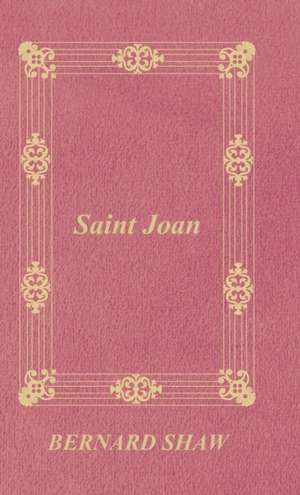
Saint Joan
Autor George Bernard Shawen Limba Engleză Hardback – 4 noi 2008
Preț: 293.41 lei
Puncte Express: 440
Carte tipărită la comandă
Livrare economică 11-25 iulie
Livrare prin curier în România Termenul estimat este afișat lângă disponibilitate.
Transport gratuit de la 400.00 lei Plată online sau ramburs, în funcție de opțiunile comenzii.
Retur gratuit în 14 zile Comandă securizată și suport în română.
Specificații
ISBN-13: 9781443724906
ISBN-10: 1443724904
Pagini: 196
Dimensiuni: 145 x 222 x 14 mm
Greutate: 0.39 kg
Editura: Hesperides Press
ISBN-10: 1443724904
Pagini: 196
Dimensiuni: 145 x 222 x 14 mm
Greutate: 0.39 kg
Editura: Hesperides Press
V-ar putea interesa
-
 PygmalionGeorge Bernard ShawPreț: 24.60 lei
 -
 SparrowMichael MorpurgoPreț: 54.56 lei
 -
 Man and SupermanGeorge Bernard Shaw-20%Preț: 55.20 lei69.26 lei
 -
 Pygmalion, Heartbreak House, and Saint JoanGeorge Bernard Shaw-18%Preț: 65.32 lei79.88 lei
 -
 Arms and the Man, The Devil's Disciple, and Caesar and CleopatraGeorge Bernard Shaw-19%Preț: 62.43 lei77.23 lei
 -
 George Bernard Shaw: A Very Short IntroductionChristopher Wixson-21%Preț: 54.86 lei69.87 lei
 -
 A Man for All SeasonsRobert BoltPreț: 163.90 lei
 -
 Cyrano de BergeracEdmond RostandPreț: 32.78 lei
 -
 Personal Recollections of Joan of ArcMark TwainPreț: 67.81 lei
 -
 Joan of ArcHelen CastorPreț: 92.49 lei
 -
 Juno and the PaycockSean O'CaseyPreț: 76.28 lei
 -
 Saint JoanBernard Shaw-24%Preț: 70.09 lei92.67 lei
 -
 Joan: The stunning new feminist reimagining of Joan of ArcKatherine J. Chen-27%Preț: 57.14 lei78.41 lei
 -
 Joan of Arc and 'The Great Pity of the Land of France'Moya Longstaffe-8%Preț: 85.87 lei93.07 lei
 -
 King JohnWilliam ShakespearePreț: 37.70 lei
 -
 Pygmalion & Other PlaysGeorge Bernard Shaw-35%Preț: 48.51 lei75.07 lei
 -
 PygmalionBernard ShawPreț: 40.90 lei
 -
 Joan of ArcJ K Jackson-12%Preț: 56.82 lei64.55 lei
 -
 An Inspector Calls: Annotation-Friendly EditionJ. B. PriestleyPreț: 84.22 lei
Notă biografică
Dublin-born George Bernard Shaw (1856-1950) was an active Socialist and a brilliant platform speaker. He was strongly critical of London theatre and closely associated with the intellectual revival of British drama. Dan H. Laurence (series editor) has edited Shaw's Collected Letters and Collected Plays with their Prefaces. Imogen Stubbs is an actress and has played leading roles on stage, television and in film. Joley Wood has taught Anglo-Irish literature at Trinity College, Dublin.
Descriere
Descriere de la o altă ediție sau format:
The life of Joan of Arc is the stuff of legend, and her cruel death led to her being declared a martyr, granting her an unwavering legacy. Following her canonisation in 1920, and against a history of overly romanticised retellings of the story, Bernard Shaw put pen to paper to give a more accurate account.
The life of Joan of Arc is the stuff of legend, and her cruel death led to her being declared a martyr, granting her an unwavering legacy. Following her canonisation in 1920, and against a history of overly romanticised retellings of the story, Bernard Shaw put pen to paper to give a more accurate account.