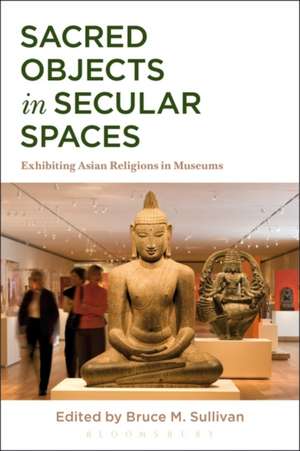
Sacred Objects in Secular Spaces: Exhibiting Asian Religions in Museums
Editat de Bruce M. Sullivanen Limba Engleză Paperback – 22 oct 2015
Bringing together religious studies scholars and museum curators, Sacred Objects in Secular Spaces is the first volume to focus on Asian religions in relation to these questions. The contributors analyze an array of issues related to the exhibition in museums of objects of religious significance from Hindu, Buddhist, and Sikh traditions. The "lives" of objects are considered, along with the categories of "sacred" and "profane", "religious" and "secular".
As interest in material manifestations of religious ideas and practices continues to grow, Sacred Objects in Secular Spaces is a much-needed contribution to religious and Asian studies, anthropology of religion and museums studies.
Preț: 193.00 lei
Preț vechi: 240.20 lei
-20%
Puncte Express: 290
Carte tipărită la comandă
Livrare economică 18 noiembrie-02 decembrie
Livrare prin curier în România Termenul estimat este afișat lângă disponibilitate.
Transport gratuit de la 400.00 lei Plată online sau ramburs, în funcție de opțiunile comenzii.
Retur gratuit în 14 zile Comandă securizată și suport în română.
Specificații
ISBN-13: 9781472590800
ISBN-10: 1472590805
Pagini: 216
Ilustrații: 8 bw illus and 32 colour illus
Dimensiuni: 154 x 232 x 14 mm
Greutate: 0.34 kg
Editura: Bloomsbury Publishing
Colecția Bloomsbury Academic
Locul publicării:London, United Kingdom
ISBN-10: 1472590805
Pagini: 216
Ilustrații: 8 bw illus and 32 colour illus
Dimensiuni: 154 x 232 x 14 mm
Greutate: 0.34 kg
Editura: Bloomsbury Publishing
Colecția Bloomsbury Academic
Locul publicării:London, United Kingdom
V-ar putea interesa
-
 Preț: 108.50 lei
 -
 BhagavadgitaEdwin ArnoldPreț: 32.80 lei
 -
 Peace Is Every StepThich Nhat HanhPreț: 104.71 lei
 -
 Radical AcceptanceTara BrachPreț: 121.64 lei
 -
 An Introduction To Zen BuddhismD T SuzukiPreț: 92.21 lei
 -
 Breathe! You Are AliveThich Nhat Hanh-21%Preț: 54.46 lei69.08 lei
 -
 Buddhism without BeliefsStephen Batchelor-29%Preț: 65.07 lei91.34 lei
 -
 Destructive EmotionsDaniel Goleman-26%Preț: 69.39 lei93.91 lei
 -
 Essays in Zen BuddhismDaisetz Teitaro SuzukiPreț: 107.36 lei
 -
 Moon in a DewdropEihei DogenPreț: 126.27 lei
 -
 Record of Things HeardDogenPreț: 115.04 lei
 -
 The Golden PresentSri Swami SatchidanandaPreț: 110.61 lei
 -
 -16%Preț: 83.85 lei100.02 lei
 -
 Dewdrops on a Lotus LeafKoshi No Sengai-21%Preț: 94.24 lei119.45 lei
 -
 Open SecretWeiwu WeiPreț: 106.90 lei
Cuprins
List of Illustrations Printed in this Volume
List of Illustrations Available to View Online at Bloomsbury.com
Notes on Contributors
Acknowledgements
Introduction to Sacred Objects in Secular Spaces: Exhibiting Asian Religions in Museums
Bruce M. Sullivan
Part 1: Exhibiting Hindu and Sikh Religious Objects in Museums
1. What Do Indian Images Really Want? A Biographical Approach
Richard H. Davis (Professor of Religion and Asian Studies, Bard College, USA)
2. Under the Gaze of Kali: Exhibitionism in the Kalighat Painting Exhibition at the Cleveland Museum of Art
Deepak Sarma (Professor of Religious Studies, Case Western Reserve University, USA)
3. Reconsecrating the Icons: The New Phenomenon of Yoga in Museums
Bruce M. Sullivan (Professor, Comparative Study of Religions & Asian Studies, Northern Arizona University, USA)
4. Sikh Museuming
Anne Murphy (Associate Professor in Punjabi Language, Literature and Sikh Studies, Dept. of Asian Studies, University of British Columbia, Canada)
Part 2: Exhibiting Buddhist Religious Objects in Museums
5. Planning the Robert H.N. Ho Family Foundation Gallery of Buddhist Sculpture 2009-2014
John Clarke (Curator of South and South East Asian Art at the Victoria & Albert Museum, UK)
6. Entering the Virtual Mandala: Transformative Environments in Hybrid Spaces
Jeff Durham (Assistant Curator of Himalayan Art, Asian Art Museum of San Francisco, USA)
7. Discovery and Display: Case Studies from the Metropolitan Museum of Art
Denise Patry Leidy (Curator of Asian Art, Metropolitan Museum of Art, USA)
8. Mapping Cultures, Digital Exhibitions, Learning Networks: The Creative Collaborations at Austin College and the Crow Collection of Asian Art
Ivette Vargas-O'Bryan (Associate Professor of Religious Studies, Austin College, USA)
Part 3: Religions, Museums, Memory
9. Curating Asian Religious Objects in the Exhibition Sacred Word and Image: Five World Religions
Janet Baker (Curator of Asian Art, Phoenix Art Museum, USA)
10. World Religions Museums: Dialogue, Domestication, and the Sacred Gaze
Charles D. Orzech (Reader in Religion, Conflict & Transition, School of Critical Studies, University of Glasgow, UK)
11. Detritus to Treasure: Memory, Metonymy, and the Museum
Michael Willis (Curator of the Early South Asian and Himalayan Collections, The British Museum, UK)
Notes
Bibliography
Index
List of Illustrations Available to View Online at Bloomsbury.com
Notes on Contributors
Acknowledgements
Introduction to Sacred Objects in Secular Spaces: Exhibiting Asian Religions in Museums
Bruce M. Sullivan
Part 1: Exhibiting Hindu and Sikh Religious Objects in Museums
1. What Do Indian Images Really Want? A Biographical Approach
Richard H. Davis (Professor of Religion and Asian Studies, Bard College, USA)
2. Under the Gaze of Kali: Exhibitionism in the Kalighat Painting Exhibition at the Cleveland Museum of Art
Deepak Sarma (Professor of Religious Studies, Case Western Reserve University, USA)
3. Reconsecrating the Icons: The New Phenomenon of Yoga in Museums
Bruce M. Sullivan (Professor, Comparative Study of Religions & Asian Studies, Northern Arizona University, USA)
4. Sikh Museuming
Anne Murphy (Associate Professor in Punjabi Language, Literature and Sikh Studies, Dept. of Asian Studies, University of British Columbia, Canada)
Part 2: Exhibiting Buddhist Religious Objects in Museums
5. Planning the Robert H.N. Ho Family Foundation Gallery of Buddhist Sculpture 2009-2014
John Clarke (Curator of South and South East Asian Art at the Victoria & Albert Museum, UK)
6. Entering the Virtual Mandala: Transformative Environments in Hybrid Spaces
Jeff Durham (Assistant Curator of Himalayan Art, Asian Art Museum of San Francisco, USA)
7. Discovery and Display: Case Studies from the Metropolitan Museum of Art
Denise Patry Leidy (Curator of Asian Art, Metropolitan Museum of Art, USA)
8. Mapping Cultures, Digital Exhibitions, Learning Networks: The Creative Collaborations at Austin College and the Crow Collection of Asian Art
Ivette Vargas-O'Bryan (Associate Professor of Religious Studies, Austin College, USA)
Part 3: Religions, Museums, Memory
9. Curating Asian Religious Objects in the Exhibition Sacred Word and Image: Five World Religions
Janet Baker (Curator of Asian Art, Phoenix Art Museum, USA)
10. World Religions Museums: Dialogue, Domestication, and the Sacred Gaze
Charles D. Orzech (Reader in Religion, Conflict & Transition, School of Critical Studies, University of Glasgow, UK)
11. Detritus to Treasure: Memory, Metonymy, and the Museum
Michael Willis (Curator of the Early South Asian and Himalayan Collections, The British Museum, UK)
Notes
Bibliography
Index
Recenzii
The essays themselves are fascinating, not least because they bring together both museum curators and religious studies scholars thinking aloud, hard, and in parallel, about the 'material' and 'religious' dimensions of the objects they are exhibiting.
This timely volume is a valuable set of essays exploring the relationship between religious material culture and the politics of display in museums. The essays deal primarily with South and East Asian objects, each delicately balancing theory with ethnography and history.
This book captures some of the many journeys made, and shifting roles played, by sacred objects when they are taken from their temples and shrines. They can become imperial trophies, scientific specimens, bland conscripts in multicultural narratives, stereotypes paraded to boost museum visits, respected ambassadors representing faiths, traditions or groups, commodities in the art market, and - perhaps - return to being intermediaries between the material and the spiritual. This book offers not a single argument, but a judicious mixture of appreciation and critique, scepticism and enthusiasm, history and philosophy. Beyond its clear relevance to religious and museum studies, it casts interesting light on one of the most important issues of our time, the public understanding of religious difference - and the role of museums as civic spaces in which difference can be explored.
This timely volume is a valuable set of essays exploring the relationship between religious material culture and the politics of display in museums. The essays deal primarily with South and East Asian objects, each delicately balancing theory with ethnography and history.
This book captures some of the many journeys made, and shifting roles played, by sacred objects when they are taken from their temples and shrines. They can become imperial trophies, scientific specimens, bland conscripts in multicultural narratives, stereotypes paraded to boost museum visits, respected ambassadors representing faiths, traditions or groups, commodities in the art market, and - perhaps - return to being intermediaries between the material and the spiritual. This book offers not a single argument, but a judicious mixture of appreciation and critique, scepticism and enthusiasm, history and philosophy. Beyond its clear relevance to religious and museum studies, it casts interesting light on one of the most important issues of our time, the public understanding of religious difference - and the role of museums as civic spaces in which difference can be explored.