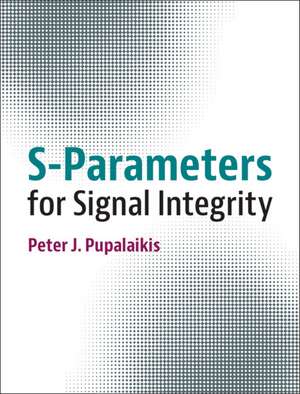
S-Parameters for Signal Integrity
Autor Peter J Pupalaikisen Limba Engleză Hardback – 6 feb 2020
ABORDAREA PRACTICĂ: S-Parameters for Signal Integrity se distinge printr-un echilibru riguros între fundamentul matematic al parametrilor de împrăștiere (S) și aplicarea lor directă în mediile de simulare și măsurare. Observăm că Peter J Pupalaikis nu se limitează la expunerea teoretică, ci oferă instrumentele necesare pentru rezolvarea problemelor critice de proiectare, precum calculul parametrilor de rețea sau de-embedding-ul. Un element central care susține această abordare este pachetul software SignalIntegrity, scris în Python, care permite cititorului să treacă de la conceptele abstracte la implementări de scripturi pentru automatizarea analizelor. Structura volumului reflectă o progresie logică, de la modelele parametrice de rețea și liniile de transmisie, până la tehnici complexe de virtual probing și extracție de modele. Partea a III-a este deosebit de relevantă pentru inginerii care lucrează cu osciloscoape de înaltă performanță, deoarece explică interconectarea dintre răspunsurile în frecvență, filtre și formele de undă în domeniul timp. Cititorul care a aplicat ideile din Signal and Power Integrity - Simplified de Eric Bogatin va găsi aici o continuare tehnică aprofundată, care completează intuiția fizică a lui Bogatin cu o metodologie matematică și computațională mult mai densă, specifică instrumentației de laborator. Subliniem că cele 223 de ilustrații și diagramele tehnice sunt esențiale pentru vizualizarea modului în care semnalele digitale sunt afectate de circuitele prin care circulă. Lucrarea reușește să unifice conceptele de domeniu de frecvență specifice teoriei parametrilor S cu cerințele riguroase ale integrității semnalului în sistemele digitale de mare viteză, transformând datele brute de măsurare în modele de simulare acurate.
Preț: 880.86 lei
Preț vechi: 1024.25 lei
-14%
Carte disponibilă
Livrare economică 17 iunie-01 iulie
Specificații
ISBN-10: 1108489966
Pagini: 664
Ilustrații: 223 b/w illus.
Dimensiuni: 197 x 254 x 37 mm
Greutate: 1.56 kg
Editura: Cambridge University Press
Locul publicării:Cambridge, United Kingdom
V-ar putea interesa
-
 Signal and Power Integrity - SimplifiedEric Bogatin-14%Preț: 793.21 lei922.33 lei
 -
 -33%Preț: 600.14 lei893.07 lei
 -
 Oh's Intensive Care ManualJonathan M. Handy-30%Preț: 666.61 lei956.17 leiRecomandat
 -
 Signals and Systems Using MATLAB®Aydin Akan-33%Preț: 645.83 lei966.24 lei
 -
 -33%Preț: 448.80 lei666.17 lei
 -
 -41%Preț: 600.48 lei1013.26 lei
 -
 Electromagnetic Compatibility EngineeringHenry W. Ott-23%Preț: 867.86 lei1127.09 lei
 -
 -25%Preț: 141.28 lei189.04 lei
 -
 Engineering Circuit Analysis, International AdaptationJ. David Irwin-19%Preț: 418.77 lei516.99 lei
 -
 -10%Preț: 125.64 lei139.73 lei
 -
 Signals and SystemsChi-Tsong ChenPreț: 156.42 lei
 -
 Spectrum and Network MeasurementsRobert A Witte-15%Preț: 596.20 lei701.41 lei
 -
 -14%Preț: 716.62 lei833.28 lei
 -
 -37%Preț: 274.08 lei434.10 lei
 -
 Signals and Systems with MATLAB® and Simulink®Farzin AsadiPreț: 431.01 lei
 -
 Microwave Numerical Solutions¿Tefan Cantaragiu-15%Preț: 623.03 lei732.98 lei
 -
 Statistics for ScientistsUmberto Michelucci-20%Preț: 286.96 lei358.70 lei
 -
 PSpice for Filters and Transmission LinesPaul TobinPreț: 295.42 lei
 -
 Simulation Techniques in Microwave Photonics SystemsRangana Banerjee Chaudhuri-18%Preț: 853.71 lei1041.11 lei
De ce să citești această carte
Recomandăm această carte inginerilor de integritate a semnalului care au nevoie de o metodologie de calcul și măsurare de înaltă precizie. Față de alte manuale introductive, acest volum oferă avantajul pachetului Python dedicat, permițând implementarea imediată a algoritmilor de de-embedding și virtual probing. Este un instrument tehnic indispensabil pentru cei care doresc să stăpânească utilizarea parametrilor S în designul circuitelor de mare viteză.
Descriere scurtă
Cuprins
Recenzii
'This book provides unique and consistent description of S-parameters use for analysis of linear networks, signal measurement and processing in one volume, supplemented and illustrated with free open source signal integrity software. The book can be used for learning the subject of emerging microwave signal integrity or as a comprehensive and indispensable reference for every microwave and signal integrity engineer and scientist.' Yuriy Shlepnev, Simberian Inc.
'This is an outstanding and refreshing book for the novice and advanced engineer alike. Written by a well-known expert in the field, it provides a rather unique access to the difficult topic of signal integrity, through a systematic learning by doing approach. A software, which is freely accessible through an open-source Python library, 'Signal Integrity', allows the user to easily program the numerous examples that accompany the theory. The material ranges from simple to complex problems, using the S-parameter concept for high-speed signal integrity as a unifying theme. The book is appropriate for self-study and as a reference for teaching, and empowers the reader with a very unusual and stimulating blend of competences.' Peter Wittwer, University of Geneva
'S-parameters for Signal Integrity is a more circuit-heavy look at the S-parameter data/simulation/design environment than one usually sees and that approach can be very helpful for a number of problems.' Jon Martens, Anritsu
'This is a long overdue and amazing book that will equally appeal to people looking for a deep theoretical foundation in the mathematics behind some of the commonly-used signal integrity computations we use today and also to those practicing engineers who are looking for real-life answers about S-parameter simulations, measurements and applications. This is also a 'must-read' book for anyone who wants to learn and use the open-source code that does pretty much everything we need to simulate in signal integrity.' Istvan Novak, IEEE Life Fellow, Samtec
'S-parameters are the industry-standard way of describing the electrical properties of interconnects; in measurement, in simulation and in specifications. While there are scattered resources on the formalism of S-parameters, they all focus on RF and microwave applications. Here, in one resource, is the definitive standard for using S-parameters in signal integrity applications where a time domain transform is essential. This new book, written by a world-class expert, establishes the foundations for using S-parameters to solve real world signal integrity related problems.' Eric Bogatin, Teledyne LeCroy Signal Integrity Academy and University of Colorado, Boulder
'… combines frequency-domain concepts from S-parameter theory with the time-domain concepts of digital oscilloscope technology to optimize transmission of digital signals through circuitry. Pupalaikis, an engineer for Teledyne LeCroy and IEEE Fellow, has produced what is likely to be the definitive work on scattering parameters as applied to modern digital systems. Supplementing its descriptive character, the book also provides code for use with an open-source Python package to perform many of the extremely complex operations discussed in the text … The ideal reader is a Python programmer and linear algebra expert who is also familiar with graduate-level signals and systems topics. That said, for specialists in signal integrity, Pupalaikis appears to have asked and answered most of the important questions about modeling and measurements with respect to passive linear circuits for digital transmission, including coverage of equalization and other recent developments.' K. D. Stephan, Choice