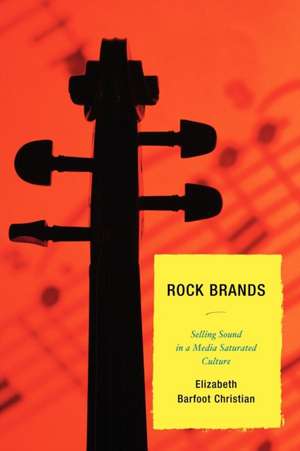
Rock Brands: Selling Sound in a Media Saturated Culture
Editat de Elizabeth Barfoot Christian Contribuţii de Jeremy V. Adolphson, Bob Batchelor, Michael Bertrand, Hazel James Cole, Charles Conaway, Daniel Cochece Davis, Bryan P. Delaney, Dedria Givens-Carroll, Heidi M. Kettler, Jacqueline Lambiase, Jordan McClain, Mary Nash-Wood, Staci Parks, Heather Pinson, Mary Beth Ray, Dave Robinson, Alison F. Slade, Deborah Clark Vanceen Limba Engleză Paperback – 22 dec 2010
The book's core objectives are addressed over three sections. In the first part of Rock Brands, the authors examine how established mainstream artists/bands are continuing to market themselves in an ever-changing technological world, and how bands can use integrated marketing communication to effectively "brand" themselves. This branding is intended as a protection so that technology and delivery changes don't stifle the bands' success. KISS, AC/DC, Ozzy Osbourne, Phish, and Miley Cyrus are all popular musical influences considered in this part of the analysis.
In the second section, the authors explore how some musicians effectively use attention-grabbing issues such as politics (for example, Kanye West and countless country musicians) and religion (such as with Christian heavy metal bands and Bon Jovi) in their lyrics, and also how imagery is utilized by artists such as Marilyn Manson to gain a fan base. Finally, the book will explore specific changes in the media available to market music today (see M.I.A. and her use of new media) and, similarly, how these resources can benefit music icons even after they are long gone, as with Elvis and Michael Jackson.
Rock Brands further examines gaming, reality television, and social networking sites as new outlets for marketing and otherwise experiencing popular music. What makes some bands stand out and succeed when so many fail? How does one find a niche that isn't just kitsch and can stand the test of time, allowing the musician to grow as an artist as well as grow a substantial fan base? Elizabeth Barfoot Christian and the book's contributors expertly navigate these questions and more in Rock Brands: Selling Sound in a Media Saturated Culture.
Preț: 355.97 lei
Preț vechi: 485.57 lei
-27%
Puncte Express: 534
Carte tipărită la comandă
Livrare economică 04-18 decembrie
Livrare prin curier în România Termenul estimat este afișat lângă disponibilitate.
Transport gratuit de la 400.00 lei Plată online sau ramburs, în funcție de opțiunile comenzii.
Retur gratuit în 14 zile Comandă securizată și suport în română.
Specificații
ISBN-13: 9780739146354
ISBN-10: 0739146351
Pagini: 353
Dimensiuni: 150 x 226 x 26 mm
Greutate: 0.56 kg
Editura: Bloomsbury Publishing
Colecția Lexington Books
Locul publicării:New York, United States
ISBN-10: 0739146351
Pagini: 353
Dimensiuni: 150 x 226 x 26 mm
Greutate: 0.56 kg
Editura: Bloomsbury Publishing
Colecția Lexington Books
Locul publicării:New York, United States
V-ar putea interesa
-
 The Rock MusicianTony SchermanPreț: 130.80 lei
 -
 U2Bill FlanaganPreț: 183.73 lei
 -
 The Unity of Music and Dance in World CulturesDavid AkomboPreț: 263.87 lei
 -
 Experiencing the Rolling Stones: A Listener's CompanionDavid Malvinni-15%Preț: 330.52 lei390.62 lei
 -
 Big Bang, BabyRichard CrousePreț: 114.63 lei
 -
 Kiss the SkyDusty BakerPreț: 69.03 lei
 -
 DealBill KreutzmannPreț: 135.41 lei
 -
 Warren Zevon: Desperado of Los AngelesGeorge Plasketes-20%Preț: 370.28 lei463.85 lei
 -
 -20%Preț: 290.76 lei362.81 lei
 -
 Lyrics 1964-2011Paul SimonPreț: 229.33 lei
 -
 Blessed ReliefScott ParkerPreț: 193.92 lei
 -
 Preț: 261.99 lei
 -
 Making Your Memories with Rock & Roll and Doo-WopJ. C. De LaduranteyPreț: 192.25 lei
 -
 The Who and PhilosophyRocco J. Gennaro-32%Preț: 615.68 lei911.91 lei
 -
 The Progressive Rock EncyclopediaMarkus FreytagPreț: 310.18 lei
 -
 Edm E: Electronic Dance Music EncylopediaVannesa ChappaPreț: 236.92 lei
 -
 -32%Preț: 616.15 lei912.18 lei
 -
 -34%Preț: 104.91 lei158.47 lei
 -
 The Beatles: Myths and LegendsNeil NixonPreț: 101.33 lei
 -
 Galactic Zoo Dossier #10: The Interview IssueGalactic Zoo DossierPreț: 128.52 lei
Cuprins
Chapter 1 Introduction
Part 2 Part I: Leaving a Lasting Impression-Why Branding Works
Chapter 3 Chapter One: KISS Your Money Goodbye: Why fans can't get enough of the biggest rock brand in history
Chapter 4 Chapter Two: Highway to Heavenly Profits: The marriage of AC/DC and Wal-Mart
Chapter 5 Chapter Three: The family Osbourne: A narrative of domesticity tames and enriches the godfather of heavy metal
Chapter 6 Chapter Four: "Moving her hips, like, yeah": Can Miley Survive the Hannah Brand?
Chapter 7 Chapter Five: Birds of a Feather? Positioning Phish in Relation to the Grateful Dead in Rolling Stone Album Reviews
Chapter 8 Chapter Six: Fandom of the Internet: Musician Communication with Fans
Part 9 Part II: Image is Everything-How Religion and Politics Play in Pop Music Culture
Chapter 10 Chapter Seven: Manson's R + J: Shakespeare, Marilyn Manson, and the Fine Art of Scapegoating
Chapter 11 Chapter Eight: Leading People to Rock: Evangelism in the Music of Bon Jovi
Chapter 12 Chapter Nine: It's Still Rock and Roll to Me: Christian Heavy Metal and the Problem of Authenticity
Chapter 13 Chapter Ten: Sight and Sound: How a Louis Vuitton Advertisement Defines Rock and Roll
Chapter 14 Chapter Eleven: Kanye West: A Critical Analysis of a Cultural Icon's Rhetoric and Celebrity
Chapter 15 Chapter Twelve: Country Crooners and FOX News
Part 16 Part III: Outlasting Your 15 Minutes-Making the Medium Work for You in Life and Death
Chapter 17 Chapter Thirteen: "If You Catch Me At The Border I Got Visas In My Name": Borders, Boundaries, and the Production of M.I.A.
Chapter 18 Chapter Fourteen: Your 'American Idol': The Intersection Between Reality Television, Ideology and the Music Industry in Popular Culture
Chapter 19 Chapter Fifteen: Gaming the Guitar: Aerosmith, Metallica, The Beatles, and the Music Video Game Revolution
Chapter 20 Chapter Sixteen: How Much Does It Cost If It's Free? The Selling (Out) of Elvis Presley
Chapter 21 Chapter Seventeen: Death in Digital: Michael Jackson, 21st Century Celebrity Death, and the Hero's Journey
Chapter 22 Acknowledgements
Chapter 23 About the Contributors
Chapter 24 About the Editor
Chapter 25 Index
Part 2 Part I: Leaving a Lasting Impression-Why Branding Works
Chapter 3 Chapter One: KISS Your Money Goodbye: Why fans can't get enough of the biggest rock brand in history
Chapter 4 Chapter Two: Highway to Heavenly Profits: The marriage of AC/DC and Wal-Mart
Chapter 5 Chapter Three: The family Osbourne: A narrative of domesticity tames and enriches the godfather of heavy metal
Chapter 6 Chapter Four: "Moving her hips, like, yeah": Can Miley Survive the Hannah Brand?
Chapter 7 Chapter Five: Birds of a Feather? Positioning Phish in Relation to the Grateful Dead in Rolling Stone Album Reviews
Chapter 8 Chapter Six: Fandom of the Internet: Musician Communication with Fans
Part 9 Part II: Image is Everything-How Religion and Politics Play in Pop Music Culture
Chapter 10 Chapter Seven: Manson's R + J: Shakespeare, Marilyn Manson, and the Fine Art of Scapegoating
Chapter 11 Chapter Eight: Leading People to Rock: Evangelism in the Music of Bon Jovi
Chapter 12 Chapter Nine: It's Still Rock and Roll to Me: Christian Heavy Metal and the Problem of Authenticity
Chapter 13 Chapter Ten: Sight and Sound: How a Louis Vuitton Advertisement Defines Rock and Roll
Chapter 14 Chapter Eleven: Kanye West: A Critical Analysis of a Cultural Icon's Rhetoric and Celebrity
Chapter 15 Chapter Twelve: Country Crooners and FOX News
Part 16 Part III: Outlasting Your 15 Minutes-Making the Medium Work for You in Life and Death
Chapter 17 Chapter Thirteen: "If You Catch Me At The Border I Got Visas In My Name": Borders, Boundaries, and the Production of M.I.A.
Chapter 18 Chapter Fourteen: Your 'American Idol': The Intersection Between Reality Television, Ideology and the Music Industry in Popular Culture
Chapter 19 Chapter Fifteen: Gaming the Guitar: Aerosmith, Metallica, The Beatles, and the Music Video Game Revolution
Chapter 20 Chapter Sixteen: How Much Does It Cost If It's Free? The Selling (Out) of Elvis Presley
Chapter 21 Chapter Seventeen: Death in Digital: Michael Jackson, 21st Century Celebrity Death, and the Hero's Journey
Chapter 22 Acknowledgements
Chapter 23 About the Contributors
Chapter 24 About the Editor
Chapter 25 Index
Recenzii
Like Alan O'Connor's Punk Record Labels and the Struggle for Autonomy (2008), which looks at the DIY movement, and Sidney Eve Matrix's Cyberpop: Digital Lifestyles and Commodity Culture (2006), the present volume explores the connection between marketing and the longevity of pop/rock. The contributors, among whom Christian (journalism, Louisiana Tech Univ.) figures prominently, discuss, among other things, the manner in which marketing has sustained the career of Ozzy Osbourne (far beyond his expiration date); demolished and amplified the career of Marilyn Manson (whose inadvertent use by the Columbine killers thrust the singer into a long, protracted campaign to distance himself from disturbed fans); and revivified the corpse of Michael Jackson (and the flagging fortunes of his estate, from $250 million at his death to a cool $1 billion in 2011). Segmented into three sections-on branding, the confluence of image/religion/politics, and sustaining fame beyond life-the essays explore, as Christian writes in her introduction, how 'older and new popular music acts ... function (and) ... thrive in this new fast-paced culture.' This book provides clever, gritty analysis of the symbiosis between advertising and pop institutions such as MTV, Elvis, the Internet, and Xbox's Rock Band without tipping over into demeaning cynicism. Summing Up: Highly recommended. All readers.
What makes some bands stand out and succeed when so many fail? How does one find a niche that isn't just kitsch and can stand the test of time, allowing the musician to grow as an artist as well as grow a substantial fan base? Elizabeth Barfoot Christian and the book's contributors expertly navigate these questions and more in Rock Brands: Selling Sound in a Media Saturated Culture.
While media studies acknowledges the business side of communication and marketing considers advertising strategies, few people bring the two together in a systematic fashion. Elizabeth Barfoot Christian takes a first step in remedying this with a volume devoted to the branding and marketing of rock music genres. . . .The overall collection offers a wealth of historical information, music industry developments, applications of new technologies, and artists' strategy.
As a rock critic-a lifelong fan who has had the privilege of seeing his passion become his profession-I abhor the very notion that the music should be viewed as commerce as well as art, and that musicians need to think of 'branding' to assure a long and fruitful career. But Elizabeth Barfoot Christian and the contributors to Rock Brands: Selling Sound in a Media Saturated Culture approach the issue as scientists and academics, setting aside the question of whether an artist should or shouldn't 'sell out,' and instead offering a fascinating, insightful, and, yes, alternately inspiring and distasteful look at the the place where music and marketing intersect in the new millennium.
Rock Brands offers an impressive analysis of the popular music industry at a pivotal moment in its history. Changes in technology and commerce are driving a revolution that's complicated, fascinating and a little bit scary. These 17 essays offer remarkable insight into the impact of this revolution on music, and they help explain what it means to American culture. The book leaves no popular music genre uncovered and critically examines the careers of many of the most important pop musicians of our day.
Catching students where they are, immersed in pop culture, Dr. Christian and other authors explore communication theories through the prism of heavy metal, rock and roll, country, and other forms of music. She examines the continuing popularity of KISS, fueled by the cross-promotions engineered by Gene Simmons, for example, and challenges readers to figure out why we know certain names and not others. Weaving in such 21st century phenomena as reality shows, free file sharing (illegal downloading), and distinctive cell phone rings, she provokes critical thinking about matters many young people take for granted. One intriguing section, subtitled "how religion and politics play in pop music culture," investigates the soft spirituality of Bon Jovi and the scary vibes of Marilyn Manson. This timely book concludes with a chapter on Michael Jackson, whose brand is even more powerful in death than in life.
Rock Brands: Selling Sound in a Media Saturated Culture is one of those handful of important books that chart the important relationship between popular art and commerce. Its assortment of highly readable essays provides valuable cultural insight into both the music business and the business of music. This is a must have book for those who want to learn more about how popular culture really works.
What makes some bands stand out and succeed when so many fail? How does one find a niche that isn't just kitsch and can stand the test of time, allowing the musician to grow as an artist as well as grow a substantial fan base? Elizabeth Barfoot Christian and the book's contributors expertly navigate these questions and more in Rock Brands: Selling Sound in a Media Saturated Culture.
While media studies acknowledges the business side of communication and marketing considers advertising strategies, few people bring the two together in a systematic fashion. Elizabeth Barfoot Christian takes a first step in remedying this with a volume devoted to the branding and marketing of rock music genres. . . .The overall collection offers a wealth of historical information, music industry developments, applications of new technologies, and artists' strategy.
As a rock critic-a lifelong fan who has had the privilege of seeing his passion become his profession-I abhor the very notion that the music should be viewed as commerce as well as art, and that musicians need to think of 'branding' to assure a long and fruitful career. But Elizabeth Barfoot Christian and the contributors to Rock Brands: Selling Sound in a Media Saturated Culture approach the issue as scientists and academics, setting aside the question of whether an artist should or shouldn't 'sell out,' and instead offering a fascinating, insightful, and, yes, alternately inspiring and distasteful look at the the place where music and marketing intersect in the new millennium.
Rock Brands offers an impressive analysis of the popular music industry at a pivotal moment in its history. Changes in technology and commerce are driving a revolution that's complicated, fascinating and a little bit scary. These 17 essays offer remarkable insight into the impact of this revolution on music, and they help explain what it means to American culture. The book leaves no popular music genre uncovered and critically examines the careers of many of the most important pop musicians of our day.
Catching students where they are, immersed in pop culture, Dr. Christian and other authors explore communication theories through the prism of heavy metal, rock and roll, country, and other forms of music. She examines the continuing popularity of KISS, fueled by the cross-promotions engineered by Gene Simmons, for example, and challenges readers to figure out why we know certain names and not others. Weaving in such 21st century phenomena as reality shows, free file sharing (illegal downloading), and distinctive cell phone rings, she provokes critical thinking about matters many young people take for granted. One intriguing section, subtitled "how religion and politics play in pop music culture," investigates the soft spirituality of Bon Jovi and the scary vibes of Marilyn Manson. This timely book concludes with a chapter on Michael Jackson, whose brand is even more powerful in death than in life.
Rock Brands: Selling Sound in a Media Saturated Culture is one of those handful of important books that chart the important relationship between popular art and commerce. Its assortment of highly readable essays provides valuable cultural insight into both the music business and the business of music. This is a must have book for those who want to learn more about how popular culture really works.