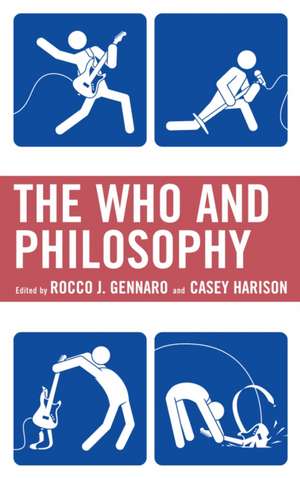
The Who and Philosophy: The Philosophy of Popular Culture
Editat de Rocco J. Gennaro, Casey Harison Contribuţii de Scott Calef, Dan Dinello, Don Fallis, Catherine Villanueva Gardner, Russell L. Johnson, Christopher Ketcham, William M. Knoblauch, S. Evan Kreider, Greg Littmann, Robert McParland, Casey Rentmeester, Peter Smith, Steven D. Williams, M. Blake Wilson, Tom Zlabingeren Limba Engleză Hardback – 23 iun 2016



Preț: 586.26 lei
Preț vechi: 883.80 lei
-34%
Puncte Express: 879
Carte tipărită la comandă
Livrare economică 11-25 iunie
Specificații
ISBN-13: 9781498514477
ISBN-10: 1498514472
Pagini: 272
Ilustrații: 2 tables;
Dimensiuni: 157 x 239 x 25 mm
Greutate: 0.57 kg
Editura: Bloomsbury Publishing
Colecția Lexington Books
Seria The Philosophy of Popular Culture
Locul publicării:New York, United States
ISBN-10: 1498514472
Pagini: 272
Ilustrații: 2 tables;
Dimensiuni: 157 x 239 x 25 mm
Greutate: 0.57 kg
Editura: Bloomsbury Publishing
Colecția Lexington Books
Seria The Philosophy of Popular Culture
Locul publicării:New York, United States
Cuprins
Introduction
by Rocco J. Gennaro and Casey Harison
Part I-"I Can't Explain": Mod Culture
Chapter 1. The Who and "My Generation": Philosophical Recollections of a Former Second Wave Mod
by Catherine Villanueva Gardner
Chapter 2. All Mod Cons: The Who and Rock 'n' Roll Authenticity
by Steven D. Williams
Part II-"We're Not Going to Take It": Alienation and Angst
Chapter 3. "I've Had Enough": The Who and Social Revolution
by Casey Rentmeester and William Knoblauch
Chapter 4. Who's That Outside?
by Greg Littmann
Chapter 5. To the Sea and Sand: Quadrophenia - An Interpretation
by Robert McParland
Chapter 6. Fiddling about Becoming a Man
by Christopher Ketcham
Part III-"The Real Me": Consciousness, Disorders, and Deception
Chapter 7. "See Me, Feel Me, Touch Me" - Know Me: Rationalism vs Empiricism in Tommy
by Russell L. Johnson
Chapter 8. What Does Tommy Feel?: The Aesthetic Experience of a Deaf, Dumb, and Blind Kid
by S. Evan Kreider
Chapter 9. "He Only Comes out Wh
by Rocco J. Gennaro and Casey Harison
Part I-"I Can't Explain": Mod Culture
Chapter 1. The Who and "My Generation": Philosophical Recollections of a Former Second Wave Mod
by Catherine Villanueva Gardner
Chapter 2. All Mod Cons: The Who and Rock 'n' Roll Authenticity
by Steven D. Williams
Part II-"We're Not Going to Take It": Alienation and Angst
Chapter 3. "I've Had Enough": The Who and Social Revolution
by Casey Rentmeester and William Knoblauch
Chapter 4. Who's That Outside?
by Greg Littmann
Chapter 5. To the Sea and Sand: Quadrophenia - An Interpretation
by Robert McParland
Chapter 6. Fiddling about Becoming a Man
by Christopher Ketcham
Part III-"The Real Me": Consciousness, Disorders, and Deception
Chapter 7. "See Me, Feel Me, Touch Me" - Know Me: Rationalism vs Empiricism in Tommy
by Russell L. Johnson
Chapter 8. What Does Tommy Feel?: The Aesthetic Experience of a Deaf, Dumb, and Blind Kid
by S. Evan Kreider
Chapter 9. "He Only Comes out Wh
Recenzii
The editors Gennaro and Harison.have successfully compiled a selection of texts on a band and their followers who could only exist at that particular time. . . .Here we have a good compilation of texts that will appeal to anybody interested in popular music, British bands of the 1960s and of course The Who.
It isn't their over-the-top stage moves or musical chops that made The Who the embodiment of their generation-youth of the Sixties. Rather, it was their verbal focus on expressing oneself authentically, the passion of the era. Authenticity was the theme of their hit songs (like "Behind Blue Eyes," "The Real Me," "I Can't Explain," "See Me, Feel Me," and "Substitute"), in the title of their 1968 album "The Who Sell Out;" and expressed by Townshend in innumerable interviews. Authenticity, and its barriers, was also central to the works of Kierkegaard, Nietzsche, Heidegger, and the philosophers most influential to young Brits in the 1960s, the French existentialists, Sartre and Camus. Discussing the philosophical underpinnings and relationships between the work of this popular and influential rock band and a set of great modern philosophers, this long overdue volume provides a deeper understanding of both.
What a terrific book! Harison and Gennaro have assembled a wide-ranging collection of essays spanning the academic, the intellectual and what is oftentimes just plain fun. Any deep fan of the Who has spent plenty of time reading into the band's Mod antecedents, the symbolism of violence in the destruction of their instruments on stage, Townshend's simultaneous striving for the power and permanence of opera while insisting that pop music is ephemeral, and how Meher Baba has lain a continuing religious thread through Townshend's musical ideas. This book is for that fan, and anyone trying to look for their own philosophical thread running through the songs and career of rock music's most philosophically adventurous act.
It isn't their over-the-top stage moves or musical chops that made The Who the embodiment of their generation-youth of the Sixties. Rather, it was their verbal focus on expressing oneself authentically, the passion of the era. Authenticity was the theme of their hit songs (like "Behind Blue Eyes," "The Real Me," "I Can't Explain," "See Me, Feel Me," and "Substitute"), in the title of their 1968 album "The Who Sell Out;" and expressed by Townshend in innumerable interviews. Authenticity, and its barriers, was also central to the works of Kierkegaard, Nietzsche, Heidegger, and the philosophers most influential to young Brits in the 1960s, the French existentialists, Sartre and Camus. Discussing the philosophical underpinnings and relationships between the work of this popular and influential rock band and a set of great modern philosophers, this long overdue volume provides a deeper understanding of both.
What a terrific book! Harison and Gennaro have assembled a wide-ranging collection of essays spanning the academic, the intellectual and what is oftentimes just plain fun. Any deep fan of the Who has spent plenty of time reading into the band's Mod antecedents, the symbolism of violence in the destruction of their instruments on stage, Townshend's simultaneous striving for the power and permanence of opera while insisting that pop music is ephemeral, and how Meher Baba has lain a continuing religious thread through Townshend's musical ideas. This book is for that fan, and anyone trying to look for their own philosophical thread running through the songs and career of rock music's most philosophically adventurous act.