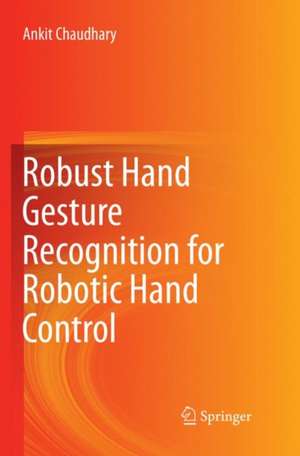
Robust Hand Gesture Recognition for Robotic Hand Control
Autor Ankit Chaudharyen Limba Engleză Paperback – 30 ian 2019
Resursele tehnice și algoritmii prezentați în Robust Hand Gesture Recognition for Robotic Hand Control oferă o soluție solidă pentru una dintre cele mai mari provocări în viziunea artificială: recunoașterea gesturilor în condiții de iluminare variabilă. Apreciem abordarea autorului Ankit Chaudhary, care propune un sistem de preprocesare bazat pe un algoritm de decupare a imaginii, asigurând astfel că doar zona de interes este analizată. Punctul forte al volumului rezidă în utilizarea histogramelor de orientare pentru extragerea vectorilor de caracteristici, o metodă care garantează că aceeași mișcare este mapată identic indiferent de intensitatea luminii ambientale.
Ca și Amit Konar în Gesture Recognition, autorul distilează experiență reală în principii acționabile, trecând de la teoria segmentării la implementarea rețelelor neuronale supervizate pentru o precizie sporită. Structura cărții este riguros organizată în nouă capitole, începând cu stabilirea obiectivelor științifice și stadiul actual al tehnicii (State of the Art), continuând cu detalii matematice despre detecția vârfurilor degetelor și terminând cu metode avansate pentru calculul unghiurilor ambelor mâini simultan. Această progresie logică transformă volumul într-un ghid tehnic indispensabil pentru configurarea sistemelor de control la distanță.
În contextul operei sale, această lucrare completează cercetările din Computer Vision and Recognition Systems Using Machine and Deep Learning Approaches, unde Ankit Chaudhary a explorat concepte fundamentale de învățare profundă. Aici, el aplică acele metodologii într-un context hardware specific: controlul mâinilor robotice electro-mecanice prin senzori webcam sau KINECT, oferind inginerilor instrumentele necesare pentru a replica mișcarea umană în medii de risc, precum cele militare sau de urgență.
Preț: 607.49 lei
Preț vechi: 714.70 lei
-15%
Carte disponibilă
Livrare economică 17 noiembrie-01 decembrie
Specificații
ISBN-10: 9811352348
Pagini: 96
Ilustrații: XXI, 96 p. 67 illus., 54 illus. in color.
Dimensiuni: 155 x 235 mm
Greutate: 0.18 kg
Ediția:Softcover reprint of the original 1st ed. 2018
Editura: Springer Nature Singapore
Colecția Springer
Locul publicării:Singapore, Singapore
V-ar putea interesa
-
 Hand SurgeryDavid Warwick-5%Preț: 365.31 lei384.54 lei
 -
 Sabiston Textbook of Surgery: The Biological Basis of Modern Surgical PracticeDouglas Scott Tyler-28%Preț: 1180.35 lei1644.95 leiRecomandat
 -
 Hand, Hand, Fingers, ThumbAl PerkinsPreț: 35.03 lei
 -
 Radiographic Atlas of Skeletal Development of the Hand and WristWilliam Greulich-5%Preț: 1331.54 lei1401.63 lei
 -
 The Big Book of RobotsCampbell BooksPreț: 84.16 lei
 -
 Introduction to Robotics, Global EditionJohn Craig-9%Preț: 596.70 lei655.72 lei
 -
 Preț: 330.77 lei
 -
 -21%Preț: 235.23 lei296.95 lei
 -
 -18%Preț: 105.56 lei128.98 leiRecomandat
 -
 Handbook of Fractures: Print + eBook with MultimediaKENNETH A. EGOL MD-21%Preț: 537.27 lei677.30 lei
 -
 Handbook of Image Processing and Computer VisionArcangelo Distante-20%Preț: 1471.45 lei1839.31 lei
 -
 Preț: 434.53 lei
 -
 -24%Preț: 737.04 lei969.80 lei
 -
 Advances in Computational Vision and RoboticsGeorge A. Tsihrintzis-18%Preț: 1455.52 lei1775.02 lei
 -
 Imaging of the Hand and WristMark Davies-5%Preț: 1241.57 lei1306.91 lei
 -
 -15%Preț: 671.61 lei790.12 lei
 -
 -20%Preț: 325.79 lei407.24 lei
 -
 Learn to Draw Hands with 50 ModelsNiels RomanPreț: 70.94 lei
 -
 -24%Preț: 1183.73 lei1557.53 lei
 -
 Human Motion Awareness and Robot TeleoperationHonghao Lyu-18%Preț: 1148.15 lei1400.19 lei
De ce să citești această carte
Recomandăm această carte inginerilor și cercetătorilor care dezvoltă sisteme de control robotic în timp real. Cititorul câștigă o metodologie clară pentru invarianța la lumină și algoritmi preciși de calcul geometric al unghiurilor degetelor. Este un instrument practic esențial pentru cei care doresc să implementeze interfețe gestuale robuste folosind echipamente accesibile, precum camerele web sau senzorii KINECT, fără a sacrifica acuratețea în medii dinamice.
Despre autor
Ankit Chaudhary este un cercetător recunoscut în domeniul viziunii computerizate și al sistemelor de recunoaștere, cu o expertiză vastă în aplicarea tehnicilor de Machine Learning și Deep Learning. Activitatea sa academică și editorială acoperă spectrul tehnologiilor emergente, de la analiza datelor prin IoT în industria sănătății, așa cum este prezentat în IoT-Based Data Analytics for the Healthcare Industry, până la dezvoltarea de metodologii complexe pentru recunoașterea formelor. Lucrările sale sunt caracterizate printr-o punte solidă între algoritmii teoretici și aplicațiile industriale practice, fiind publicate sub egida unor edituri de prestigiu precum Springer.
Descriere scurtă
An approach to controlling electro-mechanical robotic hands using dynamic hand gestures is also presented using a robot simulator. Such robotic hands have applications in commercial, military or emergency operations where human life cannot be risked. For such applications, an artificial robotic hand is required to perform real-time operations. This robotic hand should be able to move its fingers in the same manner as a human hand. For this purpose, hand geometry parameters are obtained using a webcam and also using KINECT. The parameter detection is direction invariant in both methods. Once the hand parameters are obtained, the fingers’ angle information is obtained by performing a geometrical analysis. An artificial neural network is also implemented to calculate the angles. These two methods can be used with only one hand, either right or left. A separate method that is applicable to both hands simultaneously is also developed and fingers angles are calculated. The contents of this book will be useful for researchers and professional engineers working on robotic arm/hand systems.
Cuprins
Notă biografică
Having authored sixty research publications and edited one book, Dr. Chaudhary is an Associate Editor for Computers and Electrical Engineering and serves on the Editorial Boards of several international journals. He is also a reviewer for numerous journals, including IEEE Transactions on Image Processing, IET Image Processing, Machine Vision and Applications, and Robotics and Autonomous Systems. In the past, Dr. Chaudhary was associated with the University of Iowa’s Department of Electrical and Computer Engineering and the Department of Computer Science BITS Pilani, also working as a Visiting Faculty/researcher at many research laboratories.