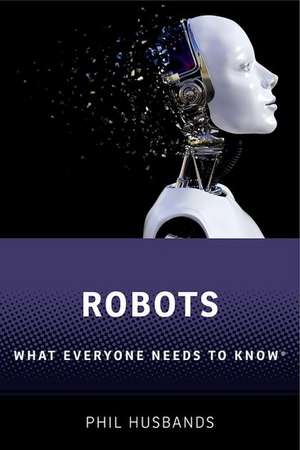
Robots: What Everyone Needs to Know®: What Everyone Needs To Know®
Autor Phil Husbandsen Limba Engleză Paperback – 28 oct 2021
Din seria What Everyone Needs To Know®
- 18%
 Preț: 77.11 lei
 - 23%
 Preț: 76.90 lei
 - 18%
 Preț: 76.65 lei
 - 18%
 Preț: 77.13 lei
 - 20%
 Preț: 335.20 lei
 -
 Preț: 110.68 lei
 - 18%
 Preț: 76.49 lei
 - 19%
 Preț: 63.88 lei
 - 19%
 Preț: 74.90 lei
 - 21%
 Preț: 81.41 lei
 - 35%
 Preț: 64.76 lei
 - 17%
 Preț: 79.70 lei
 - 18%
 Preț: 77.81 lei
 - 17%
 Preț: 78.60 lei
 - 18%
 Preț: 77.37 lei
 - 23%
 Preț: 77.12 lei
 - 35%
 Preț: 64.20 lei
 - 19%
 Preț: 74.90 lei
 - 21%
 Preț: 325.94 lei
 - 19%
 Preț: 75.25 lei
 - 18%
 Preț: 65.26 lei
 - 17%
 Preț: 66.83 lei
 - 18%
 Preț: 64.94 lei
 - 24%
 Preț: 63.01 lei
 - 22%
 Preț: 271.36 lei
 - 22%
 Preț: 296.70 lei
 - 21%
 Preț: 417.34 lei
 - 22%
 Preț: 289.82 lei
 - 22%
 Preț: 297.80 lei
 - 19%
 Preț: 63.00 lei
 - 21%
 Preț: 312.11 lei
 - 22%
 Preț: 287.35 lei
 - 18%
 Preț: 63.08 lei
 - 16%
 Preț: 67.32 lei
 - 20%
 Preț: 63.11 lei
 - 21%
 Preț: 347.82 lei
 - 19%
 Preț: 61.78 lei
 - 18%
 Preț: 64.44 lei
 - 22%
 Preț: 324.20 lei
 - 21%
 Preț: 313.63 lei
Preț: 80.24 lei
Preț vechi: 99.83 lei
-20%
Puncte Express: 120
Carte disponibilă
Livrare economică 06-11 noiembrie
Livrare express 23-29 octombrie pentru 39.95 lei
Livrare prin curier în România Termenul estimat este afișat lângă disponibilitate.
Transport gratuit de la 400.00 lei Plată online sau ramburs, în funcție de opțiunile comenzii.
Retur gratuit în 14 zile Comandă securizată și suport în română.
Specificații
ISBN-13: 9780198845393
ISBN-10: 0198845391
Pagini: 208
Ilustrații: 8 black and white images
Dimensiuni: 141 x 209 x 15 mm
Greutate: 0.22 kg
Editura: OUP OXFORD
Colecția OUP Oxford
Seria What Everyone Needs To Know®
Locul publicării:Oxford, United Kingdom
ISBN-10: 0198845391
Pagini: 208
Ilustrații: 8 black and white images
Dimensiuni: 141 x 209 x 15 mm
Greutate: 0.22 kg
Editura: OUP OXFORD
Colecția OUP Oxford
Seria What Everyone Needs To Know®
Locul publicării:Oxford, United Kingdom
V-ar putea interesa
-
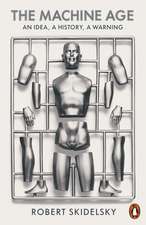 The Machine AgeRobert SkidelskyPreț: 80.00 lei
 -
 The New Breed: How to Think About RobotsKate Darling-35%Preț: 55.43 lei84.78 lei
 -
 How To Think About AI: A Guide For The PerplexedRichard Susskind-34%Preț: 66.27 lei100.73 lei
 -
 In Robots We TrustSamuele Vinanzi-16%Preț: 147.25 lei175.17 lei
 -
 Robotics: A Very Short IntroductionAlan Winfield-20%Preț: 57.12 lei71.12 lei
 -
 -25%Preț: 93.65 lei125.53 lei
 -
 Moral AIJana Schaich BorgPreț: 78.63 lei
 -
 Robot EthicsMark Coeckelbergh-16%Preț: 92.16 lei109.62 lei
 -
 Living with RobotsRuth AylettPreț: 157.79 lei
 -
 If Anyone Builds It, Everyone DiesEliezer Yudkowsky-20%Preț: 130.65 lei163.30 lei
 -
 The Technological SocietyJacques EllulPreț: 91.29 lei
 -
 Against the MachinePaul KingsnorthPreț: 193.57 lei
 -
 AI 2041Kai-Fu Lee-28%Preț: 77.51 lei108.27 lei
 -
 Talking to Robots: How Humans and Machines Will Live Together in the FutureDavid Ewing Duncan-20%Preț: 81.16 lei101.58 lei
 -
 -18%Preț: 64.94 lei78.99 lei
 -
 The Singularity is NearerRay KurzweilPreț: 94.17 lei
 -
 -24%Preț: 157.25 lei206.72 lei
 -
 Hello, RobotMateo Kries-8%Preț: 403.90 lei439.02 lei
Recenzii
The book is accessible, and readers can expect to learn much from it. Husbands has given us a historically informed introduction to robotics, rooted in technological reality and dismissing futuristic hype.
Notă biografică
Phil Husbands is Research Professor of Artificial Intelligence at the University of Sussex. He has been a leading researcher in AI, Robotics and Artificial Life for more than 30 years. He is one of the originators of the field of evolutionary robotics, was founding co-director of the Sussex Centre for Computational Neuroscience and Robotics and has worked extensively with industry. His research is wide ranging but centres on adaptive systems in robotics, AI and neuroscience. He is also a historian of AI and cybernetics.