Robotics Goes MOOC
Editat de Bruno Sicilianoen Limba Engleză Paperback – 14 iun 2025
To make robots and intelligent machines useful to humans it is necessary to have a broad and tight intersection between Robotics and AI. Sophisticated mathematical models are needed that enable the robot from a physical point of view, as well as intelligent algorithms capable of correlating all the information coming from the use of technologically advanced sensors with the data available from experience. It is expected that the synergy of model-based techniques with data-driven approaches will contribute to increasing the level of autonomy of robots and intelligent machines in the near future.
The first book of the Robotics Goes MOOC project starts with the journey of robotics in the introductory chapter by Khatib, who has pioneered our field of robotics and has ferried it to the third millennium. Sensing is crucial for the development of intelligent and autonomous robots, as covered in Chapter 2 by Nüchter et al. Model-based control is dealt with in Chapter 3 by Kröeger et al along with motion planning, as well as in Chapter 4 by Villani and Chapter 5 by Chaumette to handle force and visual feedback, respectively, when interacting with the environment. Resorting to AI techniques is the focus of the last part of the book, namely, Chapter 6 by Peters et al on Learning, Chapter 7 byBeetz et al on knowledge representation and reasoning, and Chapter 8 by Burgard et al on graph-based SLAM.
Preț: 476.00 lei
Preț vechi: 560.00 lei
-15%
Puncte Express: 714
Carte disponibilă
Livrare economică 05-19 iunie
Livrare express 22-28 mai pentru 34.33 lei
Specificații
ISBN-13: 9783319740942
ISBN-10: 3319740946
Pagini: 308
Ilustrații: Approx. 200 p.
Dimensiuni: 155 x 235 x 17 mm
Greutate: 0.47 kg
Ediția:2024
Editura: Palgrave MacMillan
Locul publicării:Cham, Switzerland
ISBN-10: 3319740946
Pagini: 308
Ilustrații: Approx. 200 p.
Dimensiuni: 155 x 235 x 17 mm
Greutate: 0.47 kg
Ediția:2024
Editura: Palgrave MacMillan
Locul publicării:Cham, Switzerland
V-ar putea interesa
-
 Robots: What Everyone Needs to Know®Phil Husbands-21%Preț: 72.54 lei91.59 lei
 -
 -25%Preț: 93.65 lei125.53 lei
 -
 Introduction to Autonomous Mobile RobotsDavide Scaramuzza-14%Preț: 578.83 lei673.06 lei
 -
 Principles of Robot MotionGeorge A. Kantor-14%Preț: 565.02 lei657.01 lei
 -
 Living with RobotsRuth AylettPreț: 134.87 lei
 -
 So That's How It Works! Robots and AITom Jackson-40%Preț: 56.74 lei95.30 lei
 -
 -20%Preț: 700.41 lei875.51 lei
 -
 The Big Book of RobotsCampbell BooksPreț: 82.86 lei
 -
 Robot Modeling and ControlM. Vidyasagar-23%Preț: 858.40 lei1114.80 lei
 -
 Introduction to Robotics, Global EditionJohn Craig-15%Preț: 567.49 lei667.63 lei
 -
 MechatronicsW. Bolton-15%Preț: 664.82 lei782.14 lei
 -
 The LEGO MINDSTORMS EV3 LaboratoryDaniele Benedettelli-20%Preț: 201.55 lei252.26 lei
 -
 Frontiers in Robotics ResearchMax A Denket-30%Preț: 1364.51 lei1962.09 lei
 -
 -18%Preț: 1064.66 lei1298.37 lei
 -
 -15%Preț: 624.56 lei734.78 lei
 -
 Springer Handbook of RoboticsBruno Siciliano-18%Preț: 2484.66 lei3030.07 lei
 -
 Preț: 361.70 lei
 -
 The Science of Soft RobotsKoichi Suzumori-20%Preț: 569.10 lei711.38 lei
Cuprins
1 Oussama Khatib, The Journey of Robotics.- 2 Dorit Borrmann and Andreas Nüchter, Sensing and Estimation.- 3 Lars Berscheid and Torsten Kröger, Control and Motion Planning.- 4 Luigi Villani, Force Control.- 5 Francois Chaumette, Visual Control.- 6 Joe Watson, Julen Urain, Joao Carvalho, Niklas Funk and Jan Peters, Learning.- 7 Michael Beetz and Daniel Nyga, Knowledge Representation and Reasoning- 8 Giorgio Grisetti, Rainer Kuemmerle, Cyrill Stachniss and Wolfram Burgard, Graph-Based SLAM.
Notă biografică
Bruno Siciliano received his doctorate degree in Electronic Engineering from the University of Naples, Italy, in 1987. He is a professor of Control and Robotics at the University of Naples Federico II. His research focuses on methodologies and technologies in industrial and service robotics, including force and visual control, cooperative robots, human-robot interaction, and aerial manipulation. He has co-authored 6 books and over 300 journal papers, conference papers and book chapters. He has delivered more than 20 keynote presentations and over 100 colloquia and seminars at institutions around the world. He is a fellow of IEEE, ASME and IFAC, and co-editor of the Springer Tracts in Advanced Robotics (STAR) series and the Springer Handbook of Robotics, which received the PROSE Award for Excellence in Physical Sciences & Mathematics and was also the winner in the category Engineering & Technology. He has served on the editorial boards of prestigious journals, as well as chair orco-chair for numerous international conferences. Professor Siciliano is the past president of the IEEE Robotics and Automation Society (RAS). He has been the recipient of several awards, including the IEEE RAS George Saridis Leadership Award in Robotics and Automation and the IEEE RAS Distinguished Service Award.
Textul de pe ultima copertă
The robot “concept” was clearly established by those many creative historical realizations, such as those recalled above. Nonetheless, the emergence of the “physical” robot had to await the advent of its underlying technologies of mechanics, controls, computers, electronics and sensors ―in one word, mechatronics― during the course of the twentieth century. As always, new designs motivate new research and discoveries which, in turn, lead to enhanced solutions and thus to novel concepts. This virtuous circle over time produced that knowledge and understanding which gave birth to the field of Robotics, properly referred to as the science and technology of robots.
To make robots and intelligent machines useful to humans it is necessary to have a broad and tight intersection between Robotics and AI. Sophisticated mathematical models are needed that enable the robot from a physical point of view, as well as intelligent algorithms capable of correlating all the information coming from the use of technologically advanced sensors with the data available from experience. It is expected that the synergy of model-based techniques with data-driven approaches will contribute to increasing the level of autonomy of robots and intelligent machines in the near future.
The first book of the Robotics Goes MOOC project starts with the journey of robotics in the introductory chapter by Khatib, who has pioneered our field of robotics and has ferried it to the third millennium. Sensing is crucial for the development of intelligent and autonomous robots, as covered in Chapter 2 by Nüchter et al. Model-based control is dealt with in Chapter 3 by Kröeger et al along with motion planning, as well as in Chapter 4 by Villani and Chapter 5 by Chaumette to handle force and visual feedback, respectively, when interacting with the environment. Resorting to AI techniques is the focus of the last part of the book, namely, Chapter 6 by Peters et al on Learning, Chapter 7 by Beetzet al on knowledge representation and reasoning, and Chapter 8 by Burgard et al on graph-based SLAM.
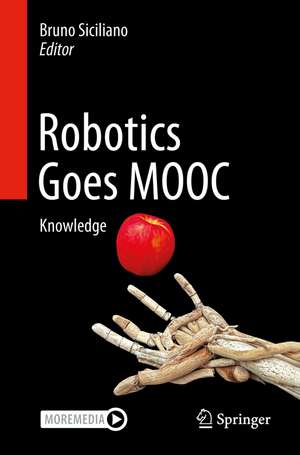
The image on the cover metaphorically illustrates the knowledge paradigm of robotics through a hand trying to catch an apple.
The content published here are linked to a series of MOOCs on Robotics specifically created and hosted by Federica Web Learning. You can access the related content via our app: download the SN More Media app for free, scan the link and access directly to the online courses on your smartphone or tablet.
To make robots and intelligent machines useful to humans it is necessary to have a broad and tight intersection between Robotics and AI. Sophisticated mathematical models are needed that enable the robot from a physical point of view, as well as intelligent algorithms capable of correlating all the information coming from the use of technologically advanced sensors with the data available from experience. It is expected that the synergy of model-based techniques with data-driven approaches will contribute to increasing the level of autonomy of robots and intelligent machines in the near future.
The first book of the Robotics Goes MOOC project starts with the journey of robotics in the introductory chapter by Khatib, who has pioneered our field of robotics and has ferried it to the third millennium. Sensing is crucial for the development of intelligent and autonomous robots, as covered in Chapter 2 by Nüchter et al. Model-based control is dealt with in Chapter 3 by Kröeger et al along with motion planning, as well as in Chapter 4 by Villani and Chapter 5 by Chaumette to handle force and visual feedback, respectively, when interacting with the environment. Resorting to AI techniques is the focus of the last part of the book, namely, Chapter 6 by Peters et al on Learning, Chapter 7 by Beetzet al on knowledge representation and reasoning, and Chapter 8 by Burgard et al on graph-based SLAM.
The image on the cover metaphorically illustrates the knowledge paradigm of robotics through a hand trying to catch an apple.
The content published here are linked to a series of MOOCs on Robotics specifically created and hosted by Federica Web Learning. You can access the related content via our app: download the SN More Media app for free, scan the link and access directly to the online courses on your smartphone or tablet.
Caracteristici
Comprehensive reference book on robotics with MOOC supplement Additional multimedia content accessible in browser or via SN More Media App Provides numerous examples and exercises for senior graduate and PhD level students