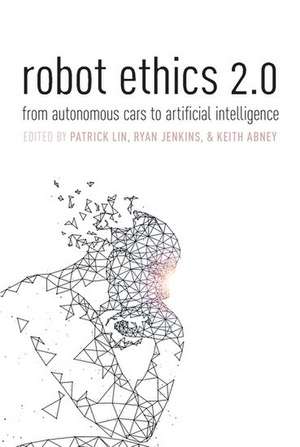
Robot Ethics 2.0: From Autonomous Cars to Artificial intelligence
Editat de Patrick Lin, Ryan Jenkins, Keith Abneyen Limba Engleză Paperback – 30 ian 2020
Preț: 212.54 lei
Preț vechi: 251.26 lei
-15%
Puncte Express: 319
Carte tipărită la comandă
Livrare economică 27 noiembrie-02 decembrie
Livrare prin curier în România Termenul estimat este afișat lângă disponibilitate.
Transport gratuit de la 400.00 lei Plată online sau ramburs, în funcție de opțiunile comenzii.
Retur gratuit în 14 zile Comandă securizată și suport în română.
Specificații
ISBN-13: 9780197503584
ISBN-10: 0197503586
Pagini: 440
Dimensiuni: 155 x 231 x 25 mm
Greutate: 0.61 kg
Editura: Oxford University Press
Colecția OUP USA
Locul publicării:New York, United States
ISBN-10: 0197503586
Pagini: 440
Dimensiuni: 155 x 231 x 25 mm
Greutate: 0.61 kg
Editura: Oxford University Press
Colecția OUP USA
Locul publicării:New York, United States
V-ar putea interesa
-
 -34%Preț: 584.07 lei888.00 lei
 -
 Preț: 278.27 lei
 -
 -24%Preț: 571.05 lei755.13 lei
 -
 Consciousness and Moral ResponsibilityNeil Levy-29%Preț: 390.70 lei546.55 lei
 -
 Utilitarianism: A Very Short IntroductionKatarzyna de Lazari-Radek-20%Preț: 57.12 lei71.12 lei
 -
 -31%Preț: 590.64 lei855.00 lei
 -
 Virtue and Law in Plato and BeyondJulia Annas-29%Preț: 536.74 lei751.61 lei
 -
 Neuroethics: Anticipating the futureJudy Illes-30%Preț: 818.15 lei1174.82 lei
 -
 -31%Preț: 556.48 lei807.13 lei
 -
 -28%Preț: 374.87 lei522.91 lei
 -
 -22%Preț: 285.24 lei366.19 lei
 -
 -18%Preț: 251.78 lei306.80 lei
 -
 Philosophical Progress: In Defence of a Reasonable OptimismDaniel Stoljar-30%Preț: 404.73 lei578.24 lei
 -
 Oxford Studies in Metaethics 12Russ Shafer-Landau-19%Preț: 300.26 lei368.76 lei
 -
 -31%Preț: 642.99 lei926.34 lei
 -
 Doing and Allowing HarmFiona Woollard-31%Preț: 608.80 lei882.31 lei
 -
 Ethical LifeWebb KeanePreț: 213.90 lei
 -
 Thinking about BriberyPhilip Nichols-27%Preț: 280.60 lei383.39 lei
 -
 Moral and Political Conceptions of Human RightsReidar Maliks-14%Preț: 746.46 lei867.98 lei
 -
 The Cambridge Handbook of Evolutionary EthicsMichael RusePreț: 252.58 lei
 -
 -15%Preț: 459.23 lei540.27 lei
 -
 The Blackwell Guide to Kant's EthicsThomas E. HillPreț: 359.51 lei
 -
 Preț: 249.03 lei
Recenzii
Robot Ethics 2.0 is worth your attention even if you are not a professional in the field...a decent amount of articles are well-written and will definitely enrich the research on robot ethics.
They have done an admirable job of organ-izing the material on a wide range of topics, and 2.0 provides a useful addition to 1.0 for exploring the new debates in this field.
The philosophy of technology, particularly its ethics, carries a heavy burden right now. This book is an excellent guide to the reasons why that burden is so pressing, and... offers a really strong roadmap of where we are, and where we ought to go.
They have done an admirable job of organ-izing the material on a wide range of topics, and 2.0 provides a useful addition to 1.0 for exploring the new debates in this field.
The philosophy of technology, particularly its ethics, carries a heavy burden right now. This book is an excellent guide to the reasons why that burden is so pressing, and... offers a really strong roadmap of where we are, and where we ought to go.
Notă biografică
Patrick Lin, Ph.D., is a philosophy professor and Director of the Ethics + Emerging Sciences Group at California Polytechnic State University. He is also affiliated with Stanford Law School, University of Notre Dame, and World Economic Forum; and previously with Stanford's School of Engineering, the U.S. Naval Academy, and Dartmouth College. On the ethics of emerging technologies, he has provided counsel to the U.S. Department of Defense, the United Nations, Google, Apple, and many other government and industry organizations.Ryan Jenkins, Ph.D., is an assistant professor of philosophy and a Senior Fellow at the Ethics + Emerging Sciences Group at California Polytechnic State University. He focuses on normative ethics (especially consequentialism) and applied ethics, including military ethics and emerging technologies such as driverless cars, robots, and autonomous weapons.Keith Abney, A.B.D., is senior lecturer in the Philosophy Department and a Senior Fellow at the Ethics +Emerging Sciences Group at California Polytechnic State University, with research that includes work on demarcating science from non-science, moral status and sustainability, astronaut and space bioethics, patenting life, human enhancement, just war theory and the use of autonomous weapons, robot ethics, and other aspects of the ethical implications of emerging sciences and technologies
Cuprins
- Preface
- I. Moral and Legal Responsibility
- 1. Autonomous Vehicles and Moral Uncertainty Vikram Bhargava and Tae Wan Kim
- 2. Ethics Settings for Autonomous Vehicles Jason Millar
- 3. Autonomy and Responsibility in Hybrid Systems: The Example of Autonomous Cars Wulf Loh and Janina Sombetzki
- 4. Imputing Driverhood: Applying a Reasonable Driver Standard to Accidents Caused by Autonomous Vehicles Jeffery K. Gurney
- 5. Liability Law for Present and Future Robotics Technology Trevor N. White and Seth D. Baum
- 6. Skilled Perception, Authenticity, and the Case Against Automation David Zoller
- II. Trust and Human-Robot Interactions
- 7. Could a Robot Care? It's All in the Movement Darian Meacham and Matthew Studley
- 8. Robot Friends for Autistic Children: Monopoly Money or Counterfeit Currency? Alexis Elder
- 9. Pediatric Robotics and Ethics: The Robot Is Ready to See You Now, But Should It Be Trusted? Jason Borenstein, Ayanna Howard, and Alan R. Wagner
- 10. Trust and Human-Robot Interactions Jesse Kirkpatrick, Erin N. Hahn, and Amy J. Haufler
- 11. White Lies on Silver Tongues: Why Robots Need to Deceive (and How) Alistair M. C. Isaac and Will Bridewell
- 12. "Who's Johnny?" Anthropomorphic Framing in Human-Robot Interaction, Integration, and Policy Kate Darling
- III. Applications: From Love to War
- 13. Lovotics: Human-Robot Love and Sex Relationships Adrian David Cheok, Kasun Karunanayaka, and Emma Yann Zhang
- 14. Church-Turing Lovers Piotr Boltuc
- 15. The Internet of Things and Dual Layers of Ethical Concern Adam Henschke
- 16. Challenges to Engineering Moral Reasoners: Time and Context Michal Klincewicz
- 17. When Robots Should Do the Wrong Thing Brian Talbot, Ryan Jenkins, and Duncan Purves
- 18. Military Robots and the Likelihood of Armed Combat Leonard Kahn
- IV. The Future of AI and Robotics
- 19. Testing the Moral Status of Artificial Beings, or "I'm Going to Ask You Some Questions" Michael LaBossiere
- 20. Artificial Identity James DiGiovanna
- 21. Superintelligence as Superethical Steve Petersen
- 22. Artificial Intelligence and the Ethics of Self-Learning Robots Shannon Vallor and George Bekey
- 23. Robots and Space Ethics Keith Abney
- 24. On the Unabomber and Robots: The Need for a Philosophy of Technology Geared Toward Human Ends Jai Galliott
- Biosketches