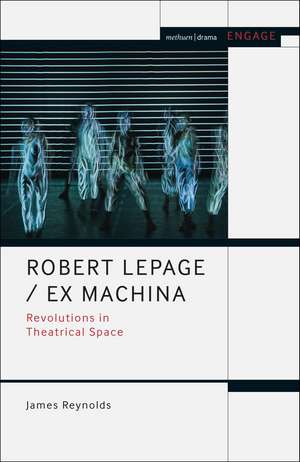
Robert Lepage / Ex Machina: Revolutions in Theatrical Space: Methuen Drama Engage
Autor Dr James Reynolds Prof. Enoch Brater, Mark Taylor-Battyen Limba Engleză Hardback – 7 feb 2019
Din seria Methuen Drama Engage
- 25%
 Preț: 249.42 lei
 - 26%
 Preț: 185.21 lei
 - 16%
 Preț: 248.44 lei
 - 15%
 Preț: 200.22 lei
 - 27%
 Preț: 242.70 lei
 - 33%
 Preț: 612.18 lei
 - 25%
 Preț: 260.54 lei
 - 25%
 Preț: 241.01 lei
 - 25%
 Preț: 253.73 lei
 - 33%
 Preț: 580.60 lei
 -
 Preț: 189.58 lei
 - 19%
 Preț: 196.98 lei
 - 24%
 Preț: 251.22 lei
 -
 Preț: 215.35 lei
 - 25%
 Preț: 240.81 lei
 - 33%
 Preț: 581.20 lei
 - 16%
 Preț: 193.28 lei
 - 35%
 Preț: 622.54 lei
 -
 Preț: 383.45 lei
 - 33%
 Preț: 581.47 lei
 - 16%
 Preț: 197.87 lei
 - 17%
 Preț: 195.73 lei
 - 23%
 Preț: 355.92 lei
 - 27%
 Preț: 233.60 lei
 - 25%
 Preț: 721.03 lei
 - 25%
 Preț: 249.73 lei
 - 20%
 Preț: 192.19 lei
 - 33%
 Preț: 591.47 lei
 - 14%
 Preț: 613.23 lei
 - 33%
 Preț: 654.91 lei
 - 15%
 Preț: 295.35 lei
Preț: 623.19 lei
Preț vechi: 925.11 lei
-33%
Puncte Express: 935
Carte tipărită la comandă
Livrare economică 30 noiembrie-14 decembrie
Livrare prin curier în România Termenul estimat este afișat lângă disponibilitate.
Transport gratuit pentru acest produs Plată online sau ramburs, în funcție de opțiunile comenzii.
Retur gratuit în 14 zile Comandă securizată și suport în română.
Specificații
ISBN-13: 9781474276092
ISBN-10: 1474276091
Pagini: 256
Ilustrații: 12 bw illus
Dimensiuni: 138 x 216 mm
Greutate: 0.44 kg
Editura: Bloomsbury Publishing
Colecția Methuen Drama
Seria Methuen Drama Engage
Locul publicării:London, United Kingdom
ISBN-10: 1474276091
Pagini: 256
Ilustrații: 12 bw illus
Dimensiuni: 138 x 216 mm
Greutate: 0.44 kg
Editura: Bloomsbury Publishing
Colecția Methuen Drama
Seria Methuen Drama Engage
Locul publicării:London, United Kingdom
V-ar putea interesa
-
 The Empty SpacePeter Brook-27%Preț: 56.93 lei77.92 lei
 -
 Digital PerformanceSteve DixonPreț: 436.41 lei
 -
 A Boal Companion: Dialogues on Theatre and Cultural PoliticsJan Cohen-Cruz-5%Preț: 444.56 lei467.95 lei
 -
 -8%Preț: 527.58 lei573.46 lei
 -
 Nagler, A: Source Book in Theatrical HistoryAlois Maria NaglerPreț: 199.22 lei
 -
 Brecht on TheatreBertolt BrechtPreț: 143.63 lei
 -
 Architecture For CultureBeatrice GrenierPreț: 342.12 lei
 -
 Philosophy, Analytic Aesthetics, and TheaterMichael Y. BennettPreț: 354.63 lei
 -
 Preț: 384.83 leiRecomandat
 -
 -26%Preț: 198.33 lei268.04 lei
 -
 Research and Development in British TheatreDr Tom Cantrell-11%Preț: 172.35 lei193.98 lei
 -
 A Beginner’s Guide to Directing TheatreRobert Marsden-10%Preț: 169.73 lei189.22 lei
 -
 -11%Preț: 159.06 lei178.30 lei
 -
 -18%Preț: 151.03 lei183.97 lei
 -
 New Dramaturgy: International Perspectives on Theory and PracticeKatalin Trencsényi-14%Preț: 236.99 lei274.38 lei
 -
 Flesh and TextSara GiddensPreț: 377.80 lei
 -
 Preț: 108.14 lei
 -
 -18%Preț: 309.95 lei380.00 lei
 -
 Preț: 362.53 lei
Cuprins
Acknowledgements
Introduction: Genesis
Ex Machina in brief
Revolutions in theatrical space
Architectural aesthetics
The road to Ex Machina
Learning curves
Foundations: la Caserne and the patenteux
Part One: Foundations and Stepping Stones (1994-1999)
Introduction
Chapter One: Lepagean Aesthetics
Discovering Japan's geo-poetry: Seven Streams of the River Ota
Turning the power of space into theatre
Contradiction as aesthetic key
Flagships
Counterpoint: A Dream Play
Chapter Two: Making Concrete Narratives
Ground work: The Geometry of Miracles
Concrete poetry
Making Narrative Concrete: Elsinore
Scenographic acting and the body politic
Concrete narratives - sublime effects
Critical condition
Form as cultural expression
Chapter Three: Critical Themes
Evolution
Turning point: the importance of Celestine
Class, contradiction and the antihero
The Damnation of Faust in Japan
Process, collaboration, authorship and directing
Cultural difference, cultural specificity
Part Two: Choosing All Directions (2000-2008)
Introduction
Chapter Four: Upgrades
Zulu Time: Q for Québec
Upgrading the Trilogy
The importance of Métissages
Making The Far Side of the Moon
Dramatic devices and the architecture of convergence
Chapter Five: Québec Stories
Art and politics: La Casa Azul and The Busker's Opera
Dance with three hands: Eonnagata
Narrative terms: the story of the story of the storyteller
KÀ: entertainment architecture
Writing the myth
Reading the circus
Chapter Six: New Ways
The Image Mill: all roads lead to home
Opera on tour: 1984 and The Rake's Progress
Ex Machina at the Metropolitan Opera
The Blue Dragon: character, culture and concrete narrative
Lipsynch: staging the scream
Process in process
Part Three: Starting Points (2008-2018)
Introduction
Chapter Seven: Critical Relationships
The Nightingale and Other Short Fables
Totem: evolving through the gift shop
Collaboration: Ex Machina and the Metropolitan Opera
Wagner, architectural aesthetics, and Der Ring des Nibelungen
Reviewing the Ring
The Tempest and L'Amour de Loin
Paying for art
Chapter Eight: Brave New Worlds
Virtual reality: The Library at Night
The Tempest: collaborating the nation
Hearts design
Writing Hearts
Concrete Hearts
Writing
Bet on red
Chapter Nine: Beginning
Frame by Frame
Upgrades
Making 887
Taking the narrative turn
Le Diamant
Coda
Notes
Bibliography
Index
Introduction: Genesis
Ex Machina in brief
Revolutions in theatrical space
Architectural aesthetics
The road to Ex Machina
Learning curves
Foundations: la Caserne and the patenteux
Part One: Foundations and Stepping Stones (1994-1999)
Introduction
Chapter One: Lepagean Aesthetics
Discovering Japan's geo-poetry: Seven Streams of the River Ota
Turning the power of space into theatre
Contradiction as aesthetic key
Flagships
Counterpoint: A Dream Play
Chapter Two: Making Concrete Narratives
Ground work: The Geometry of Miracles
Concrete poetry
Making Narrative Concrete: Elsinore
Scenographic acting and the body politic
Concrete narratives - sublime effects
Critical condition
Form as cultural expression
Chapter Three: Critical Themes
Evolution
Turning point: the importance of Celestine
Class, contradiction and the antihero
The Damnation of Faust in Japan
Process, collaboration, authorship and directing
Cultural difference, cultural specificity
Part Two: Choosing All Directions (2000-2008)
Introduction
Chapter Four: Upgrades
Zulu Time: Q for Québec
Upgrading the Trilogy
The importance of Métissages
Making The Far Side of the Moon
Dramatic devices and the architecture of convergence
Chapter Five: Québec Stories
Art and politics: La Casa Azul and The Busker's Opera
Dance with three hands: Eonnagata
Narrative terms: the story of the story of the storyteller
KÀ: entertainment architecture
Writing the myth
Reading the circus
Chapter Six: New Ways
The Image Mill: all roads lead to home
Opera on tour: 1984 and The Rake's Progress
Ex Machina at the Metropolitan Opera
The Blue Dragon: character, culture and concrete narrative
Lipsynch: staging the scream
Process in process
Part Three: Starting Points (2008-2018)
Introduction
Chapter Seven: Critical Relationships
The Nightingale and Other Short Fables
Totem: evolving through the gift shop
Collaboration: Ex Machina and the Metropolitan Opera
Wagner, architectural aesthetics, and Der Ring des Nibelungen
Reviewing the Ring
The Tempest and L'Amour de Loin
Paying for art
Chapter Eight: Brave New Worlds
Virtual reality: The Library at Night
The Tempest: collaborating the nation
Hearts design
Writing Hearts
Concrete Hearts
Writing
Bet on red
Chapter Nine: Beginning
Frame by Frame
Upgrades
Making 887
Taking the narrative turn
Le Diamant
Coda
Notes
Bibliography
Index
Recenzii
The 'revolutions' in the title of this exhaustively researched study refer at first glance to the immense
impact Robert Lepage has had on international theatre culture through the works he has produced with
the team of designers, scenographers, architects, project managers, dramaturgs, performers, and technicians
he has assembled in his Quebec City-based company, Ex Machina . Reynolds's personal observations of Lepage in rehearsal are detailed and revelatory.
Robert Lepage is one of theatre's greatest living artists. This book shows why. Engaging comprehensively and intimately with Lepage's huge range of work, it reveals his extraordinary theatrical inventiveness and deep political commitment.
In this provocative volume James Reynolds offers new ways of understanding Robert Lepage's approach to theatre-making, arguing persuasively that this approach must be understood in spatial and architectural terms. Making skillful use of interview material and behind-the-scenes access to several Ex Machina productions and co-productions, this book offers Lepage studies a much-needed kick in the pants.
impact Robert Lepage has had on international theatre culture through the works he has produced with
the team of designers, scenographers, architects, project managers, dramaturgs, performers, and technicians
he has assembled in his Quebec City-based company, Ex Machina . Reynolds's personal observations of Lepage in rehearsal are detailed and revelatory.
Robert Lepage is one of theatre's greatest living artists. This book shows why. Engaging comprehensively and intimately with Lepage's huge range of work, it reveals his extraordinary theatrical inventiveness and deep political commitment.
In this provocative volume James Reynolds offers new ways of understanding Robert Lepage's approach to theatre-making, arguing persuasively that this approach must be understood in spatial and architectural terms. Making skillful use of interview material and behind-the-scenes access to several Ex Machina productions and co-productions, this book offers Lepage studies a much-needed kick in the pants.
Notă biografică
Dr James Reynolds was formerly a lecturer in Drama at Kingston University in London. He has also taught at Queen Mary, University of London, and Rose Bruford College. His Ph.D. research at Queen Mary investigated performance practices in Robert Lepage's devised theatre. Published work explores Howard Barker's direction of his own plays, Lepage's work with objects, the cinematic adaptation of graphic novels, applied theatre and the relationship between addiction and performance.