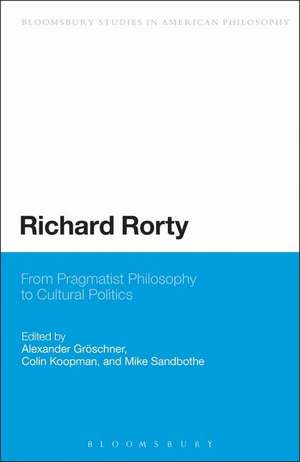
Richard Rorty: From Pragmatist Philosophy to Cultural Politics: Bloomsbury Studies in American Philosophy
Editat de Dr Alexander Groeschner, Professor Colin Koopman, Professor Mike Sandbotheen Limba Engleză Paperback – 23 oct 2014
This collection of essays, by an international and interdisciplinary group of eminent scholars and thinkers in their own right, including Jürgen Habermas, Saskia Sassen, Robert Brandom, and Richard Shusterman, presents the first complete posthumous study of Rorty's work as a whole. The collection reflects on Rorty's myriad accomplishments, with particular attention on the role of pragmatist philosophy in Rorty's increasing identification of his thinking with the work of cultural politics. The book covers the full range of Rortyan themes, including the practice of philosophy and metaphilosophy, the politics of culture, and Rorty's place in the contemporary philosophical and critical-cultural landscapes. These reflections serve to both introduce the arc of Rorty's thinking and advance the critical reception of his work.


Preț: 277.20 lei
Preț vechi: 369.09 lei
-25%
Puncte Express: 416
Carte tipărită la comandă
Livrare economică 20 noiembrie-04 decembrie
Livrare prin curier în România Termenul estimat este afișat lângă disponibilitate.
Transport gratuit de la 400.00 lei Plată online sau ramburs, în funcție de opțiunile comenzii.
Retur gratuit în 14 zile Comandă securizată și suport în română.
Specificații
ISBN-13: 9781472589279
ISBN-10: 1472589270
Pagini: 224
Ilustrații: 1 halftone illus
Dimensiuni: 154 x 232 x 14 mm
Greutate: 0.32 kg
Editura: Bloomsbury Publishing
Colecția Bloomsbury Academic
Seria Bloomsbury Studies in American Philosophy
Locul publicării:London, United Kingdom
ISBN-10: 1472589270
Pagini: 224
Ilustrații: 1 halftone illus
Dimensiuni: 154 x 232 x 14 mm
Greutate: 0.32 kg
Editura: Bloomsbury Publishing
Colecția Bloomsbury Academic
Seria Bloomsbury Studies in American Philosophy
Locul publicării:London, United Kingdom
V-ar putea interesa
-
 -12%Preț: 366.30 lei413.91 lei
 -
 -11%Preț: 377.07 lei424.12 lei
 -
 A Confusion of the Spheres: Kierkegaard and Wittgenstein on Philosophy and ReligionGenia Schönbaumsfeld-12%Preț: 377.68 lei428.07 lei
 -
 Philosophers Past and Present: Selected EssaysBarry Stroud-31%Preț: 634.71 lei919.73 lei
 -
 Frege's NotationsGregory LandiniPreț: 398.49 lei
 -
 -27%Preț: 776.73 lei1064.02 lei
 -
 The Parallax ViewSlavoj Zizek-28%Preț: 201.48 lei279.56 lei
 -
 Giorgio AgambenAlex MurrayPreț: 211.10 lei
 -
 Walter Benjamin: Images, the Creaturely, and the HolySigrid WeigelPreț: 211.58 lei
 -
 Adorno: A Guide for the PerplexedDr Alex Thomson-25%Preț: 1021.32 lei1356.18 lei
 -
 Theory of the SubjectAlain Badiou-37%Preț: 271.52 lei432.60 lei
 -
 The Lost Thread: The Democracy of Modern FictionSteven Corcoran-21%Preț: 159.22 lei200.77 lei
 -
 Times of Crisis: What the Financial Crisis Revealed and How to Reinvent our Lives and FutureProfessor Michel Serres-45%Preț: 174.11 lei314.10 lei
 -
 R. G. Collingwood: A Research CompanionProfessor James Connelly-33%Preț: 1026.68 lei1527.78 lei
 -
 Theology After DeleuzeDr Kristien Justaert-15%Preț: 236.65 lei276.99 lei
 -
 After Finitude: An Essay on the Necessity of ContingencyDr Quentin Meillassoux-37%Preț: 112.53 lei177.58 lei
 -
 Principles of Non-PhilosophyProfessor Francois Laruelle-47%Preț: 269.99 lei507.73 lei
 -
 Living CurrencyPierre Klossowski-45%Preț: 99.10 lei179.78 lei
 -
 The Bloomsbury Companion to LeibnizBrandon C. Look-20%Preț: 274.55 lei342.57 lei
 -
 Heidegger and the Place of EthicsDr Michael Lewis-16%Preț: 277.29 lei329.16 lei
 -
 Key WritingsProfessor Keith Ansell Pearson-23%Preț: 187.41 lei244.22 lei
 -
 The Bloomsbury Companion to SpinozaProfessor Wiep van Bunge-19%Preț: 277.02 lei343.90 lei
 -
 Deleuze and Futurism: A Manifesto for NonsenseHelen Palmer-16%Preț: 195.12 lei233.14 lei
 -
 -34%Preț: 220.68 lei333.04 lei
 -
 Topophobia: A Phenomenology of AnxietyDylan Trigg-17%Preț: 192.23 lei231.73 lei
 -
 The Sublime Object of IdeologySlavoj ZizekPreț: 113.31 lei
Cuprins
List of Contributors \ Preface Alexander Gröschner, Colin Koopman and Mike Sandbothe \ Abbreviations of Works by Richard Rorty \ Introduction \ 1. From Pragmatist Philosophy to Cultural Politics Alexander Gröschner and Mike Sandbothe \ 2. '. . . And to define America, Her Athletic Democracy': The Philosopher and the Language Shaper. In Memory of Richard Rorty Jürgen Habermas \ Part I: Pragmatist Philosophy \ 3. An Arc of Thought: From Rorty's Eliminative Materialism to his Pragmatism Robert Brandom \ 4. The Contingent Status of Epistemic Norms: Rorty, Kantian Pragmatisms, and Feminist Epistemologies Susan Dieleman \ 5. For the Sake of His Own Generation: Rorty on Destruction and Edification Bjørn Torgrim Ramberg \ Part II: From Pragmatist Philosophy to Cultural Politics \ 6. Challenging Philosophy: Locating Rorty's Positive Conception of Philosophy Colin Koopman \ 7. Pragmatist Philosophy and Enlarging Human Freedom: Rorty's Deweyan Pragmatism Christopher J. Voparil \ Part III: Cultural Politics \ 8. The Transformation of Citizenship: Rorty's Concept of Cosmopolitan Patriotism Saskia Sassen \ 9. Kindness to Babies: Radical Ideas in Rorty's Anti-Cynical Philosophy Esa Saarinen \ 10. Pragmatism and Cultural Politics: Variations on a Rortian Theme Richard Shusterman \ Bibliography \ Index
Recenzii
This remains an essential volume for engaging with Rorty's work; whether as an initial enquiry or a continuing conversation, it has much to offer on both Rorty's project and his relevance to social and political life.
Richard Rorty associated the meliorism of old American pragmatism to a vocabulary or narrativistic philosophical social activism. He also gathered pragmatism meliorism with Nietzschean anti-authoritarianism. This mix of linguistic social activism and anti-authoritarianism is unique. He left us with useful vocabulary tools to deal with the challenges of democracy and humanism. Through essays from well-known scholars this book shows the reader why Rorty's writings, his personal way of telling the history of philosophy, his frank dialogues with a wide spectrum of contemporary philosophers, constitute a pathfinder. His writings represents an effort of showing us how philosophy can affect our private and public spheres in a positive way.
This collection is engaging and timely. It is symptomatic of a new wave in the encroaching seas of Rorty commentary. The authors approach Rorty's ideas in an admirably bold, but not uncritical spirit. Moreover, they concentrate on exploring his most challenging insights before developing them in ways that shed welcome light on the wider cultural significance of his unique conception of pragmatist philosophy.
This collection provides an insightful analysis Richard Rorty's widely-discussed but often-misunderstood oeuvre, and succeeds, moreover, in showing its continuing relevance. Written by an excellent cast of authors, with such towering figures as Jürgen Habermas among them, the essays are fresh, powerful, and inspiring. By discussing Rorty's pragmatism in the context of topics as diverse as epistemic normativity, bodily awareness, the mother-infant dyad, cosmopolitan patriotism, cultural politics, and the like, they do justice to the breadth and interdisciplinarity of Rorty's pragmatism and should be of interest not only to philosophers, but also to social scientists, political theorists, and specialists in feminist, literary, and cultural studies. Highly recommended. /* Style Definitions */
This excellent collection of essays, by young and world renowned thinkers, from across many disciplines, foregrounds Rorty's irreverence against any form of dogmatism, while celebrating the generosity of his thinking. What this collection demonstrates amply and eloquently is that Rorty's entire oeuvre had at its core a profound ethical and political sensibility that made him a philosophical sibling of figures like Socrates, Montaigne, Voltaire, Russell, Sartre, Derrida, de Beauvoir, Chomsky, and Nussbaum. Like them, Rorty exhibited why we are the poetic species.
Richard Rorty has done more than any other contemporary philosopher to stimulate interest in pragmatism and to connect it to social and political questions. The essays in this excellent collection are a fitting tribute to pragmatism's most controversial figure, providing insight into his contribution to that tradition as well as suggestions about how that contribution might be taken forward.
A rich and affectionate tribute to a great pragmatist -- highly recommended.
Richard Rorty associated the meliorism of old American pragmatism to a vocabulary or narrativistic philosophical social activism. He also gathered pragmatism meliorism with Nietzschean anti-authoritarianism. This mix of linguistic social activism and anti-authoritarianism is unique. He left us with useful vocabulary tools to deal with the challenges of democracy and humanism. Through essays from well-known scholars this book shows the reader why Rorty's writings, his personal way of telling the history of philosophy, his frank dialogues with a wide spectrum of contemporary philosophers, constitute a pathfinder. His writings represents an effort of showing us how philosophy can affect our private and public spheres in a positive way.
This collection is engaging and timely. It is symptomatic of a new wave in the encroaching seas of Rorty commentary. The authors approach Rorty's ideas in an admirably bold, but not uncritical spirit. Moreover, they concentrate on exploring his most challenging insights before developing them in ways that shed welcome light on the wider cultural significance of his unique conception of pragmatist philosophy.
This collection provides an insightful analysis Richard Rorty's widely-discussed but often-misunderstood oeuvre, and succeeds, moreover, in showing its continuing relevance. Written by an excellent cast of authors, with such towering figures as Jürgen Habermas among them, the essays are fresh, powerful, and inspiring. By discussing Rorty's pragmatism in the context of topics as diverse as epistemic normativity, bodily awareness, the mother-infant dyad, cosmopolitan patriotism, cultural politics, and the like, they do justice to the breadth and interdisciplinarity of Rorty's pragmatism and should be of interest not only to philosophers, but also to social scientists, political theorists, and specialists in feminist, literary, and cultural studies. Highly recommended. /* Style Definitions */
This excellent collection of essays, by young and world renowned thinkers, from across many disciplines, foregrounds Rorty's irreverence against any form of dogmatism, while celebrating the generosity of his thinking. What this collection demonstrates amply and eloquently is that Rorty's entire oeuvre had at its core a profound ethical and political sensibility that made him a philosophical sibling of figures like Socrates, Montaigne, Voltaire, Russell, Sartre, Derrida, de Beauvoir, Chomsky, and Nussbaum. Like them, Rorty exhibited why we are the poetic species.
Richard Rorty has done more than any other contemporary philosopher to stimulate interest in pragmatism and to connect it to social and political questions. The essays in this excellent collection are a fitting tribute to pragmatism's most controversial figure, providing insight into his contribution to that tradition as well as suggestions about how that contribution might be taken forward.
A rich and affectionate tribute to a great pragmatist -- highly recommended.