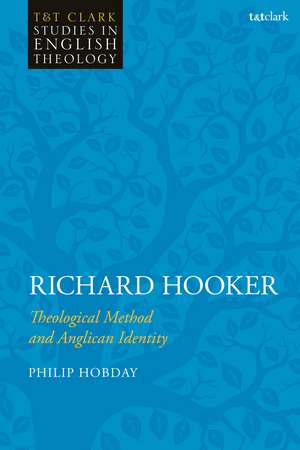
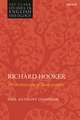
Richard Hooker: Theological Method and Anglican Identity: T&T Clark Studies in English Theology
Autor Revd Dr Philip Hobdayen Limba Engleză Paperback – 20 mar 2025
On the role of scripture in theology, the theological capacity of human reason, and the place of tradition, these 3 theologians have far more in common than many subsequent commentators have understood. This book shows how both Hooker and the Anglicanism he defended in such elegant prose, can be coherently both 'catholic' and 'reformed' (rather than one, or the other, or some middle way). Relocating Hooker, and Anglicanism, in this way reveals them to be rich, fruitful conversation partners in ecumenical dialogue and theological debates across Christian traditions.
Din seria T&T Clark Studies in English Theology
- 14%
 Preț: 522.57 lei
 - 25%
 Preț: 256.05 lei
 - 16%
 Preț: 255.03 lei
 - 16%
 Preț: 244.87 lei
 - 27%
 Preț: 235.86 lei
 - 26%
 Preț: 215.85 lei
 - 23%
 Preț: 238.85 lei
 - 25%
 Preț: 211.07 lei
 - 28%
 Preț: 212.15 lei
 - 25%
 Preț: 213.24 lei
 - 29%
 Preț: 204.44 lei
 - 30%
 Preț: 503.92 lei
 - 25%
 Preț: 209.73 lei
 - 27%
 Preț: 203.26 lei
 - 26%
 Preț: 206.07 lei
Preț: 207.19 lei
Preț vechi: 278.80 lei
-26%
Puncte Express: 311
Carte disponibilă
Livrare economică 10-24 noiembrie
Livrare prin curier în România Termenul estimat este afișat lângă disponibilitate.
Transport gratuit de la 400.00 lei Plată online sau ramburs, în funcție de opțiunile comenzii.
Retur gratuit în 14 zile Comandă securizată și suport în română.
Specificații
ISBN-13: 9780567708083
ISBN-10: 056770808X
Pagini: 240
Dimensiuni: 152 x 232 x 18 mm
Greutate: 0.34 kg
Editura: Bloomsbury Publishing
Colecția T&T Clark
Seria T&T Clark Studies in English Theology
Locul publicării:London, United Kingdom
ISBN-10: 056770808X
Pagini: 240
Dimensiuni: 152 x 232 x 18 mm
Greutate: 0.34 kg
Editura: Bloomsbury Publishing
Colecția T&T Clark
Seria T&T Clark Studies in English Theology
Locul publicării:London, United Kingdom
Cuprins
Introduction:
Location, Location, Location
Chapter One:
The Knowledge of God in Aquinas
Chapter Two:
The Knowledge of God in Calvin
Chapter Three:
The Knowledge of God in Hooker
Chapter Four:
Tradition in Aquinas, Calvin, and Hooker
Chapter Five:
Applications
Conclusion:
Relocations
Bibliography
Index
Location, Location, Location
Chapter One:
The Knowledge of God in Aquinas
Chapter Two:
The Knowledge of God in Calvin
Chapter Three:
The Knowledge of God in Hooker
Chapter Four:
Tradition in Aquinas, Calvin, and Hooker
Chapter Five:
Applications
Conclusion:
Relocations
Bibliography
Index
Recenzii
Hobday's book shows immense exegetical deftness in handling three thinkers whose thought is drowned in a sea of interpretation. He offers a plausible account of how their similarities in key areas are often overlooked or obscured. Hobday establishes a well-evidenced synthetic account that shows the confluence rather than conflict in how they treat each of the theological warrants.
Learned, nuanced and adventurous, this is a fine contribution to the new wave of scholarship on Richard Hooker. It does full justice to the extent of Hooker's engagement with both Aquinas and Calvin, and expertly dismantles some received wisdom so as to show us a persuasively original figure, who has some unexpected and valuable insights for theological debate today
The reception of Richard Hooker's thought has always shown remarkable plasticity and debates over his theological identity have accordingly taken on an intractable quality over the centuries. Philip Hobday's remarkable work cuts the Gordian knot of how to locate Hooker's theological identity by re-examining Hooker's theological method. Hobday adeptly re-locates Hooker's thought as a confluence rather than a conflict between Thomist and Calvinist influences, rendering Hooker as a creative, pragmatic, and protean thinker. Hobday's Theological Method and Anglican Identity connects Hookerian studies with a broader retrieval in Reformed and Thomist studies of the points of connection and continuity between theological traditions often cast in a reductionist and oppositional binary. Scholars of the Reformed, Thomist, and Anglican traditions are indebted to Hobday's luminous study.
For too long, the mythic tale of a third way Anglicanism charting a path between the Roman Scylla and Genevan Charybdis, helmed by its hero Richard Hooker, has tyrannized over church historians and catechists, even as a richer understanding of medieval Catholicism and 16th-century Calvinism has rendered old dichotomies untenable. Philip Hobday does a wonderful service to the church by drawing deeply from both contemporary re-appraisals of Thomas Aquinas and John Calvin to argue that, when it came to fundamentals of theological method, much less separated the two men than we might imagine. On this basis, Hobday demonstrates convincingly that there was nothing especially surprising about Hooker's claim to be both reformed and catholic. Hooker's greatness lies not so much in forging a unique synthesis between fundamentally contrary elements, but rather in giving eloquent expression to a more widely-shared consensus about the relation of Scripture, reason, and tradition. With this volume, Hobday makes a decisive and valuable contribution not only to scholarship around Richard Hooker, but to contemporary debates about Anglican theological identity.
Learned, nuanced and adventurous, this is a fine contribution to the new wave of scholarship on Richard Hooker. It does full justice to the extent of Hooker's engagement with both Aquinas and Calvin, and expertly dismantles some received wisdom so as to show us a persuasively original figure, who has some unexpected and valuable insights for theological debate today
The reception of Richard Hooker's thought has always shown remarkable plasticity and debates over his theological identity have accordingly taken on an intractable quality over the centuries. Philip Hobday's remarkable work cuts the Gordian knot of how to locate Hooker's theological identity by re-examining Hooker's theological method. Hobday adeptly re-locates Hooker's thought as a confluence rather than a conflict between Thomist and Calvinist influences, rendering Hooker as a creative, pragmatic, and protean thinker. Hobday's Theological Method and Anglican Identity connects Hookerian studies with a broader retrieval in Reformed and Thomist studies of the points of connection and continuity between theological traditions often cast in a reductionist and oppositional binary. Scholars of the Reformed, Thomist, and Anglican traditions are indebted to Hobday's luminous study.
For too long, the mythic tale of a third way Anglicanism charting a path between the Roman Scylla and Genevan Charybdis, helmed by its hero Richard Hooker, has tyrannized over church historians and catechists, even as a richer understanding of medieval Catholicism and 16th-century Calvinism has rendered old dichotomies untenable. Philip Hobday does a wonderful service to the church by drawing deeply from both contemporary re-appraisals of Thomas Aquinas and John Calvin to argue that, when it came to fundamentals of theological method, much less separated the two men than we might imagine. On this basis, Hobday demonstrates convincingly that there was nothing especially surprising about Hooker's claim to be both reformed and catholic. Hooker's greatness lies not so much in forging a unique synthesis between fundamentally contrary elements, but rather in giving eloquent expression to a more widely-shared consensus about the relation of Scripture, reason, and tradition. With this volume, Hobday makes a decisive and valuable contribution not only to scholarship around Richard Hooker, but to contemporary debates about Anglican theological identity.