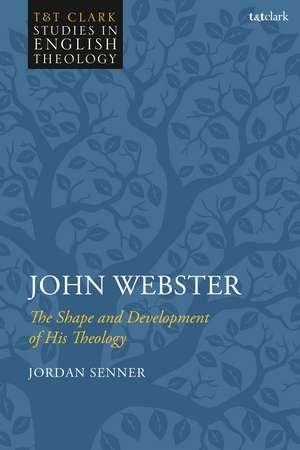
John Webster: The Shape and Development of His Theology: T&T Clark Studies in English Theology
Autor Revd Dr Jordan Senneren Limba Engleză Paperback – 20 apr 2023
This volume not only provides a dynamic introduction to Webster's theology as a whole, but it also includes fascinating forays into the complexities of Webster's engagement with Barth and Aquinas, raising interesting questions for constructive theological dialogue that is neither straightforwardly Protestant nor Catholic.
Din seria T&T Clark Studies in English Theology
- 14%
 Preț: 522.57 lei
 - 25%
 Preț: 256.05 lei
 - 16%
 Preț: 255.03 lei
 - 16%
 Preț: 244.87 lei
 - 27%
 Preț: 235.86 lei
 - 26%
 Preț: 215.85 lei
 - 23%
 Preț: 238.85 lei
 - 28%
 Preț: 212.15 lei
 - 25%
 Preț: 213.24 lei
 - 29%
 Preț: 204.44 lei
 - 26%
 Preț: 207.19 lei
 - 30%
 Preț: 503.92 lei
 - 25%
 Preț: 209.73 lei
 - 27%
 Preț: 203.26 lei
 - 26%
 Preț: 206.07 lei
Preț: 211.07 lei
Preț vechi: 283.09 lei
-25%
Puncte Express: 317
Carte tipărită la comandă
Livrare economică 30 noiembrie-14 decembrie
Livrare prin curier în România Termenul estimat este afișat lângă disponibilitate.
Transport gratuit de la 400.00 lei Plată online sau ramburs, în funcție de opțiunile comenzii.
Retur gratuit în 14 zile Comandă securizată și suport în română.
Specificații
ISBN-13: 9780567698872
ISBN-10: 0567698874
Pagini: 216
Dimensiuni: 152 x 232 x 12 mm
Greutate: 0.3 kg
Editura: Bloomsbury Publishing
Colecția T&T Clark
Seria T&T Clark Studies in English Theology
Locul publicării:London, United Kingdom
ISBN-10: 0567698874
Pagini: 216
Dimensiuni: 152 x 232 x 12 mm
Greutate: 0.3 kg
Editura: Bloomsbury Publishing
Colecția T&T Clark
Seria T&T Clark Studies in English Theology
Locul publicării:London, United Kingdom
Cuprins
Introduction
Chapter 1
Ordering and Grounding the God-Creature Relation
Chapter 2
Christology
Chapter 3
Ecclesiology
Chapter 4
Bibliology
Chapter 5
Theological Theology
Conclusion
Bibliography
Index
Chapter 1
Ordering and Grounding the God-Creature Relation
Chapter 2
Christology
Chapter 3
Ecclesiology
Chapter 4
Bibliology
Chapter 5
Theological Theology
Conclusion
Bibliography
Index
Recenzii
Jordan Senner's clearly structured and elegantly written study on the development of John Webster's theology carefully reconstructs the shaping of a dogmatic theology. From the interpreter of Eberhard Jüngel and the student of Karl Barth to John Webster's mature dogmatic outlook, inspired by Aquinas and increasingly shaped by engagement with Reformed scholasticism, Senner portrays a 'theological theology' that is kept in motion by theology's subject-matter. Continuities and discontinuities are elucidated from the fundamental questions with which this theology engages. As John Webster frequently emphasised, our theology is a theology of pilgrims still on the way to full knowledge of God in the beatific vision. It is therefore always provisional and fragmentary and may not be identified with a theological school. Jordan Senner's study captures the dynamics of John Webster's theology with precision and theological empathy. It encourages readers to follow John Webster's theological itinerary and continue their own ways of theologising in constructive conversation with a theologian for whom being 'dogmatic' was always a compliment.
Jordan Senner offers a clear, compelling and nuanced study of the development of John Webster's dogmatic theology. It is fitting that the first book-length treatment of Webster's thought is such a faithful testimony to his legacy: a lucid, perceptive, generous and critically discerning account of the work of a 'theologian's theologian'. The book is expertly crafted, exhibiting deep familiarity with Webster's work and sound knowledge of its wider theological context. Senner demonstrates why Webster's theology, blending Reformed instincts and Thomist inflections, will have a deep and lasting legacy.
This is a landmark study of John Webster. As the first book-length treatment of Webster's theology, Jordan Senner presents an in-depth analysis of how Webster matured in his understanding of the God-creature relationship. Meticulously tracing Webster's understanding of Christ, church, Scripture, and theology, Senner convincingly argues that Webster's journey from Barth to Aquinas is the result of his increasing recognition that the economy is suspended from theology. Senner sets the benchmark for any future engagement with Webster's theology.
It has become apparent that John Webster - such a disarmingly humble man - was the greatest Protestant theologian of our times. The way he brought together Barth and Aquinas into his own extraordinary synthesis has set him apart. Here we have the best study yet of Webster's work, showing how his attention to the doctrines of divine perfection and creation stand at the heart of his mature theocentric and Trinitarian thought. It is imperative that Protestant and Catholic theologians today, in the crossfire of academic trends, listen to Webster's 'theological theology' -- and Jordan Senner has given us a definitive guide for doing so.
Webster wrote very carefully, with the result that he is easy to quote but hard to paraphrase. In this excellent account of his theology, Jordan Senner has done the hard work of clarifying Webster's crucial moves and key claims by way of alternative terms and different categories. Senner's outlook is comprehensive and his judgments are keen. The result is an uncommonly helpful presentation of Webster's thought, ideal for students and stimulating for contemporary theology.
For anyone who wants to understand Webster or to extend his project, Senner's work is an essential read.
Jordan Senner offers a clear, compelling and nuanced study of the development of John Webster's dogmatic theology. It is fitting that the first book-length treatment of Webster's thought is such a faithful testimony to his legacy: a lucid, perceptive, generous and critically discerning account of the work of a 'theologian's theologian'. The book is expertly crafted, exhibiting deep familiarity with Webster's work and sound knowledge of its wider theological context. Senner demonstrates why Webster's theology, blending Reformed instincts and Thomist inflections, will have a deep and lasting legacy.
This is a landmark study of John Webster. As the first book-length treatment of Webster's theology, Jordan Senner presents an in-depth analysis of how Webster matured in his understanding of the God-creature relationship. Meticulously tracing Webster's understanding of Christ, church, Scripture, and theology, Senner convincingly argues that Webster's journey from Barth to Aquinas is the result of his increasing recognition that the economy is suspended from theology. Senner sets the benchmark for any future engagement with Webster's theology.
It has become apparent that John Webster - such a disarmingly humble man - was the greatest Protestant theologian of our times. The way he brought together Barth and Aquinas into his own extraordinary synthesis has set him apart. Here we have the best study yet of Webster's work, showing how his attention to the doctrines of divine perfection and creation stand at the heart of his mature theocentric and Trinitarian thought. It is imperative that Protestant and Catholic theologians today, in the crossfire of academic trends, listen to Webster's 'theological theology' -- and Jordan Senner has given us a definitive guide for doing so.
Webster wrote very carefully, with the result that he is easy to quote but hard to paraphrase. In this excellent account of his theology, Jordan Senner has done the hard work of clarifying Webster's crucial moves and key claims by way of alternative terms and different categories. Senner's outlook is comprehensive and his judgments are keen. The result is an uncommonly helpful presentation of Webster's thought, ideal for students and stimulating for contemporary theology.
For anyone who wants to understand Webster or to extend his project, Senner's work is an essential read.