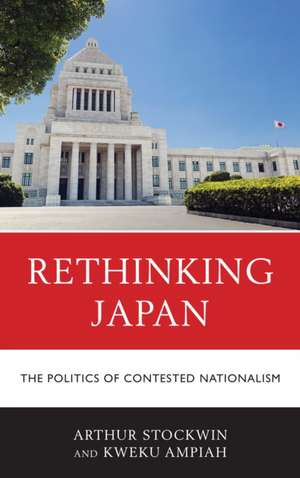
Rethinking Japan: The Politics of Contested Nationalism: New Studies in Modern Japan
Autor Arthur Stockwin, Kweku Ampiahen Limba Engleză Hardback – 15 feb 2017
The first four chapters deal with Japanese political development since 1945 and factors leading to the emergence of Abe Shinzo as Prime Minister in 2012. Chapter 5 examines the Abe Government's flagship economic policy, dubbed "Abenomics." The authors then analyse four highly controversial objectives promoted by the Abe Government: revision of the 1947 'Peace Constitution'; the introduction of a Secrecy Law; historical revision, national identity and issues of war apology; and revised constitutional interpretation permitting collective defence. In the final three chapters they turn to foreign policy, first examining relations with China, Russia and the two Koreas, second Japan and the wider world, including public diplomacy, economic relations and overseas development aid, and finally, the vexed question of how far Japanese policies are as reactive to foreign pressure.
In the Conclusion, the authors ask how far right wing trends in Japan exhibit common causality with shifts to the right in the United States, Europe and elsewhere. They argue that although in Japan immigration has been a relatively minor factor, economic stagnation, demographic decline, a sense of regional insecurity in the face of challenges from China and North Korea, and widening gaps in life chances, bear comparison with trends elsewhere. Nevertheless, they maintain that "[a] more sane regional future may be possible in East Asia."
Din seria New Studies in Modern Japan
- 35%
 Preț: 594.56 lei
 - 24%
 Preț: 309.53 lei
 - 16%
 Preț: 361.12 lei
 - 22%
 Preț: 324.41 lei
 - 22%
 Preț: 324.71 lei
 - 29%
 Preț: 345.00 lei
 - 35%
 Preț: 594.98 lei
 - 37%
 Preț: 659.03 lei
 - 36%
 Preț: 679.81 lei
 - 27%
 Preț: 261.24 lei
 -
 Preț: 358.86 lei
 - 28%
 Preț: 382.42 lei
 - 25%
 Preț: 362.45 lei
 - 27%
 Preț: 269.84 lei
 - 33%
 Preț: 582.81 lei
 - 26%
 Preț: 258.47 lei
 - 27%
 Preț: 254.91 lei
 - 28%
 Preț: 221.74 lei
 - 22%
 Preț: 324.09 lei
 - 32%
 Preț: 551.39 lei
 - 27%
 Preț: 270.53 lei
 - 27%
 Preț: 284.87 lei
 - 28%
 Preț: 221.74 lei
 - 36%
 Preț: 527.54 lei
 - 25%
 Preț: 364.08 lei
 - 28%
 Preț: 220.37 lei
 - 28%
 Preț: 221.22 lei
 - nou
 Preț: 534.74 lei
 - nou
 Preț: 581.93 lei
 - nou
 Preț: 616.86 lei
Preț: 706.19 lei
Preț vechi: 1056.40 lei
-33%
Puncte Express: 1059
Carte tipărită la comandă
Livrare economică 09-23 noiembrie
Livrare prin curier în România Termenul estimat este afișat lângă disponibilitate.
Transport gratuit pentru acest produs Plată online sau ramburs, în funcție de opțiunile comenzii.
Retur gratuit în 14 zile Comandă securizată și suport în română.
Specificații
ISBN-13: 9781498537926
ISBN-10: 1498537928
Pagini: 336
Dimensiuni: 163 x 235 x 24 mm
Greutate: 0.61 kg
Editura: Bloomsbury Publishing
Colecția Lexington Books
Seria New Studies in Modern Japan
Locul publicării:New York, United States
ISBN-10: 1498537928
Pagini: 336
Dimensiuni: 163 x 235 x 24 mm
Greutate: 0.61 kg
Editura: Bloomsbury Publishing
Colecția Lexington Books
Seria New Studies in Modern Japan
Locul publicării:New York, United States
V-ar putea interesa
-
 Beyond TransparencyBrett GoldsteinPreț: 103.60 lei
 -
 -27%Preț: 1020.06 lei1393.49 lei
 -
 -27%Preț: 1024.30 lei1396.29 lei
 -
 -27%Preț: 1022.35 lei1395.00 lei
 -
 -27%Preț: 1024.59 lei1396.47 lei
 -
 Maher, S: Salafi-JihadismShiraz Maher-21%Preț: 198.12 lei251.17 lei
 -
 -11%Preț: 102.00 lei114.30 lei
Cuprins
Chapter 1: Peace, Democracy and Economic Growth: Political Economy under the Postwar Dispensation
Chapter 2: The System Begins to Change: From the 1990s to 2009
Chapter 3: The Opposition in Power: September 2009 to December 2012
Chapter 4: Abe Takes Charge: From December 2012
Chapter 5: Abenomics
Chapter 6: Revising and Reinterpreting the 1947 Constitution
Chapter 7: The Designated Secrets Law and Freedom of Speech
Chapter 8: Historical Revisionism, National Identity, and War Apology
Chapter 9: Legislating for Collective Defense by Fiat: The Realist View of Japan as a Normal Country
Chapter 10: Japan and Its Neighbors: China, Russia and the Two Koreas
Chapter 11: Japan and the Wider World: Public Diplomacy, Economic Relations and Overseas Development Aid
Chapter 12: Japan: Reactionary State?
Chapter 2: The System Begins to Change: From the 1990s to 2009
Chapter 3: The Opposition in Power: September 2009 to December 2012
Chapter 4: Abe Takes Charge: From December 2012
Chapter 5: Abenomics
Chapter 6: Revising and Reinterpreting the 1947 Constitution
Chapter 7: The Designated Secrets Law and Freedom of Speech
Chapter 8: Historical Revisionism, National Identity, and War Apology
Chapter 9: Legislating for Collective Defense by Fiat: The Realist View of Japan as a Normal Country
Chapter 10: Japan and Its Neighbors: China, Russia and the Two Koreas
Chapter 11: Japan and the Wider World: Public Diplomacy, Economic Relations and Overseas Development Aid
Chapter 12: Japan: Reactionary State?
Recenzii
Stockwin and Ampiah do an excellent job providing historical and political context to several of the debates currently animating Japanese politics. . . . this is a book that outlines and provides historical context to many of the most important issues facing Japan today. It would be useful as a textbook in courses on the politics of Japan, politics in East Asia, and/or the comparative politics of advanced industrialized states, and would also be useful to those wanting thoughtful background on the challenges currently facing Japanese democracy.
Rethinking Japan is a book that needs to be read by anyone interested in a better understanding of the recent dramatic shifts in Japan's domestic as well as foreign and security policies. Each chapter provides a well-documented and comprehensive analysis of core policies and recent developments. It is unequivocally critical of most of the policies advocated by Shinzo Abe and passionately argues that nationalist ideology is Abe's core driving force. While readers may reasonably disagree over how dangerous the security policy changes of recent years really are, the authors have to be commended for making this debate accessible to a wider audience.
Rethinking Japan provides an easy-to-read overview of postwar politics and what. . . has changed in Japan since the 1990s, particularly since 2012. . . . Rethinking Japan [is]. . . a well-researched, knowledgeable analysis of developments in Japan's domestic and international politics. Hence, as a serious and critical reflection on long-term trends in Japanese politics, Rethinking Japan certainly does have its merits and therefore a place on many old-school book shelves, hard disks, or cloud spaces.
Rethinking Japan argues that the changes taking place in Japan in the second half of the twenty-first century are of 'seminal importance.' The authors' sustained analysis of the emergence and consolidation of the right wing in Japan confirms this assessment. The book sets its rise in the context of the Liberal Democratic Party's fall from power at the hands of the opposition and the party's return to government in the wake of its defeat at the polls. This study is particularly impressive in offering concrete details and a convincing explanation for the policies of the current Shinzo Abe administration. The authors are to be congratulated for producing a work that should find a place on the bookshelves of all those with an interest in Japanese politics.
Democracy is currently facing challenges all over the world from political outsiders who appeal to public sentiment and exaggerate or lie to attack opponents. Shinzo Abe turns out to be the forerunner of this trend, and Japanese politics in the coming years will reach a democratic crisis. In Rethinking Japan: The Politics of Contested Nationalism, Arthur Stockwin and Kweku Ampiah provide a meaningful contribution not only to Japanese studies but also to comparative politics.
This book is essential reading for understanding contemporary Japan and the reality behind the headlines. Abenomics has entered the global lexicon as an ambitious program of economic rejuvenation, but here we learn how and why it has failed by widening disparities while avoiding substantive reforms. The authors explain in an engaging style how it has served as a distraction from more controversial policies of revising the constitution, easing constraints on the military, and rehabilitating the wartime past, an agenda that doesn't resonate with most Japanese. These pages are brimming with insiders' insights that help readers delve into the socioeconomic issues that confronting Japan and how the Japanese are responding. In doing so, this book helps to dismantle stereotypes of a harmonious society of deferential citizens.
Combining deep knowledge of postwar Japan with up-to-date analyses of the developments since Prime Minister Abe's return to power in December 2012, this study places the '2012 political system' in its historical context and convincingly makes the case for the need to 'rethink Japan' as it has become more assertive under a radical right-wing government. This is the most comprehensive study of contemporary Japanese politics under the Abe government in any language to date and covers a wide range of topics, including Abenomics, the constitution, historical revisionism, and foreign and security policy. Balanced and fair, with ample documentation of opinions and arguments presented by both the government and its critics, this book will satisfy the interest and curiosity of academics, students, and general readers.
Rethinking Japan is a book that needs to be read by anyone interested in a better understanding of the recent dramatic shifts in Japan's domestic as well as foreign and security policies. Each chapter provides a well-documented and comprehensive analysis of core policies and recent developments. It is unequivocally critical of most of the policies advocated by Shinzo Abe and passionately argues that nationalist ideology is Abe's core driving force. While readers may reasonably disagree over how dangerous the security policy changes of recent years really are, the authors have to be commended for making this debate accessible to a wider audience.
Rethinking Japan provides an easy-to-read overview of postwar politics and what. . . has changed in Japan since the 1990s, particularly since 2012. . . . Rethinking Japan [is]. . . a well-researched, knowledgeable analysis of developments in Japan's domestic and international politics. Hence, as a serious and critical reflection on long-term trends in Japanese politics, Rethinking Japan certainly does have its merits and therefore a place on many old-school book shelves, hard disks, or cloud spaces.
Rethinking Japan argues that the changes taking place in Japan in the second half of the twenty-first century are of 'seminal importance.' The authors' sustained analysis of the emergence and consolidation of the right wing in Japan confirms this assessment. The book sets its rise in the context of the Liberal Democratic Party's fall from power at the hands of the opposition and the party's return to government in the wake of its defeat at the polls. This study is particularly impressive in offering concrete details and a convincing explanation for the policies of the current Shinzo Abe administration. The authors are to be congratulated for producing a work that should find a place on the bookshelves of all those with an interest in Japanese politics.
Democracy is currently facing challenges all over the world from political outsiders who appeal to public sentiment and exaggerate or lie to attack opponents. Shinzo Abe turns out to be the forerunner of this trend, and Japanese politics in the coming years will reach a democratic crisis. In Rethinking Japan: The Politics of Contested Nationalism, Arthur Stockwin and Kweku Ampiah provide a meaningful contribution not only to Japanese studies but also to comparative politics.
This book is essential reading for understanding contemporary Japan and the reality behind the headlines. Abenomics has entered the global lexicon as an ambitious program of economic rejuvenation, but here we learn how and why it has failed by widening disparities while avoiding substantive reforms. The authors explain in an engaging style how it has served as a distraction from more controversial policies of revising the constitution, easing constraints on the military, and rehabilitating the wartime past, an agenda that doesn't resonate with most Japanese. These pages are brimming with insiders' insights that help readers delve into the socioeconomic issues that confronting Japan and how the Japanese are responding. In doing so, this book helps to dismantle stereotypes of a harmonious society of deferential citizens.
Combining deep knowledge of postwar Japan with up-to-date analyses of the developments since Prime Minister Abe's return to power in December 2012, this study places the '2012 political system' in its historical context and convincingly makes the case for the need to 'rethink Japan' as it has become more assertive under a radical right-wing government. This is the most comprehensive study of contemporary Japanese politics under the Abe government in any language to date and covers a wide range of topics, including Abenomics, the constitution, historical revisionism, and foreign and security policy. Balanced and fair, with ample documentation of opinions and arguments presented by both the government and its critics, this book will satisfy the interest and curiosity of academics, students, and general readers.