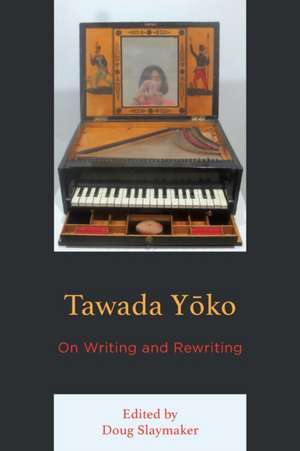
Tawada Yoko: On Writing and Rewriting: New Studies in Modern Japan
Editat de Doug Slaymaker Contribuţii de Brett de Bary, Naoki Sakai, Sigrid Wiegel, Christine Ivanovic, Gizem Arslan, Paul McQuade, Madalina Meirosu, Fujiwara Dan, Annegret Märten, Sachiyo Taniguchi, Tingting Hui, Suzuko Knott, Tomoko Takeuchi Slutsky, Seungyeon Kimen Limba Engleză Paperback – noi 2021
Tawada's writing unfolds at the intersections of borders, whether of language, identity, nationality, or gender. Her characters are all travelers of some sort, often foreigners and outsiders, caught in surreal in-between spaces, such as between language and culture, or between species, subjectivities, and identities. Sometimes they exist in the spaces between gendered and national identities; sometimes they are found caught between reality and the surreal, perhaps madness. Tawada has been one of the most prescient and provocative thinkers on the complexities of travelling and living in the contemporary world, and thus has always been obsessed with passports and trouble at borders.
This current volume was conceived to augment the first edited volume of Tawada's work, Yoko Tawada: Voices from Everywhere, which appeared from Lexington Books in 2007. That volume represented the first extensive English language coverage of Tawada's writing. In the meantime, there is increased scholarly interest in Tawada's artistic activity, and it is time for more sustained critical examinations of her output. This collection gathers and analyzes essays that approach the complex international themes found in many of Tawada's works.
Din seria New Studies in Modern Japan
- 35%
 Preț: 594.56 lei
 - 24%
 Preț: 309.53 lei
 - 16%
 Preț: 361.12 lei
 - 22%
 Preț: 324.41 lei
 - 22%
 Preț: 324.71 lei
 - 29%
 Preț: 345.00 lei
 - 35%
 Preț: 594.98 lei
 - 37%
 Preț: 659.03 lei
 - 36%
 Preț: 679.81 lei
 - 27%
 Preț: 261.24 lei
 -
 Preț: 358.86 lei
 - 28%
 Preț: 382.42 lei
 - 25%
 Preț: 362.45 lei
 - 27%
 Preț: 269.84 lei
 - 33%
 Preț: 582.81 lei
 - 27%
 Preț: 254.91 lei
 - 28%
 Preț: 221.74 lei
 - 22%
 Preț: 324.09 lei
 - 32%
 Preț: 551.39 lei
 - 27%
 Preț: 270.53 lei
 - 27%
 Preț: 284.87 lei
 - 28%
 Preț: 221.74 lei
 - 36%
 Preț: 527.54 lei
 - 25%
 Preț: 364.08 lei
 - 28%
 Preț: 220.37 lei
 - 28%
 Preț: 221.22 lei
 - nou
 Preț: 534.74 lei
 - nou
 Preț: 592.57 lei
 - nou
 Preț: 626.87 lei
Preț: 258.47 lei
Preț vechi: 351.53 lei
-26%
Puncte Express: 388
Carte tipărită la comandă
Livrare economică 18 noiembrie-02 decembrie
Livrare prin curier în România Termenul estimat este afișat lângă disponibilitate.
Transport gratuit de la 400.00 lei Plată online sau ramburs, în funcție de opțiunile comenzii.
Retur gratuit în 14 zile Comandă securizată și suport în română.
Specificații
ISBN-13: 9781498590068
ISBN-10: 1498590063
Pagini: 296
Ilustrații: 1 b/w photos;
Dimensiuni: 154 x 220 x 21 mm
Greutate: 0.44 kg
Editura: Bloomsbury Publishing
Colecția Lexington Books
Seria New Studies in Modern Japan
Locul publicării:New York, United States
ISBN-10: 1498590063
Pagini: 296
Ilustrații: 1 b/w photos;
Dimensiuni: 154 x 220 x 21 mm
Greutate: 0.44 kg
Editura: Bloomsbury Publishing
Colecția Lexington Books
Seria New Studies in Modern Japan
Locul publicării:New York, United States
Cuprins
Introduction, by Doug Slaymaker
Chapter 1. "Choosing Between Life and Human," Tawada Yoko
Chapter 2. "Theory, Fiction, and the Lightness of Translation: Tawada Yoko's Schwager in Bordeaux/Borudo no gikei," Brett de Bary
Chapter 3. "Image and the Unity of a Language: Translation and the Indeterminacy of National Language," Naoki Sakai
Chapter 4. "Yoko Tawada's Poetics on the Threshold of Different Writing Systems," Sigrid Wiegel
Chapter 5. "Translationalism as poetic principle: Tawada's translational rewriting of Kafka's "The Metamorphosis,'" Christine Ivanovic
Chapter 6. "Yoko Tawada Writes Ernst Jandl: Movements of Alphabetic And Sino-Japanese Writing Across Time And Media," Gizem Arslan
Chapter 7. "Sprachmutter: The Death of the Mother Tongue," Paul McQuade
Chapter 8. "Yoko Tawada's Überseezungen: Feminist Self-Translation and Creative Resistance," Madalina Meirosu
Chapter 9. "Laudatio for Uljana Wolf, Erlangener Prize for Poetry As Translation 1980," Tawada Yoko
Chapter 10. "Spherical Narrative Temporality in Tawada Yoko's fiction," Fujiwara Dan
Chapter 11. "From the Linguistic Mother to the Salt Water Mother: Poetics of Catastrophe in Tawada Yoko's Eco-critical Writing," Annegret Märten
Chapter 12. "The Destruction and Recreation of Japanese Mythology through Yoko Tawada's Literature," Taniguchi Sachiyo
Chapter 13. "Words That I Swallowed Whole: The Linguistic Edibility of Yoko Tawada's Exophonic Writings," Tingting Hui
Chapter 14. "Transmigration and Cultural Memory in Yoko Tawada's Etüden im Schnee 7670," Suzuko Mousel Knott
Chapter 15. "Staging of Self, Performance of Life: Formation of a Subject in Yuki no renshusei," Tomoko Takeuchi Slutsky
Chapter 16. "The hands of bears, the hands of men: Animal Writing in Tawada Yoko's Tawada Yoko's Yuki no renshusei," Doug Slaymaker
Chapter 17. "The fictional-Reality of actual-Virtuality: Yoko Tawada's Kentoshi (The Emissary)," Kim Seungyeon
Chapter 1. "Choosing Between Life and Human," Tawada Yoko
Chapter 2. "Theory, Fiction, and the Lightness of Translation: Tawada Yoko's Schwager in Bordeaux/Borudo no gikei," Brett de Bary
Chapter 3. "Image and the Unity of a Language: Translation and the Indeterminacy of National Language," Naoki Sakai
Chapter 4. "Yoko Tawada's Poetics on the Threshold of Different Writing Systems," Sigrid Wiegel
Chapter 5. "Translationalism as poetic principle: Tawada's translational rewriting of Kafka's "The Metamorphosis,'" Christine Ivanovic
Chapter 6. "Yoko Tawada Writes Ernst Jandl: Movements of Alphabetic And Sino-Japanese Writing Across Time And Media," Gizem Arslan
Chapter 7. "Sprachmutter: The Death of the Mother Tongue," Paul McQuade
Chapter 8. "Yoko Tawada's Überseezungen: Feminist Self-Translation and Creative Resistance," Madalina Meirosu
Chapter 9. "Laudatio for Uljana Wolf, Erlangener Prize for Poetry As Translation 1980," Tawada Yoko
Chapter 10. "Spherical Narrative Temporality in Tawada Yoko's fiction," Fujiwara Dan
Chapter 11. "From the Linguistic Mother to the Salt Water Mother: Poetics of Catastrophe in Tawada Yoko's Eco-critical Writing," Annegret Märten
Chapter 12. "The Destruction and Recreation of Japanese Mythology through Yoko Tawada's Literature," Taniguchi Sachiyo
Chapter 13. "Words That I Swallowed Whole: The Linguistic Edibility of Yoko Tawada's Exophonic Writings," Tingting Hui
Chapter 14. "Transmigration and Cultural Memory in Yoko Tawada's Etüden im Schnee 7670," Suzuko Mousel Knott
Chapter 15. "Staging of Self, Performance of Life: Formation of a Subject in Yuki no renshusei," Tomoko Takeuchi Slutsky
Chapter 16. "The hands of bears, the hands of men: Animal Writing in Tawada Yoko's Tawada Yoko's Yuki no renshusei," Doug Slaymaker
Chapter 17. "The fictional-Reality of actual-Virtuality: Yoko Tawada's Kentoshi (The Emissary)," Kim Seungyeon
Recenzii
The prolific and peripatetic TawadaYoko, who tells us in these pages that the word "national" meant nothing to her as a child other than as a brand name for kitchen appliances, continues to attract critical attention in a world equally innocent of older geopolitical borders. This, Doug Slaymaker's second anthology of essays on Tawada, focuses on the linguistic and rhetorical in-betweenness of language in her works and their affront to the norms of narrative closure, be they originally written in Japanese, German, or English. Contributors, who include not only Tawada but also an international array of senior and junior scholars, mine Tawada for what she has to say about species not our own, a planet in ecological disarray, temporalities other than the linear, and as Slaymaker puts it in his critical introduction, those places where our once ordinary reality now encounters "dream space, the surreal, perhaps madness."
TawadaYoko is one of the most significant writers of our time, and the contributors to Doug Slaymaker's outstanding collection of essays show us just how and why her writing-novels, plays, poems, essays-has such resonance today. Tawada, who writes both in Japanese and in German, the language of her adopted country, regularly poses the question that animates her own lead essay here: What does it mean to be human? What is language? Identity? Gender? Nation? How do we negotiate the borders between these troubling terms? Given the experimental nature of Tawada's writing-her almost visceral response to words and their etymologies-the incisive readings found here will be helpful, not just to Japanese scholars but also to anyone who wants to understand our own literary moment. A truly exciting book!
This riveting analysis by an impressive constellation of international scholars combines with post-Fukushima essays by TawadaYoko to yield fresh and even indispensable perspectives on this magnificent writer and her many contributions to thinking language and world literature today. This collection is a must-read for anyone interested in twenty-first century concepts and practices of translation, kinship, temporality, media, and eco-critical thresholds.
"This volume represents an important contribution to scholarship on Tawada's writings and sparks new possibilities for conceptualizing translation and multilingual work."
TawadaYoko is one of the most significant writers of our time, and the contributors to Doug Slaymaker's outstanding collection of essays show us just how and why her writing-novels, plays, poems, essays-has such resonance today. Tawada, who writes both in Japanese and in German, the language of her adopted country, regularly poses the question that animates her own lead essay here: What does it mean to be human? What is language? Identity? Gender? Nation? How do we negotiate the borders between these troubling terms? Given the experimental nature of Tawada's writing-her almost visceral response to words and their etymologies-the incisive readings found here will be helpful, not just to Japanese scholars but also to anyone who wants to understand our own literary moment. A truly exciting book!
This riveting analysis by an impressive constellation of international scholars combines with post-Fukushima essays by TawadaYoko to yield fresh and even indispensable perspectives on this magnificent writer and her many contributions to thinking language and world literature today. This collection is a must-read for anyone interested in twenty-first century concepts and practices of translation, kinship, temporality, media, and eco-critical thresholds.
"This volume represents an important contribution to scholarship on Tawada's writings and sparks new possibilities for conceptualizing translation and multilingual work."