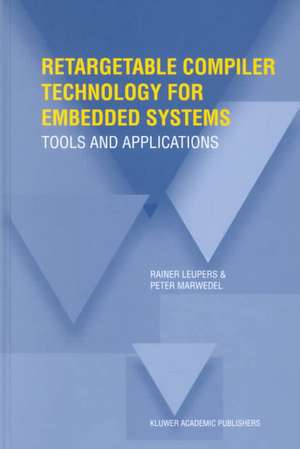
Retargetable Compiler Technology for Embedded Systems
Autor Rainer Leupers, Peter Marwedelen Limba Engleză Hardback – 31 oct 2001
Retargetable Compiler Technology for Embedded Systems is mostly self-contained and requires only fundamental knowledge in software and compiler design. It is intended to be a key reference for researchers and designers working on software, compilers, and processor optimization for embedded systems.
Preț: 665.99 lei
Preț vechi: 832.49 lei
-20%
Puncte Express: 999
Carte tipărită la comandă
Livrare economică 23 noiembrie-07 decembrie
Livrare prin curier în România Termenul estimat este afișat lângă disponibilitate.
Transport gratuit pentru acest produs Plată online sau ramburs, în funcție de opțiunile comenzii.
Retur gratuit în 14 zile Comandă securizată și suport în română.
Specificații
ISBN-13: 9780792375784
ISBN-10: 0792375785
Pagini: 196
Ilustrații: XII, 176 p.
Dimensiuni: 160 x 241 x 16 mm
Greutate: 0.41 kg
Ediția:2001
Editura: Springer
Locul publicării:New York, NY, United States
ISBN-10: 0792375785
Pagini: 196
Ilustrații: XII, 176 p.
Dimensiuni: 160 x 241 x 16 mm
Greutate: 0.41 kg
Ediția:2001
Editura: Springer
Locul publicării:New York, NY, United States
V-ar putea interesa
-
 -40%Preț: 493.63 lei823.98 lei
 -
 Embedded Systems: ARM Programming and OptimizationJason D. Bakos-34%Preț: 412.11 lei624.90 lei
 -
 ARM System-on-Chip ArchitectureSteve Furber-23%Preț: 591.53 lei768.22 lei
 -
 -41%Preț: 447.91 lei755.52 lei
 -
 -31%Preț: 438.72 lei638.36 lei
 -
 Programming Language PragmaticsMichael Scott-40%Preț: 484.42 lei806.85 lei
 -
 Modern Assembly Language Programming with the ARM ProcessorLarry D Pyeatt-31%Preț: 462.90 lei675.11 lei
 -
 Computer Architecture: A Quantitative ApproachJohn L. Hennessy-39%Preț: 536.81 lei884.58 lei
 -
 CompilersAlfred V. Aho-20%Preț: 629.07 lei786.34 lei
 -
 Computer Systems: A Programmer's Perspective, Global EditionRandal E. Bryant-20%Preț: 643.64 lei804.55 lei
 -
 Making Embedded SystemsElecia White-38%Preț: 200.48 lei324.68 lei
 -
 Modern C, Third EditionJens Gustedt-20%Preț: 350.34 lei437.92 lei
 -
 -35%Preț: 358.75 lei551.12 lei
 -
 Introduction to Computer Organization: ARM EditionRobert G. Plantz-35%Preț: 303.72 lei468.10 lei
 -
 Embedded C Coding StandardMichael Barr-20%Preț: 37.40 lei46.74 lei
 -
 -20%Preț: 531.38 lei664.22 lei
 -
 -20%Preț: 321.81 lei402.26 lei
 -
 -20%Preț: 321.81 lei402.26 lei
 -
 -20%Preț: 328.16 lei410.20 lei
 -
 Handbook of Hardware/Software CodesignSoonhoi Ha-18%Preț: 5725.98 lei6982.90 lei
Public țintă
ResearchCuprins
1. Introduction.- 2. Compilers in Embedded System Design.- 3. Some Compiler Technology Background.- 4. Historical Overview.- 5. Retargetable Compiler Case Studies.- 6. Summary and Outlook.- Appendices.- Tabular overview of compiler tools.- References.- About the authors.
Notă biografică
Stefan Schuermans started his computer science studies at RWTH Aachen University in 2000 and received his diploma degree with honors in 2005. Afterwards, he worked for secunet Security Networks AG, Essen as a software developer. In 2008, he joined the Chair for Software for Systems on Silicon at RWTH Aachen University. His research activities comprised simulation and estimation of power consumption at Electronic System Level as well as exploration and programming of MPSoC architectures. He joined Silexica GmbH, Köln in 2016 and adopted the position as Chief Architect in the same year. In 2018, he received his Ph.D. (Dr.-Ing.) degree from the Faculty of Electrical Engineering and Information Technology of RWTH Aachen University.
Rainer Leupers received the M.Sc. (Dipl.-Inform.) and Ph.D. (Dr. rer. nat.) degrees in Computer Science with honors from TU Dortmund in 1992 and 1997. From 1997-2001 he was the chief engineer at the Embedded Systems chair at TU Dortmund. In 2002, he joined RWTH Aachen University as a professor for Software for Systems on Silicon. His research comprises software development tools, processor architectures, and system-level electronic design automation, with focus on application-specific multicore systems. He published numerous books and technical papers and served in committees of the leading international EDA conferences. He received various scientific awards, including Best Paper Awards at DAC and twice at DATE, as well as several industrial awards. Dr. Leupers is also engaged as an entrepreneur and in turning novel technologies into innovations. He holds several patents on system-on-chip design technologies and has been a co-founder of LISATek (now with Synopsys), Silexica, and Secure Elements. He has served as consultant for various companies, as an expert for the European Commission, and in the management boards of large-scale projects like HiPEAC and UMIC. He is the coordinator of EU projects TETRACOM and TETRAMAX on academia/industry technology transfer.