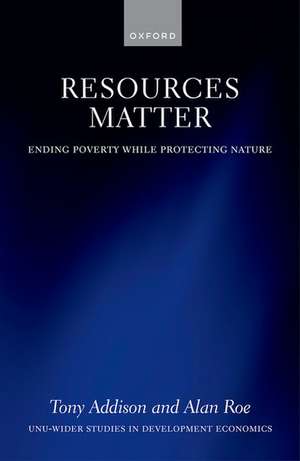
Resources Matter: Ending Poverty While Protecting Nature: WIDER Studies in Development Economics
Autor Tony Addison, Alan Roeen Limba Engleză Hardback – 19 dec 2024
Din seria WIDER Studies in Development Economics
- 32%
 Preț: 658.85 lei
 - 32%
 Preț: 545.13 lei
 - 32%
 Preț: 714.62 lei
 - 33%
 Preț: 545.09 lei
 - 32%
 Preț: 619.20 lei
 - 32%
 Preț: 824.47 lei
 - 32%
 Preț: 581.66 lei
 - 33%
 Preț: 538.29 lei
 - 33%
 Preț: 642.98 lei
 - 14%
 Preț: 875.04 lei
 - 16%
 Preț: 182.83 lei
 - 19%
 Preț: 682.02 lei
 - 33%
 Preț: 871.22 lei
 - 30%
 Preț: 521.71 lei
 - 21%
 Preț: 399.94 lei
 - 33%
 Preț: 1011.35 lei
 - 33%
 Preț: 1010.47 lei
 - 33%
 Preț: 962.98 lei
 - 33%
 Preț: 1124.84 lei
 - 33%
 Preț: 1059.37 lei
 - 22%
 Preț: 214.91 lei
 - 31%
 Preț: 729.89 lei
 - 21%
 Preț: 400.12 lei
 - 28%
 Preț: 454.43 lei
 - 33%
 Preț: 1248.59 lei
 - 33%
 Preț: 1253.02 lei
 - 28%
 Preț: 395.18 lei
 - 33%
 Preț: 1537.97 lei
 - 22%
 Preț: 1454.48 lei
 - 33%
 Preț: 1044.64 lei
 - 24%
 Preț: 580.26 lei
 - 33%
 Preț: 1248.79 lei
 - 33%
 Preț: 1058.40 lei
 - 28%
 Preț: 531.51 lei
 - 25%
 Preț: 606.73 lei
 - 33%
 Preț: 1081.18 lei
 - 33%
 Preț: 1188.06 lei
 - 30%
 Preț: 480.16 lei
 - 18%
 Preț: 490.29 lei
 - 33%
 Preț: 1409.72 lei
 - 33%
 Preț: 977.70 lei
 - 31%
 Preț: 1204.48 lei
 - 20%
 Preț: 366.44 lei
 - 30%
 Preț: 535.16 lei
Preț: 576.12 lei
Preț vechi: 854.00 lei
-33%
Puncte Express: 864
Carte disponibilă
Livrare economică 30 octombrie-10 noiembrie
Livrare prin curier în România Termenul estimat este afișat lângă disponibilitate.
Transport gratuit pentru acest produs Plată online sau ramburs, în funcție de opțiunile comenzii.
Retur gratuit în 14 zile Comandă securizată și suport în română.
Specificații
ISBN-13: 9780192872197
ISBN-10: 0192872192
Pagini: 240
Dimensiuni: 160 x 240 x 16 mm
Greutate: 0.48 kg
Editura: OUP OXFORD
Colecția OUP Oxford
Seria WIDER Studies in Development Economics
Locul publicării:Oxford, United Kingdom
ISBN-10: 0192872192
Pagini: 240
Dimensiuni: 160 x 240 x 16 mm
Greutate: 0.48 kg
Editura: OUP OXFORD
Colecția OUP Oxford
Seria WIDER Studies in Development Economics
Locul publicării:Oxford, United Kingdom
V-ar putea interesa
-
 The Looting MachineTom BurgisPreț: 79.75 lei
 -
 The Elements of PowerNicolas NiarchosPreț: 125.36 lei
 -
 The Plundered PlanetPaul Collier-19%Preț: 62.93 lei77.79 lei
 -
 Preț: 217.26 lei
 -
 Material WorldEd Conway-29%Preț: 66.81 lei94.55 lei
 -
 Volt RushHenry SandersonPreț: 77.96 lei
 -
 -27%Preț: 88.18 lei120.65 lei
 -
 Preț: 70.91 lei
 -
 Nature¿s Evil - A Cultural History of Natural ResourcesAlexander EtkindPreț: 131.91 lei
 -
 Capitalism at the LimitUlrich BrandPreț: 157.39 lei
 -
 On Natural CapitalPartha DasguptaPreț: 146.84 lei
 -
 Moral Case For Fossil FuelsAlex Epstein-24%Preț: 144.94 lei191.02 lei
 -
 The War BelowErnest Scheyder-18%Preț: 101.86 lei124.00 lei
 -
 The War Below: AS HEARD ON BBC RADIO 4 'TODAY'Ernest ScheyderPreț: 93.57 lei
 -
 -20%Preț: 67.49 lei84.46 lei
 -
 Ending Fossil FuelsHolly Jean BuckPreț: 76.76 lei
 -
 The Age of ExtractionTim WuPreț: 107.56 lei
 -
 Going NuclearTim GregoryPreț: 124.00 lei
 -
 The End of GrowthRichard HeinbergPreț: 109.70 lei
 -
 Standing up for the PlanetFrancesco PaganoPreț: 171.28 lei
Notă biografică
Tony Addison is a Professor of Economics at the University of Copenhagen Development Economics Research Group (DERG), and formerly Chief Economist and Deputy Director of the United Nations University World Institute for Development Economics Research (UNU-WIDER) in Helsinki. He was previously a Professor at Manchester University, and lecturer at the University of Warwick and SOAS, London University. He has 40 years of experience in the field of development economics. He has undertaken many advisory assignments for governments, and for ILO, IMF, UNICEF, and the World Bank. He began his career in Tanzania's Ministry of Trade and Industry.Alan Roe is Honorary Professorial Fellow at University of Warwick. Early in his career he was a research economist at the University of Dar-es-Salaam, at the University of Cambridge (Economic Growth Project) and a Visiting Professor of Economics at Washington University in the USA. He then taught economics for many years at the University of Warwick where he was also for a period the Chairman of Department. In 1994 he was appointed Principal Economist at the World Bank where he worked on the challenges of reform in the former Soviet republics of Ukraine, and Armenia. After leaving the Bank in 2000, he returned part-time to the University of Warwick where he is now, in retirement, an Honorary Professorial Fellow but also joined Oxford Policy Management (OPM) as Principal Economist and Board Director. He initiated OPM's involvement in the economics of mining and other natural resources issues. He has written extensively in books, academic journals, and for other outle
Cuprins
- 1: Living in a Materials World
- 2: Imperatives, Opportunities and Dilemmas
- 3: Recognizing the Risks
- 4: Seizing the Opportunities
- 5: Transforming Economies
- 6: Transforming States: Transparency and Corruption
- 7: Transforming States: Economic Management
- 8: Transforming Companies
- 9: Values, Knowledge, and Interests