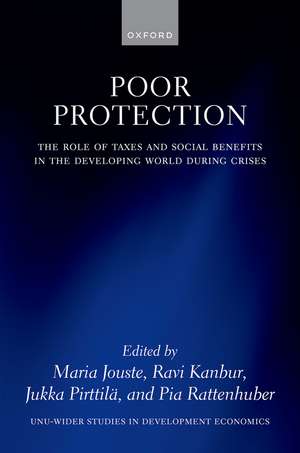
Poor Protection: The Role of Taxes and Social Benefits in the Developing World During Crises: WIDER Studies in Development Economics
Maria Jouste, Ravi Kanbur, Jukka Pirttilä, Pia Rattenhuberen Limba Engleză Hardback – 6 noi 2025
Descoperim în Poor Protection un model analitic riguros dedicat modului în care arhitectura fiscală și sistemele de asistență socială pot proteja economiile emergente în fața șocurilor externe. Considerăm că propunerea centrală a volumului — necesitatea unui „stress testing” sistematic pentru politicile de protecție socială — reprezintă un salt metodologic esențial. Autorii demonstrează că, în absența unor mecanisme automate de stabilizare, țările în curs de dezvoltare rămân vulnerabile la fluctuații bruște, precum cele cauzate de pandemii sau de criza prețurilor la energie. Găsim aici o analiză tehnică a modului în care sistemele de taxe și beneficii pot fi recalibrate pentru a oferi asistență rapidă pe întreaga distribuție a veniturilor, nu doar ca soluție de avarie, ci ca structură sustenabilă de reziliență.
Stilul lucrării este unul autoritar și fundamentat pe date, evitând generalitățile în favoarea unor soluții de politică publică acționabile. Ca și A. Barrientos în Social Protection for the Poor and Poorest, editorii acestui volum distilează experiența reală a crizelor recente în principii de guvernanță economică, însă Poor Protection merge mai departe, integrând dimensiunea fiscală ca element inseparabil de cel social. În timp ce Dominic de Cogan în Tax Law in Times of Crisis and Recovery explorează constrângerile juridice ale fiscalității, lucrarea de față se concentrează pe funcția de redistribuire și pe crearea spațiului fiscal necesar pentru a preveni adâncirea inegalităților. Este o resursă vitală pentru înțelegerea mecanismelor care permit unei economii să traverseze o perioadă de contracție fără a sacrifica segmentele cele mai expuse ale populației.
Din seria WIDER Studies in Development Economics
- 32%
 Preț: 545.13 lei
 - 32%
 Preț: 714.62 lei
 - 32%
 Preț: 558.37 lei
 - 32%
 Preț: 590.18 lei
 - 32%
 Preț: 619.20 lei
 - 32%
 Preț: 829.43 lei
 - 19%
 Preț: 700.68 lei
 - 33%
 Preț: 538.29 lei
 - 31%
 Preț: 664.65 lei
 - 14%
 Preț: 875.04 lei
 - 16%
 Preț: 182.83 lei
 - 19%
 Preț: 682.02 lei
 - 33%
 Preț: 871.22 lei
 - 29%
 Preț: 539.26 lei
 - 20%
 Preț: 413.34 lei
 - 32%
 Preț: 1045.53 lei
 - 33%
 Preț: 1010.47 lei
 - 33%
 Preț: 962.98 lei
 - 32%
 Preț: 1162.87 lei
 - 32%
 Preț: 1095.19 lei
 - 22%
 Preț: 214.91 lei
 - 30%
 Preț: 754.51 lei
 - 20%
 Preț: 413.53 lei
 - 28%
 Preț: 454.43 lei
 - 32%
 Preț: 1290.85 lei
 - 32%
 Preț: 1295.43 lei
 - 27%
 Preț: 408.44 lei
 - 33%
 Preț: 1537.97 lei
 - 21%
 Preț: 1503.66 lei
 - 32%
 Preț: 1079.96 lei
 - 24%
 Preț: 580.26 lei
 - 32%
 Preț: 1291.04 lei
 - 32%
 Preț: 1094.17 lei
 - 27%
 Preț: 549.39 lei
 - 25%
 Preț: 606.73 lei
 - 31%
 Preț: 1117.74 lei
 - 32%
 Preț: 1228.24 lei
 - 29%
 Preț: 496.30 lei
 - 18%
 Preț: 490.29 lei
 - 32%
 Preț: 1457.43 lei
 - 32%
 Preț: 1010.74 lei
 - 30%
 Preț: 1245.23 lei
 - 19%
 Preț: 378.70 lei
 - 29%
 Preț: 553.18 lei
Preț: 659.22 lei
Preț vechi: 968.16 lei
-32%
Carte disponibilă
Livrare economică 13-24 noiembrie
Livrare express 30 octombrie-05 noiembrie pentru 174.26 lei
Specificații
ISBN-10: 019890942X
Pagini: 368
Dimensiuni: 163 x 240 x 25 mm
Greutate: 0.7 kg
Editura: OUP OXFORD
Colecția OUP Oxford
Seria WIDER Studies in Development Economics
Locul publicării:Oxford, United Kingdom
V-ar putea interesa
-
 The Third PillarRaghuram RajanPreț: 108.24 lei
 -
 Crisis EconomicsNouriel Roubini-18%Preț: 65.57 lei79.82 lei
 -
 Left BehindPaul CollierPreț: 93.10 lei
 -
 Social Security in Developing CountriesEhtisham Ahmad-21%Preț: 259.19 lei327.42 lei
 -
 How States Respond to Crisis: Pandemic Governance Across the Global SouthRachel M. Gisselquist-32%Preț: 558.37 lei821.28 lei
 -
 How Not to Die (Too Soon)Devi SridharPreț: 159.77 lei
 -
 2020Eric KlinenbergPreț: 154.98 lei
 -
 Shared Prosperity in a Fractured WorldDani RodrikPreț: 165.98 lei
 -
 Hunger Inc.: Building Solidarity Beyond the Food BankKayleigh GarthwaitePreț: 122.16 lei
 -
 Resilience: Why Things Bounce BackAndrew Zolli-7%Preț: 73.88 lei79.56 lei
 -
 -8%Preț: 443.84 lei482.44 lei
 -
 -17%Preț: 158.15 lei190.00 lei
 -
 Pandemic Policies and Resistance: Southern Feminist Critiques in Times of Covid-19Masaya Llavaneras Blanco-14%Preț: 167.24 lei195.47 lei
 -
 Pandemics, Poverty, and PoliticsTyler B. EvansPreț: 310.82 lei
 -
 Developing Countries: Political, Economic & Social IssuesArthur Ramazzotti-27%Preț: 1331.54 lei1813.60 lei
 -
 LifehouseAdam GreenfieldPreț: 92.16 lei
 -
 Against the CrisisStåle HolgersenPreț: 153.25 lei
 -
 Doom LoopEswar S. PrasadPreț: 185.03 lei
 -
 Food FightStuart GillespiePreț: 146.22 lei
 -
 -18%Preț: 797.17 lei972.16 lei
De ce să citești această carte
Această carte se adresează economiștilor, decidenților politici și specialiștilor în dezvoltare care caută soluții concrete pentru consolidarea rezilienței naționale. Cititorul va câștiga o înțelegere profundă a designului sistemelor de protecție socială capabile să acționeze ca stabilizatori automatici. Este un instrument esențial pentru cei care doresc să implementeze politici fiscale care nu doar colectează venituri, ci protejează activ nivelul de trai în timpul recesiunilor globale.
Despre autor
Volumul este coordonat de o echipă de experți de renume, printre care Ravi Kanbur, profesor la Universitatea Cornell și fost economist șef pentru Africa la Banca Mondială, alături de Jukka Pirttilä, Maria Jouste și Pia Rattenhuber, cercetători afiliați UNU-WIDER. Expertiza lor combinată acoperă economia dezvoltării, politicile fiscale și sistemele de protecție socială în sudul global. Aceștia au contribuit semnificativ la literatura academică privind inegalitatea și rolul statului în economiile în curs de dezvoltare, oferind prin această lucrare o sinteză a cercetărilor derulate în cadrul Institutului Mondial pentru Cercetarea Economiei Dezvoltării al Universității Națiunilor Unite.
Descriere
Notă biografică
Cuprins
- 1: Jukka Pirttilä, Maria Jouste, Ravi Kanbur; Pia Rattenhuber: Introduction: Protecting the poor and vulnerable when crises are the New Normal
- 2: Rodrigo Oliveira, Jesse Lastunen, Pia Rattenhuber, Melissa Samarin; Adnan Shahir: Strengthening resilience: Investigating the effectiveness of social protection and tax policies in cushioning income and poverty impacts amidst crises in low- and middle-income countries: A scoping review
- Part I Performance of tax-benefit systems during crises
- 3: Katrin Gasior, Iva V. Tasseva; Gemma Wright: The impact of social protection on poverty through normal times and times of crisis: Evidence from Ghana, Mozambique, Tanzania, Uganda, and Zambia
- 4: Jesse Lastunen, Adnan Shahir, Pia Rattenhuber, Kwabena Adu-Ababio; Rodrigo C. Oliveira: Performance of tax-benefit systems during the COVID-19 pandemic in sub-Saharan Africa: A comparative perspective
- 5: David Rodríguez Guerrero, H. Xavier Jara, Mariana Dondo, Cristina Arancibia, David Macas Romero, Rebeca Riella, Joana Urraburu, Linda Llamas, Luis Huesca, Javier Torres; Rodrigo Chang: The role of taxes and benefits in protecting household incomes during the COVID-19 pandemic: An analysis of seven Latin American countries
- 6: Antoine de Mahieu;Jesse Lastunen: The cushioning effects of tax-benefit policies in Viet Nam during the COVID-19 pandemic
- Part II Income developments and specific policies during COVID-19
- 7: Timothy Köhler, Haroon Bhorat;Robert Hill: The effect of wage subsidies on job retention: Evidence from South Africa during the COVID-19 pandemic
- 8: Cuong Viet Nguyen: The impact of COVID-19 lockdowns and aid packages in Vietnam
- 9: Olivier Bargain, Paul Carrillo-Maldonado, and H. Xavier Jara: Top earnings and inequality during the COVID-19 pandemic in Ecuador: Evidence from administrative data
- Part III Looking ahead
- 10: Annalena Oppel: Social protection floor gaps and pandemic relief: Embracing universalism?
- 11: Enrico Nichelatti, Maria Jouste;Pia Rattenhuber: The potential of universal basic income schemes to buffer shocks: Comparing Uganda and Zambia during COVID-19
- 12: Adnan Shahir, Ravi Kanbur, Jukka Pirttilä; Pia Rattenhuber: Targeted versus universal benefits: Poverty-reduction performance in times of crisis
- 13: Dingquan Miao, Ravi Kanbur;Jukka Pirttilä: Optimal taxation in crisis times: Simulation results for Zambia
- Part IV Summary and policy takeaways
- 14: Rattenhuber: Summary
- 15: Jukka Pirttilä, Maria Jouste, Ravi Kanbur; Pia Rattenhuber: Discussion of main policy implications