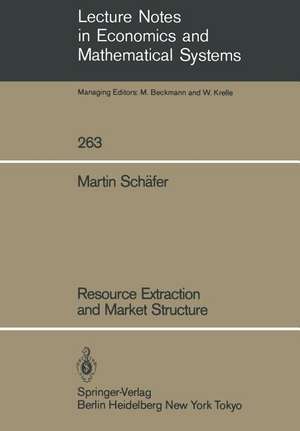
Resource Extraction and Market Structure: Lecture Notes in Economics and Mathematical Systems, cartea 263
Autor Martin Schäferen Limba Engleză Paperback – feb 1986
Din seria Lecture Notes in Economics and Mathematical Systems
-
 Preț: 368.38 lei
 -
 Preț: 365.65 lei
 -
 Preț: 428.35 lei
 -
 Preț: 478.67 lei
 -
 Preț: 365.90 lei
 -
 Preț: 398.93 lei
 -
 Preț: 384.48 lei
 - 15%
 Preț: 646.64 lei
 -
 Preț: 364.71 lei
 -
 Preț: 437.64 lei
 -
 Preț: 370.76 lei
 - 15%
 Preț: 618.65 lei
 -
 Preț: 363.99 lei
 -
 Preț: 331.98 lei
 -
 Preț: 409.58 lei
 -
 Preț: 363.18 lei
 - 18%
 Preț: 778.82 lei
 -
 Preț: 377.68 lei
 -
 Preț: 405.53 lei
 - 15%
 Preț: 620.72 lei
 -
 Preț: 367.23 lei
 -
 Preț: 363.18 lei
 - 15%
 Preț: 611.54 lei
 - 15%
 Preț: 621.61 lei
 -
 Preț: 363.41 lei
 -
 Preț: 430.76 lei
 - 15%
 Preț: 618.65 lei
 -
 Preț: 371.37 lei
 - 15%
 Preț: 629.18 lei
 -
 Preț: 399.23 lei
 -
 Preț: 395.12 lei
 -
 Preț: 383.75 lei
 -
 Preț: 383.75 lei
 -
 Preț: 377.40 lei
 - 15%
 Preț: 610.96 lei
 - 20%
 Preț: 628.32 lei
 -
 Preț: 365.45 lei
 -
 Preț: 476.60 lei
 -
 Preț: 363.14 lei
 - 15%
 Preț: 611.04 lei
 -
 Preț: 371.20 lei
 -
 Preț: 364.19 lei
 - 15%
 Preț: 640.81 lei
 -
 Preț: 364.48 lei
 - 15%
 Preț: 611.19 lei
 -
 Preț: 365.09 lei
 - 15%
 Preț: 613.62 lei
 - 15%
 Preț: 612.55 lei
 -
 Preț: 432.70 lei
Preț: 367.85 lei
Puncte Express: 552
Carte tipărită la comandă
Livrare economică 08-22 decembrie
Livrare prin curier în România Termenul estimat este afișat lângă disponibilitate.
Transport gratuit de la 400.00 lei Plată online sau ramburs, în funcție de opțiunile comenzii.
Retur gratuit în 14 zile Comandă securizată și suport în română.
Specificații
ISBN-13: 9783540160816
ISBN-10: 3540160817
Pagini: 172
Ilustrații: XI, 157 p.
Dimensiuni: 170 x 244 x 9 mm
Greutate: 0.28 kg
Ediția:Softcover reprint of the original 1st ed. 1986
Editura: Springer Berlin, Heidelberg
Colecția Springer
Seria Lecture Notes in Economics and Mathematical Systems
Locul publicării:Berlin, Heidelberg, Germany
ISBN-10: 3540160817
Pagini: 172
Ilustrații: XI, 157 p.
Dimensiuni: 170 x 244 x 9 mm
Greutate: 0.28 kg
Ediția:Softcover reprint of the original 1st ed. 1986
Editura: Springer Berlin, Heidelberg
Colecția Springer
Seria Lecture Notes in Economics and Mathematical Systems
Locul publicării:Berlin, Heidelberg, Germany
V-ar putea interesa
-
 Managing the Chinese EnvironmentRichard Louis Edmonds-27%Preț: 357.19 lei486.60 lei
 -
 International Environmental Economics: A Survey of the IssuesGünther G. Schulze-19%Preț: 261.26 lei322.03 lei
 -
 Green to GoldAndrew WinstonPreț: 135.76 lei
 -
 Security and Environmental ChangeSimon DalbyPreț: 193.28 lei
 -
 SustainagilityPatrick DixonPreț: 279.11 lei
 -
 Green Economics: An Introduction to Theory, Policy and PracticeMolly Scott CatoPreț: 456.37 lei
 -
 Preț: 416.63 lei
 -
 Green Scorecard: Measuring the Return on Investment in Sustainability InitiativesPatricia Pulliam PhillipsPreț: 184.04 lei
 -
 Howell, D: Empires in CollisionDavid Howell-12%Preț: 120.19 lei136.51 lei
Public țintă
ResearchCuprins
I Dynamic Models of Resource Extraction in Markets of Monopoly or Pure Competition with Full Information.- 1. Hotelling’s Model.- 2. Optimal Extraction Rates and Exploration.- 2.1 Pure Competition.- 2.2 Monopoly.- 3. Optimal Extraction Rates and Constant Elasticity of Demand.- 4. Market Structure and Optimal Depletion Rates.- 4.1 Pure Competition.- 4.2 Monopoly.- 5. Extraction of an Exhaustible Resource and Production of a Substitute.- 5.1 Social Optimum.- 5.2 Extraction of the Resource and Production of the Substitute by the same Monopoly.- 5.3 Many Owners of the Resource and Production of the Substitute by Monopoly.- 5.4 Many Owners of the Resource and Production of the Substitute by all.- 6. Extraction of Durable Exhaustible Resources.- 6.1 Discrete Time.- 6.2 Continuous Time.- 6.2.1 Pure Competition.- 6.2.2 Monopoly.- 7. Conclusions.- II Dynamic Models with Uncertainty and Monopolistic Markets or Pure Competition.- 1. Optimal Extraction Rates and Uncertainty with Respect to R&D towards Future Technologies.- 1.1 Exogenous Technical Progress.- 1.1.1 Basic Model.- 1.1.2 First Extension: Production.- 1.1.3 Second Extension: Exhaustible Resources.- 1.1.4 Third Extension: Uncertainty about the Future Technological Development.- 1.2 Endogenous Technical Progress.- 1.2.1 Basic Model.- 1.2.2 Modification of the Basic Model.- 1.2.3 Example with Exponentially Distributed Z.- 2. Optimal Extraction Rates and Unknown Reserves.- 2.1 Monopolistic Extraction Rates Depending on Time only.- 2.2 Monopolistic Extraction Rates Depending on Time and Quantities already Extracted.- 2.3 Optimal Extraction Rates and Pure Competition.- 2.3.1 Basic Model.- 2.3.2 Example with Two Suppliers.- 2.4 Optimal Extraction Rates from Consumer’s View.- 2.4.1 Basic Model.- 2.4.2 Example withExponentially Distributed Z.- 2.5 Pure Competition and Optimal Extraction.- 3. Optimal Extraction Rates and Unknown Costs of the Development of a Substitute.- 3.1 One-period Analysis and Monopoly.- 3.2 One-period Analysis and Pure Competition.- 3.3 Two-period Analysis.- 3.3.1 Optimal Extraction and One Decision Maker.- 3.3.1.1 Basic Model.- 3.3.1.2 Example with Linear Demand.- 3.3.2 Optimal Extraction and Pure Competition.- 3.3.3 Extraction of the Resource and Production of the Substitute by Exactly One Monopoly.- 4. Conclusions.- III Short Introduction to the Theory of Differential Games.- IV Dynamic Models of Resource Extraction and Duopolistic Markets.- 1. An Introductory Duopoly Model with Production Strategies.- 2. Duopoly with Price Strategies and Exploration.- 2.1 Open-loop Controls.- 2.2 Closed-loop Controls.- 3. A Duopoly Model with Quantity Strategies.- 3.1 Introduction of the Model.- 3.2 Specialization of the Model: Linear-Quadratic Differential Game.- 4. Cartelization and Optimal Extraction of Exhaustible Resources.- 4.1 Pure Competition.- 4.2 Monopolistic Behaviour of the Cartel.- 4.3 Implications of Cartelization to the Profits of the Non-Cartel.- 5. Oligopoly with Discrete Time Parameter.- 6. Conclusions.- V Oligopolistic Extraction with Continuous Time.- 1. Basic Model with Quantity Strategies.- 1.1 Introduction of the Model.- 1.2 Algorithm for the Determination of a Nash Equilibrium.- 2. Specializations of the Basic Model.- 2.1 Fixed Resource Stock.- 2.2 Deterministic Expandable Resource Stocks.- 3. Oligopoly and Price Strategies.- 4. Conclusions.