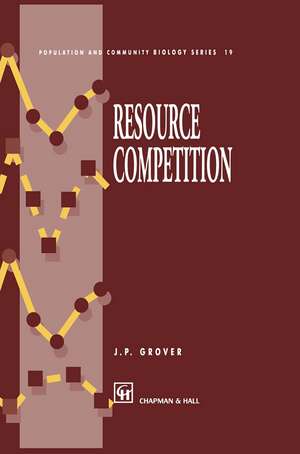
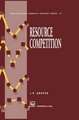
Resource Competition: Population and Community Biology Series, cartea 19
Autor James P. Groveren Limba Engleză Paperback – 2 noi 2012
Din seria Population and Community Biology Series
- 15%
 Preț: 665.54 lei
 - 18%
 Preț: 1262.27 lei
 -
 Preț: 389.13 lei
 -
 Preț: 369.85 lei
 -
 Preț: 385.10 lei
 -
 Preț: 379.62 lei
 - 15%
 Preț: 614.41 lei
 -
 Preț: 370.91 lei
 - 5%
 Preț: 362.47 lei
 - 18%
 Preț: 1262.48 lei
 -
 Preț: 369.16 lei
 - 24%
 Preț: 1187.31 lei
 - 18%
 Preț: 1168.53 lei
 - 24%
 Preț: 1117.23 lei
 - 18%
 Preț: 1261.56 lei
 - 18%
 Preț: 1598.06 lei
 - 18%
 Preț: 1483.50 lei
 - 18%
 Preț: 966.92 lei
 - 18%
 Preț: 983.00 lei
 - 15%
 Preț: 611.27 lei
 - 18%
 Preț: 980.46 lei
 - 24%
 Preț: 831.70 lei
 - 15%
 Preț: 622.64 lei
 -
 Preț: 381.55 lei
 - 18%
 Preț: 1338.98 lei
 - 18%
 Preț: 1275.52 lei
 - 15%
 Preț: 631.79 lei
 -
 Preț: 371.73 lei
 -
 Preț: 385.84 lei
 - 15%
 Preț: 643.25 lei
Preț: 910.58 lei
Preț vechi: 1110.47 lei
-18%
Puncte Express: 1366
Carte tipărită la comandă
Livrare economică 26 noiembrie-10 decembrie
Livrare prin curier în România Termenul estimat este afișat lângă disponibilitate.
Transport gratuit pentru acest produs Plată online sau ramburs, în funcție de opțiunile comenzii.
Retur gratuit în 14 zile Comandă securizată și suport în română.
Specificații
ISBN-13: 9781461379393
ISBN-10: 1461379393
Pagini: 356
Ilustrații: X, 342 p.
Dimensiuni: 155 x 235 x 19 mm
Greutate: 0.5 kg
Ediția:Softcover reprint of the original 1st ed. 1997
Editura: Springer Us
Colecția Springer
Seria Population and Community Biology Series
Locul publicării:New York, NY, United States
ISBN-10: 1461379393
Pagini: 356
Ilustrații: X, 342 p.
Dimensiuni: 155 x 235 x 19 mm
Greutate: 0.5 kg
Ediția:Softcover reprint of the original 1st ed. 1997
Editura: Springer Us
Colecția Springer
Seria Population and Community Biology Series
Locul publicării:New York, NY, United States
V-ar putea interesa
-
 Cradle to CradleMichael Braungart-19%Preț: 57.49 lei71.32 lei
 -
 The Revenge of GaiaJames Lovelock-21%Preț: 61.73 lei77.71 lei
 -
 The Vanishing Face of GaiaJames Lovelock-32%Preț: 63.04 lei92.24 lei
 -
 -18%Preț: 254.28 lei309.47 lei
 -
 Ecological Methods in Forest Pest ManagementDavid Wainhouse-32%Preț: 697.76 lei1032.21 lei
 -
 DispersalJean Clobert-28%Preț: 456.75 lei634.14 lei
 -
 Symbiotic InteractionsA. E. Douglas-21%Preț: 299.10 lei378.72 lei
 -
 -12%Preț: 358.96 lei408.64 lei
 -
 ColdStreeverPreț: 124.78 lei
 -
 The Unified Neutral Theory of Biodiversity and BiogeographyStephen P. Hubbell-19%Preț: 634.43 lei783.25 lei
 -
 The Great DisruptionPaul Gilding-28%Preț: 85.41 lei118.55 lei
 -
 WILD LAW SECOND EDITION SECO 2Cormac Cullinan-42%Preț: 112.41 lei193.16 lei
Public țintă
ResearchCuprins
1 Introduction.- 1.1 Resources.- 1.2 A paradigm of population growth.- 1.3 Competition and resources.- 1.4 Classical competition theory.- 1.5 Concluding remarks.- 2 Theoretical and experimental foundations.- 2.1 Introduction.- 2.2 Chemostat models.- 2.3 Competition for a single abiotic resource.- 2.4 Competition for two abiotic resources.- 2.5 Concluding remarks.- 3 Experimental studies of resource competition.- 3.1 Introduction.- 3.2 General overview.- 3.3 Microorganisms.- 3.4 Higher plants.- 3.5 Metazoa.- 3.6 Concluding remarks.- 4 Critiques.- 4.1 Introduction.- 4.2 The logical structure of theory and experimentation.- 4.3 Critiques of resource competition theory.- 4.4 A look ahead.- 5 Nonequilibrium resource competition.- 5.1 General notions.- 5.2 Experimental and theoretical studies of plankton.- 5.3 Competition for biotic resources.- 5.4 Other approaches.- 5.5 Remaining issues.- 6 Competition within food webs.- 6.1 Introduction.- 6.2 A resource-dependent food web.- 6.3 Special cases of the resource-dependent food web.- 6.4 Remaining issues.- 6.5 Conclusions.- 7 Spatial heterogeneity.- 7.1 Introduction.- 7.2 General approaches.- 7.3 Island or site-based models.- 7.4 Continuum models.- 7.5 Stepping-stone models.- 7.6 Empirical and theoretical challenges.- 7.7 Conclusions.- 8 Competition for light.- 8.1 Introduction.- 8.2 The vertical nature of light supply, consumption and photosynthesis.- 8.3 Horizontal aspects of competition for light.- 8.4 Temporal aspects of competition for light.- 8.5 Conclusions and remaining issues.- 9 Resource competition and evolution.- 9.1 Introduction.- 9.2 Purely phenotypic approaches.- 9.3 Genetic approaches.- 9.4 Conclusions and remaining issues.- 10 Applications.- 10.1 Introduction.- 10.2 Water quality management.- 10.3 Medicine.- 10.4Conservation.- 10.5 Conclusions and remaining issues.- 11 Conclusions.- 11.1 Introductory remarks.- 11.2 The current status of resource competition.- 11.3 Concluding remarks.- References.