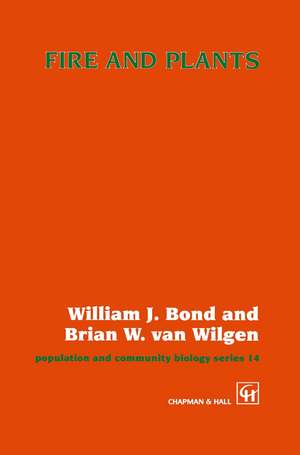
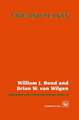
Fire and Plants: Population and Community Biology Series, cartea 14
Autor William J. Bond, B.W. van Wilgenen Limba Engleză Paperback – 28 sep 2011
Din seria Population and Community Biology Series
- 15%
 Preț: 665.54 lei
 - 18%
 Preț: 1262.27 lei
 -
 Preț: 389.13 lei
 -
 Preț: 369.85 lei
 -
 Preț: 385.10 lei
 -
 Preț: 379.62 lei
 - 15%
 Preț: 614.41 lei
 -
 Preț: 370.91 lei
 - 5%
 Preț: 362.47 lei
 - 18%
 Preț: 1262.48 lei
 -
 Preț: 369.16 lei
 - 24%
 Preț: 1187.31 lei
 - 24%
 Preț: 1117.23 lei
 - 18%
 Preț: 1261.56 lei
 - 18%
 Preț: 1598.06 lei
 - 18%
 Preț: 1483.50 lei
 - 18%
 Preț: 966.92 lei
 - 18%
 Preț: 983.00 lei
 - 15%
 Preț: 611.27 lei
 - 18%
 Preț: 980.46 lei
 - 24%
 Preț: 831.70 lei
 - 15%
 Preț: 667.86 lei
 -
 Preț: 381.55 lei
 - 18%
 Preț: 1338.98 lei
 - 18%
 Preț: 1275.52 lei
 - 15%
 Preț: 631.79 lei
 -
 Preț: 371.73 lei
 -
 Preț: 385.84 lei
 - 15%
 Preț: 643.25 lei
Preț: 1168.53 lei
Preț vechi: 1425.04 lei
-18%
Puncte Express: 1753
Carte tipărită la comandă
Livrare economică 30 noiembrie-14 decembrie
Livrare prin curier în România Termenul estimat este afișat lângă disponibilitate.
Transport gratuit pentru acest produs Plată online sau ramburs, în funcție de opțiunile comenzii.
Retur gratuit în 14 zile Comandă securizată și suport în română.
Specificații
ISBN-13: 9789401071703
ISBN-10: 9401071705
Pagini: 280
Ilustrații: VIII, 263 p.
Dimensiuni: 155 x 235 x 15 mm
Greutate: 0.39 kg
Ediția:Softcover reprint of the original 1st ed. 1996
Editura: SPRINGER NETHERLANDS
Colecția Springer
Seria Population and Community Biology Series
Locul publicării:Dordrecht, Netherlands
ISBN-10: 9401071705
Pagini: 280
Ilustrații: VIII, 263 p.
Dimensiuni: 155 x 235 x 15 mm
Greutate: 0.39 kg
Ediția:Softcover reprint of the original 1st ed. 1996
Editura: SPRINGER NETHERLANDS
Colecția Springer
Seria Population and Community Biology Series
Locul publicării:Dordrecht, Netherlands
Public țintă
ResearchCuprins
1 Introduction.- 1.1 The global importance of fire.- 1.2 Why we have written this book.- 1.3 What this book is about.- 1.4 Methods of fire ecology.- 1.5 Ecological concepts and fire ecology.- 1.6 Fire and the ecology of plants.- 2 Why and how do ecosystems burn?.- 2.1 The fire regime.- 2.2 Prerequisites for fire.- 2.3 Plants as ‘fuel’: what makes vegetation flammable?.- 2.4 Fire recurrence intervals and their measurement.- 2.5 Temperature of fires and survival of plant tissues.- 2.6 Conclusions.- 3 Surviving fires — vegetative and reproductive responses.- 3.1 Vegetative survival.- 3.2 The post-burn environment as reproductive stimulus.- 3.3 Reproduction and fire.- 3.4 Fire life-histories.- 3.5 Conclusions.- 4 Plant demography and fire I. Interval-dependent effects.- 4.1 Introduction.- 4.2 Types of population growth.- 4.3 Modelling populating growth.- 4.4 Demography and the fire-interval hypothesis.- 4.5 Density dependence and population regulation — the self-regulatory hypothesis.- 4.6 Event-dependent dynamics and population regulation.- 4.7 Conclusion.- 5 Plant demography and fire II. Event-dependent effects.- 5.1 Introduction.- 5.2 Effects of fire intensity and season on survival.- 5.3 Effects of fire intensity and season on recruitment.- 5.4 Effects of climate variation on recruitment.- 5.5 Effects of ground fires.- 5.6 Effects of fire area.- 5.7 The causes of event-dependent effects.- 5.8 Explaining survival patterns.- 5.9 Explaining recruitment patterns.- 5.10 Predicting event-dependent effects.- 5.11 Event-dependent effects in different biomes.- 5.12 Conclusions.- 6 Fire and the evolutionary ecology of plants.- 6.1 Fire and the evolution of plant traits.- 6.2 Sprouters versus non-sprouters.- 6.3 Life-history evolution.- 6.4 Timing of reproduction andrecruitment.- 6.5 Evolution of fire-survival traits.- 6.6 Evolution of flammability.- 6.7 Conclusions.- 7 Fire, competition and the organization of communities.- 7.1 Introduction.- 7.2 What determines changes in plant communities over time?.- 7.3 What determines spatial patterns in communities?.- 7.4 Which combinations of species occur together and why?.- 7.5 Determinants of species diversity.- 7.6 Which rules for which communities?.- 7.7 Conclusions.- 8 Fire and management.- 8.1 Introduction.- 8.2 Fire as a versatile management practice.- 8.3 Predicting the ecological effects of fire.- 8.4 Managing fires.- 8.5 Conclusions.- 9 Fire and the ecology of a changing world.- 9.1 Introduction.- 9.2 Climate, fire and biogeography.- 9.3 Changing patterns of fire in modern landscapes.- 9.4 Ecological consequences of changing fire regimes.- 9.5 Conclusions.- References.- Species Index.