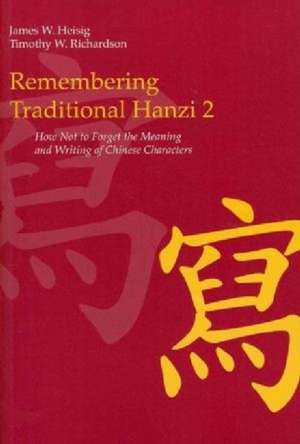
Remembering Traditional Hanzi 2
Autor James W. Heisig, Timothy W Richardsonen Limba Engleză Paperback – 31 ian 2012
Evoluția pedagogiei limbilor asiatice a demonstrat că memorarea prin repetiție mecanică este ineficientă pentru sistemele logografice complexe. Observăm că Remembering Traditional Hanzi 2 consolidează o schimbare de paradigmă în sinologie, prioritizând structura cognitivă a învățării în fața frecvenței brute a utilizării. Această lucrare, publicată de University of Hawaii Press, finalizează proiectul început de James W. Heisig și Timothy W Richardson, adăugând ultimele 1.500 de caractere necesare pentru a atinge pragul de 3.000 de unități fundamentale în scrierea tradițională. Spre deosebire de metodele care se concentrează pe pronunție, autorii utilizează „memoria imaginativă”, un sistem în care fiecare caracter este descompus în „elemente primitive”. Recomandăm atenție modului în care volumul extinde cadrul propus de Remembering Simplified Hanzi 2 cu date noi din sfera variantelor tradiționale, oferind o alternativă riguroasă pentru studenții care vizează textele din Taiwan, Hong Kong sau literatura clasică. Structura este flexibilă: lecțiile pot fi parcurse după finalizarea primului volum sau în paralel, permițând o înțelegere organică a modului în care componentele simple se cuibăresc în caractere complexe. Spre deosebire de The Second 100 Chinese Characters: Simplified Character Edition de Alison Matthews, care se limitează la un set restrâns de caractere, lucrarea lui Heisig oferă un sistem complet și unitar. Formatul include indici detaliați și o secțiune inovatoare despre „compuși” — caractere care funcționează optim atunci când sunt învățate împreună. Este o resursă academică ce transformă radical ritmul de retenție, eliminând confuzia vizuală prin povești mnemotehnice bine ancorate.
Preț: 215.11 lei
Carte disponibilă
Livrare economică 07-21 noiembrie
Specificații
ISBN-10: 0824836561
Pagini: 336
Dimensiuni: 153 x 228 x 22 mm
Greutate: 0.52 kg
Editura: University of Hawaii Press
V-ar putea interesa
-
 Chinese CharactersL. Wieger-20%Preț: 238.31 lei296.08 lei
 -
 -23%Preț: 149.64 lei193.99 lei
 -
 Preț: 109.28 lei
 -
 Preț: 122.09 lei
 -
 -16%Preț: 61.58 lei73.73 lei
 -
 -49%Preț: 62.81 lei123.05 lei
 -
 -17%Preț: 61.55 lei73.73 lei
 -
 Preț: 87.55 lei
 -
 -16%Preț: 105.89 lei126.12 lei
 -
 Preț: 40.02 lei
 -
 Remembering Simplified Hanzi 1James W. HeisigPreț: 185.68 lei
 -
 Remembering Traditional Hanzi 1James W. HeisigPreț: 243.22 lei
 -
 Preț: 222.09 lei
 -
 Remembering the Kanji 3James W. HeisigPreț: 273.93 lei
 -
 Chinese Characters: A Genealogy and DictionaryRick HarbaughPreț: 175.41 lei
 -
 Preț: 123.63 lei
 -
 -30%Preț: 218.79 lei314.13 lei
 -
 -19%Preț: 579.91 lei715.94 lei
De ce să citești această carte
Recomandăm această lucrare studenților care au parcurs deja primul volum și doresc să stăpânească scrierea tradițională la nivel avansat. Prin metoda Heisig, cititorul câștigă o strategie de memorare pe termen lung, nu doar o listă de vocabular. Este instrumentul ideal pentru a trece de la recunoașterea de bază la fluența în scrierea și citirea a 3.000 de caractere chinezești, folosind logica vizuală în locul efortului brut.
Despre autor
James W. Heisig este un cercetător renumit la Institutul Nanzan pentru Religie și Cultură din Nagoya, Japonia. Este cunoscut la nivel mondial pentru revoluționarea metodelor de învățare a caracterelor chinezești (Hanzi) și japoneze (Kanji) prin mnemotehnici vizuale. Timothy W Richardson colaborează în această serie pentru a adapta rigoarea lingvistică la nevoile studenților moderni. Împreună, au creat un sistem pedagogic ce a devenit standard în studiul autodidact și universitar al limbilor est-asiatice.