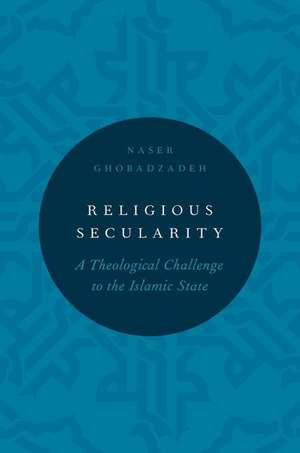
Religious Secularity: A Theological Challenge to the Islamic State: Religion and Global Politics
Autor Naser Ghobadzadehen Limba Engleză Hardback – 15 ian 2015
Din seria Religion and Global Politics
- 16%
 Preț: 219.90 lei
 - 30%
 Preț: 407.41 lei
 - 30%
 Preț: 442.41 lei
 - 30%
 Preț: 468.66 lei
 - 26%
 Preț: 165.08 lei
 - 31%
 Preț: 914.13 lei
 - 19%
 Preț: 369.09 lei
 - 11%
 Preț: 353.60 lei
 - 28%
 Preț: 492.76 lei
 - 31%
 Preț: 603.12 lei
 - 11%
 Preț: 367.14 lei
 - 11%
 Preț: 364.93 lei
 - 31%
 Preț: 629.65 lei
 - 28%
 Preț: 504.82 lei
 - 31%
 Preț: 533.59 lei
 - 13%
 Preț: 288.68 lei
 - 13%
 Preț: 273.48 lei
 - 20%
 Preț: 281.87 lei
 - 21%
 Preț: 258.30 lei
 - 19%
 Preț: 385.41 lei
 - 15%
 Preț: 409.26 lei
 - 31%
 Preț: 663.94 lei
 - 27%
 Preț: 172.84 lei
 - 31%
 Preț: 662.18 lei
 - 34%
 Preț: 744.55 lei
 - 31%
 Preț: 708.25 lei
 - 31%
 Preț: 566.39 lei
 - 31%
 Preț: 663.05 lei
 - 21%
 Preț: 203.73 lei
Preț: 662.18 lei
Preț vechi: 960.87 lei
-31%
Puncte Express: 993
Carte tipărită la comandă
Livrare economică 19-25 noiembrie
Livrare prin curier în România Termenul estimat este afișat lângă disponibilitate.
Transport gratuit pentru acest produs Plată online sau ramburs, în funcție de opțiunile comenzii.
Retur gratuit în 14 zile Comandă securizată și suport în română.
Specificații
ISBN-13: 9780199391172
ISBN-10: 0199391173
Pagini: 288
Dimensiuni: 157 x 231 x 23 mm
Greutate: 0.52 kg
Editura: Oxford University Press
Colecția OUP USA
Seria Religion and Global Politics
Locul publicării:New York, United States
ISBN-10: 0199391173
Pagini: 288
Dimensiuni: 157 x 231 x 23 mm
Greutate: 0.52 kg
Editura: Oxford University Press
Colecția OUP USA
Seria Religion and Global Politics
Locul publicării:New York, United States
V-ar putea interesa
-
 Religion and the Global Politics of Human RightsThomas Banchoff-13%Preț: 303.90 lei347.54 lei
 -
 -31%Preț: 872.53 lei1264.86 lei
 -
 -11%Preț: 352.86 lei397.71 lei
 -
 -28%Preț: 355.00 lei493.05 lei
 -
 -19%Preț: 341.37 lei419.56 lei
 -
 -21%Preț: 366.98 lei465.47 lei
 -
 -19%Preț: 355.26 lei437.68 lei
 -
 God in PublicMark G. ToulousePreț: 281.12 lei
 -
 -24%Preț: 147.34 lei192.90 lei
 -
 IraqAndrew White-41%Preț: 90.43 lei154.06 lei
 -
 Islamic and Jewish Legal ReasoningAnver Emon-5%Preț: 165.47 lei174.34 lei
 -
 -21%Preț: 138.42 lei174.13 lei
 -
 FaithonomicsTorkel Brekke-21%Preț: 197.89 lei251.04 lei
 -
 Preț: 106.34 lei
Recenzii
Ghobadzadeh's book is a valuable addition to the current literature on Islam and secularism. His book will be useful to students and scholars interested in Iranian political history and thought and modern Muslim reformist thought more generally. Perhaps his greatest contribution is in writing a highly readable book that shows modern Muslims not as simply passive subjects of tyrannical regimes but as critical thinkers who are pushing the envelope of Islamic political thought into a more promising future.
Ghobadzadeh's assessment of Middle Eastern politics is superb and concise. He adopts the Islamic state of Iran as a case study and in essence develops a strong argument for the liberation of religion through a democratic state founded upon a secularity with religious roots planted deep in the theological soil of Islamic teachings.
An authoritative and highly persuasive innovative Shia alternative to the clerical Islamic state. Ghobazadeh's systematic documentation of an authoritative critique of Khomeini's doctrine of Velayat-e-Faqih from within the Shia tradition can be inspiring and instructive for proponents of similar strategies in the Sunni Muslim world.
This is a path-breaking book that seeks a middle way between Islamism and assertive secularism. Ghobadzadeh reveals how several Iranian intellectuals and even influential members of the Shiite clergy have opposed the semi-theocratic regime in Iran. Such theological arguments about the necessity of an institutional separation between Islam and the state are hard to find in any other book.
This book is a valuable contribution to the global debate on Islam and democracy. By focusing on the concept of 'religious secularity,' Naser Ghobadzadeh deepens our understanding of how Islamic politics continues to evolve based on the lived experiences of Muslim societies, rather than on some medieval essence. Students and scholars interested in the intersection of religion and politics will benefit from the author's argument and ideas.
The book is well written ... Scholars of Iran will find it interesting
Ghobadzadeh's assessment of Middle Eastern politics is superb and concise. He adopts the Islamic state of Iran as a case study and in essence develops a strong argument for the liberation of religion through a democratic state founded upon a secularity with religious roots planted deep in the theological soil of Islamic teachings.
An authoritative and highly persuasive innovative Shia alternative to the clerical Islamic state. Ghobazadeh's systematic documentation of an authoritative critique of Khomeini's doctrine of Velayat-e-Faqih from within the Shia tradition can be inspiring and instructive for proponents of similar strategies in the Sunni Muslim world.
This is a path-breaking book that seeks a middle way between Islamism and assertive secularism. Ghobadzadeh reveals how several Iranian intellectuals and even influential members of the Shiite clergy have opposed the semi-theocratic regime in Iran. Such theological arguments about the necessity of an institutional separation between Islam and the state are hard to find in any other book.
This book is a valuable contribution to the global debate on Islam and democracy. By focusing on the concept of 'religious secularity,' Naser Ghobadzadeh deepens our understanding of how Islamic politics continues to evolve based on the lived experiences of Muslim societies, rather than on some medieval essence. Students and scholars interested in the intersection of religion and politics will benefit from the author's argument and ideas.
The book is well written ... Scholars of Iran will find it interesting
Notă biografică
Naser Ghobadzadeh is a Research Fellow at the Institute for Social Justice, the Australian Catholic University (ACU). Researching the intersection of religion and politics, his interests lie in the study of Islamic political theology, secularism, state-religion-society relations, and Middle East and Iranian politics.