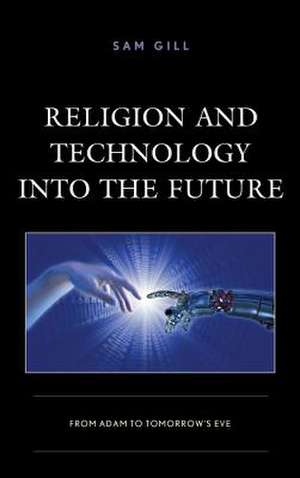
Religion and Technology into the Future: From Adam to Tomorrow's Eve: Studies in Body and Religion
Autor Sam Gillen Limba Engleză Hardback – 15 aug 2018







Preț: 612.46 lei
Preț vechi: 930.72 lei
-34%
Puncte Express: 919
Carte tipărită la comandă
Livrare economică 06-20 iunie
Specificații
ISBN-13: 9781498580908
ISBN-10: 1498580904
Pagini: 316
Dimensiuni: 160 x 230 x 30 mm
Greutate: 0.66 kg
Editura: Bloomsbury Publishing
Colecția Lexington Books
Seria Studies in Body and Religion
Locul publicării:New York, United States
ISBN-10: 1498580904
Pagini: 316
Dimensiuni: 160 x 230 x 30 mm
Greutate: 0.66 kg
Editura: Bloomsbury Publishing
Colecția Lexington Books
Seria Studies in Body and Religion
Locul publicării:New York, United States
V-ar putea interesa
-
 Plato on Art and BeautyAlison Denham-18%Preț: 704.81 lei859.52 lei
 -
 Royal Mourning and Regency CultureS. Behrendt-15%Preț: 621.52 lei731.20 lei
 -
 The Dream of RealityLynn SegalPreț: 369.60 lei
 -
 Computers in Art, Design and AnimationJohn Lansdown-15%Preț: 628.53 lei739.44 lei
 -
 -18%Preț: 2955.52 lei3604.29 lei
 -
 Acting: An International Encyclopedia of Traditional CultureMary Beth Osnes-53%Preț: 365.26 lei770.99 lei
 -
 Researching Visual Arts Education in Museums and GalleriesM. Xanthoudaki-18%Preț: 949.92 lei1158.44 lei
 -
 Volume 9: Aesthetics and Philosophy of ArtGuttorm Fløistad-18%Preț: 1080.04 lei1317.13 lei
 -
 Reflective Practices in Arts EducationPamela Burnard-15%Preț: 615.31 lei723.89 lei
 -
 -34%Preț: 523.46 lei790.36 lei
 -
 A Critical Companion to Tim BurtonAdam Barkman-34%Preț: 611.38 lei930.04 lei
 -
 The Encyclopedia of American Animated Television ShowsDavid Perlmutter-33%Preț: 754.76 lei1127.83 lei
 -
 Hitler in the Movies: Finding Der Führer on FilmSidney Homan-14%Preț: 512.52 lei595.96 lei
 -
 Hitler in the Movies: Finding Der Führer on FilmSidney Homan-28%Preț: 270.84 lei375.39 lei
 -
 Preț: 401.43 lei
 -
 -15%Preț: 671.67 lei790.20 lei
 -
 Marcel Duchamp's FountainRobert KilroyPreț: 468.50 lei
 -
 Der Weg Zum Käufer: Eine Theorie der Praktischen ReklameKurt Th. FriedlaenderPreț: 401.43 lei
 -
 Preț: 426.01 lei
 -
 Kunsttheorie: Eine ideengeschichtliche ErkundungStavros ArabatzisPreț: 118.49 lei
 -
 "Voi Altri Pochi"Mark KyburzPreț: 372.05 lei
 -
 Hanna Nagel: Ich zeichne weil es mein Leben istIrene Fischer-NagelPreț: 395.89 lei
 -
 Biographische Sicherheit im Wandel?: Eine historisch vergleichende Analyse von KünstlerbiographienHelga Pelizäus-HoffmeisterPreț: 472.83 lei
 -
 Palette PerfectWager Lauren-10%Preț: 126.77 lei141.44 lei
 -
 Der Turm: als Symbol und ErlebnisM. Révész-AlexanderPreț: 402.52 lei
 -
 Geschichte der Russischen Malerei im MittelalterPhilipp Schweinfurth Schweinfurth-15%Preț: 464.30 lei546.23 lei
Cuprins
Into the Future: An Introduction
1. Thumbelina's Severed Head
2. Little Green Sprout
3. Fury Road
4. Garden of Making and Unmaking
5. Ava and the Ultimate Turing Test
6. Cursed, Cursed Creator! Why Did I Live?
7. Falling in Love With "Her": One Singular Sensation
8. Made of Clay: Prometheus and Golem
9. Gender Matters
10. Creepy Dollies or My Fair Ladies?
11. I-Robot
12. Orphans of the Sky: Outside, Movement, & Corporeal Concepts
13. Violent Delights
14. Robots & the End of Work
15. "Beam Me Up Scotty!" Corporeal Concepts & Posthuman
16. The Matrix
17. Meet Me on the Holodeck!
18. ToolsRUs
19. Cyborg/Metahuman: Future of Gender & Religion
20. Watson and the Jeopardy! Test: Machine Learning
21. It is Bigger on the Inside! TARDIS & Wormholes
22. Secret Hidden Horror
23. Step Again Into the Forge
24. Song of Tomorrow's Eve
1. Thumbelina's Severed Head
2. Little Green Sprout
3. Fury Road
4. Garden of Making and Unmaking
5. Ava and the Ultimate Turing Test
6. Cursed, Cursed Creator! Why Did I Live?
7. Falling in Love With "Her": One Singular Sensation
8. Made of Clay: Prometheus and Golem
9. Gender Matters
10. Creepy Dollies or My Fair Ladies?
11. I-Robot
12. Orphans of the Sky: Outside, Movement, & Corporeal Concepts
13. Violent Delights
14. Robots & the End of Work
15. "Beam Me Up Scotty!" Corporeal Concepts & Posthuman
16. The Matrix
17. Meet Me on the Holodeck!
18. ToolsRUs
19. Cyborg/Metahuman: Future of Gender & Religion
20. Watson and the Jeopardy! Test: Machine Learning
21. It is Bigger on the Inside! TARDIS & Wormholes
22. Secret Hidden Horror
23. Step Again Into the Forge
24. Song of Tomorrow's Eve
Recenzii
Religion and Technology into the Future discovers untold possibilities in religious texts and science fiction. It traces a journey from the modern rejection of transcendence toward a future of emotionless robots. It proposes that the surrender of moving rites for the stasis of correct belief presaged the rise of an information-obsessed individualist world. A bleak, merely nostalgic religious future is, however, not the pessimistic prediction of this book. Rather, Religion and Technology into the Future sends us toward the 'moving flesh' of our bodies to rediscover and retheorize religion in more thoroughly embodied, everyday human relations. And in religion, we rediscover humanity.
In a series of articulate, well-crafted meditations, Sam Gill offers in his new book provocative thought about technology in modern life. From school kids in social media and sci-fi film and literature to the intellectual gurus of modern thought such as Haraway and Kurzweil, Gill spans a broad range of current practice and critique, showing in very readable prose how religion permeates the culture of cyberpunk, dystopian visions, AI, and technological hopes and fears. With an eye to history, Gill asks for a longer view of the relation between religion and science as a more productive way to understand their complex relationship today. Ancient myth, ritual, and sacred literature resurface in sci-fi films in the form of struggles over embodiment, sexuality, love, self-awareness, and simulacra, speaking to the present with an urgency that belies their antiquity. Pulling it all together in brief and poignant chapters, Gill's book will be indispensable in the religious studies classroom.
Anyone watching videos online of robotic prototypes being kicked by their developers (to demonstrate their resiliency and balance), and who instinctively feels bad for the robots, needs to spend some time with Sam Gill, to eavesdrop as he mulls over the mixings and possibilities of bodies, technologies, and identity-from the ancient past to the near future. What started out as lectures in an introductory course has turned into a wide-ranging book that makes plain that scholars of religion have tools to help us understand more about the present moment than we might at first think.
In a series of articulate, well-crafted meditations, Sam Gill offers in his new book provocative thought about technology in modern life. From school kids in social media and sci-fi film and literature to the intellectual gurus of modern thought such as Haraway and Kurzweil, Gill spans a broad range of current practice and critique, showing in very readable prose how religion permeates the culture of cyberpunk, dystopian visions, AI, and technological hopes and fears. With an eye to history, Gill asks for a longer view of the relation between religion and science as a more productive way to understand their complex relationship today. Ancient myth, ritual, and sacred literature resurface in sci-fi films in the form of struggles over embodiment, sexuality, love, self-awareness, and simulacra, speaking to the present with an urgency that belies their antiquity. Pulling it all together in brief and poignant chapters, Gill's book will be indispensable in the religious studies classroom.
Anyone watching videos online of robotic prototypes being kicked by their developers (to demonstrate their resiliency and balance), and who instinctively feels bad for the robots, needs to spend some time with Sam Gill, to eavesdrop as he mulls over the mixings and possibilities of bodies, technologies, and identity-from the ancient past to the near future. What started out as lectures in an introductory course has turned into a wide-ranging book that makes plain that scholars of religion have tools to help us understand more about the present moment than we might at first think.