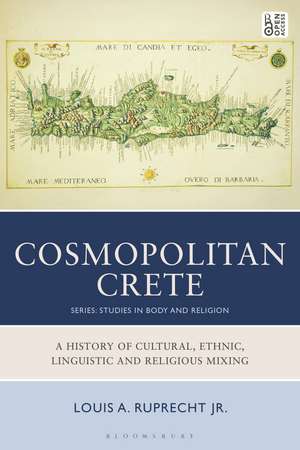
Cosmopolitan Crete: A History of Cultural, Ethnic, Linguistic, and Religious Mixing: Studies in Body and Religion
Autor Louis A. Ruprecht Jr.en Limba Engleză Hardback – 10 ian 2026
Louis A Ruprecht Jr. explores the mixture of culture, traditions, languages, and religion in the Greek island of Crete to explore the idea that mixing creates both marvels and monsters. The book considers how all of the bodies living and mixing on Crete were caught up in ritual, ceremony, and contexts which can be identified as religious. Ruprecht explores archeology, literature, myths, and biblical stories, revealing how the history of mixing cultures and ideas in Crete, focusing mostly on Greek mythology and the early spread of Christianity. In essence, Ruprecht uses Crete's history as an example to show how we can live in mixed societies rather than amidst constant culture wars.
The ebook editions of this book are available open access under a CC BY-NC-ND 4.0 license on bloomsburycollections.com. Open access was funded by Emory University and the Andrew W. Mellon Foundation.
Din seria Studies in Body and Religion
- 33%
 Preț: 643.16 lei
 - 23%
 Preț: 336.84 lei
 - 35%
 Preț: 377.51 lei
 - 33%
 Preț: 544.04 lei
 - 33%
 Preț: 544.57 lei
 - 23%
 Preț: 322.97 lei
 - 23%
 Preț: 320.91 lei
 - 32%
 Preț: 583.59 lei
 - 28%
 Preț: 220.46 lei
 - 33%
 Preț: 515.62 lei
 - 26%
 Preț: 205.49 lei
 - 28%
 Preț: 220.56 lei
 - 29%
 Preț: 343.67 lei
 - 34%
 Preț: 493.56 lei
 - nou
 Preț: 564.09 lei
Preț: 566.74 lei
Preț vechi: 832.28 lei
-32%
Puncte Express: 850
Carte disponibilă
Livrare economică 02-16 noiembrie
Livrare prin curier în România Termenul estimat este afișat lângă disponibilitate.
Transport gratuit pentru acest produs Plată online sau ramburs, în funcție de opțiunile comenzii.
Retur gratuit în 14 zile Comandă securizată și suport în română.
Specificații
ISBN-13: 9798216365778
Pagini: 336
Ilustrații: 2 bw illus
Dimensiuni: 158 x 230 x 24 mm
Greutate: 0.62 kg
Editura: Bloomsbury Publishing
Colecția Bloomsbury Academic
Seria Studies in Body and Religion
Locul publicării:New York, United States
Pagini: 336
Ilustrații: 2 bw illus
Dimensiuni: 158 x 230 x 24 mm
Greutate: 0.62 kg
Editura: Bloomsbury Publishing
Colecția Bloomsbury Academic
Seria Studies in Body and Religion
Locul publicării:New York, United States
Cuprins
Preface
Acknowledgments
Introduction: Cretan Myths: Women, Marvels, Pirates, and Monsters
PART ONE: ANCIENT HISTORY AND THE EMERGENCE OF THE COSMOPOLITAN IDEAL
1: Crete in the Stone Age: Oceans Connect: The Sea and Stone Age Seafarers
2. Crete in the Bronze Age: Sir Arthur Evans and the Marvels of Minoan Mixing
3. Crete in the Classical Age: The Classical Commons: Mixed Laws, Mixed Constitutions, Mixed Citizens
PART TWO: CRETE AS A ROMAN MONSTER
4. Crete in the Roman Age: The Politics of Piracy: The Roman War on Terror
5: Christianity on Crete: Titus on Christian Virtue: Cultural Mixing and Cretan Vice
PART THREE: COSMOPOLITAN MARVELS BETWEEN THE LATER ROMES
6. Arab and Byzantine Crete: Imperial Peripheries: Arabs, Crete and Constantinople
7. Venetian Crete: The Transformation of a Cultural Landscape by a Maritime Republic
8. The Cretan Renaissance: Epic Poetry and Christian Visions: Erotokritos and El Greco
Epilogue: Crete Beyond Nationalist (Pre)Occupations
Acknowledgments
Introduction: Cretan Myths: Women, Marvels, Pirates, and Monsters
PART ONE: ANCIENT HISTORY AND THE EMERGENCE OF THE COSMOPOLITAN IDEAL
1: Crete in the Stone Age: Oceans Connect: The Sea and Stone Age Seafarers
2. Crete in the Bronze Age: Sir Arthur Evans and the Marvels of Minoan Mixing
3. Crete in the Classical Age: The Classical Commons: Mixed Laws, Mixed Constitutions, Mixed Citizens
PART TWO: CRETE AS A ROMAN MONSTER
4. Crete in the Roman Age: The Politics of Piracy: The Roman War on Terror
5: Christianity on Crete: Titus on Christian Virtue: Cultural Mixing and Cretan Vice
PART THREE: COSMOPOLITAN MARVELS BETWEEN THE LATER ROMES
6. Arab and Byzantine Crete: Imperial Peripheries: Arabs, Crete and Constantinople
7. Venetian Crete: The Transformation of a Cultural Landscape by a Maritime Republic
8. The Cretan Renaissance: Epic Poetry and Christian Visions: Erotokritos and El Greco
Epilogue: Crete Beyond Nationalist (Pre)Occupations
Recenzii
With Olympian bravado, Lou Ruprecht delivers an audacious work charting cultural and ethnic mixing in Crete from the Neolithic Age to the present. Drawing on a vast range of reading, archival research, and archaeological excavation, the book offers a bold and urgently needed analysis of cosmopolitanism.
Louis Ruprecht has written a sweeping history of Crete as "the mixed place," a place where peoples, cultures, and languages mingle, giving rise to the new and unforeseen. If Cretan mixing was a powerful source of political anxiety (as mixing so often is), Ruprecht insists that it was also a wellspring of pleasure and possibility. At once learned and lively, Cosmopolitan Crete is no less than a spirited defense of the traditions of encounter and exchange that can animate shared life in a diverse society.
In a work of astonishingly rich and engaging erudition, Ruprecht critically transmutes the historical stereotypes of Crete as home to liars, pirates, and bandits into a vision of persistently effervescent cultural mixing and creativity. Tracing the durable calumnies from prehistory to the Renaissance, he exposes in their place the robust reality of ingenuity and sharing that shaped a complex cultural universe. A few asides on the bureaucratic and political manipulations of culture today reinforce the central theme of how easily a collective reputation for violence, such as still afflicts the island's reputation, can distort the historical reality of cultural vitality.
In this book Ancient Greek mythos of the mixing of peoples, which typified Crete as both "monstrous and marvelous" becomes Ruprecht's template for exploring receptions of the island's ethnic, linguistic, and cultural mixing by centuries of imperial powers. From Roman depictions of 'monstrous' Cretan pirates to the Venetian embrace of Crete's 'marvelous' mixing as a new cosmopolitanism, Ruprecht presents a formidable transhistorical analysis of Crete and its mixing and convinces us that cosmopolitanism's gift is also its greatest challenge: to dwell in a space where solidarities must emerge irrespective of ethnic, social, and cultural identities.
Louis Ruprecht has written a sweeping history of Crete as "the mixed place," a place where peoples, cultures, and languages mingle, giving rise to the new and unforeseen. If Cretan mixing was a powerful source of political anxiety (as mixing so often is), Ruprecht insists that it was also a wellspring of pleasure and possibility. At once learned and lively, Cosmopolitan Crete is no less than a spirited defense of the traditions of encounter and exchange that can animate shared life in a diverse society.
In a work of astonishingly rich and engaging erudition, Ruprecht critically transmutes the historical stereotypes of Crete as home to liars, pirates, and bandits into a vision of persistently effervescent cultural mixing and creativity. Tracing the durable calumnies from prehistory to the Renaissance, he exposes in their place the robust reality of ingenuity and sharing that shaped a complex cultural universe. A few asides on the bureaucratic and political manipulations of culture today reinforce the central theme of how easily a collective reputation for violence, such as still afflicts the island's reputation, can distort the historical reality of cultural vitality.
In this book Ancient Greek mythos of the mixing of peoples, which typified Crete as both "monstrous and marvelous" becomes Ruprecht's template for exploring receptions of the island's ethnic, linguistic, and cultural mixing by centuries of imperial powers. From Roman depictions of 'monstrous' Cretan pirates to the Venetian embrace of Crete's 'marvelous' mixing as a new cosmopolitanism, Ruprecht presents a formidable transhistorical analysis of Crete and its mixing and convinces us that cosmopolitanism's gift is also its greatest challenge: to dwell in a space where solidarities must emerge irrespective of ethnic, social, and cultural identities.
Notă biografică
Louis A. Ruprecht Jr.is William M. Suttles Chair in Religious Studies and the Director of the Center for Hellenic Studies at Georgia State University, Atlanta, GA, USA. He studies the appropriation of classical themes in subsequent cultural contexts, focusing primarily on ethics and politics, philosophy, psychology and sexuality, art and archaeology.