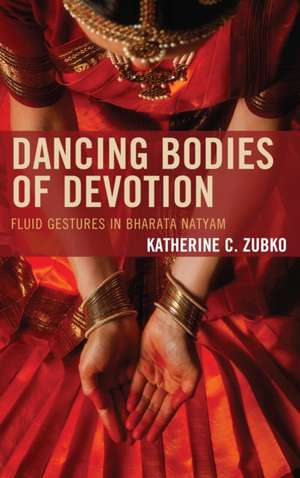
Dancing Bodies of Devotion: Fluid Gestures in Bharata Natyam: Studies in Body and Religion
Autor Katherine C. Zubkoen Limba Engleză Paperback – 27 apr 2016
Din seria Studies in Body and Religion
- 33%
 Preț: 643.16 lei
 - 23%
 Preț: 336.84 lei
 - 35%
 Preț: 377.51 lei
 - 33%
 Preț: 544.04 lei
 - 33%
 Preț: 544.57 lei
 - 23%
 Preț: 320.91 lei
 - 32%
 Preț: 583.59 lei
 - 28%
 Preț: 220.46 lei
 - 33%
 Preț: 515.62 lei
 - 26%
 Preț: 205.49 lei
 - 28%
 Preț: 226.22 lei
 - 29%
 Preț: 343.67 lei
 - 34%
 Preț: 493.56 lei
 - 32%
 Preț: 566.74 lei
 - nou
 Preț: 564.44 lei
Preț: 322.97 lei
Preț vechi: 417.40 lei
-23%
Puncte Express: 484
Carte tipărită la comandă
Livrare economică 03-17 decembrie
Livrare prin curier în România Termenul estimat este afișat lângă disponibilitate.
Transport gratuit de la 400.00 lei Plată online sau ramburs, în funcție de opțiunile comenzii.
Retur gratuit în 14 zile Comandă securizată și suport în română.
Specificații
ISBN-13: 9780739195840
ISBN-10: 0739195840
Pagini: 270
Ilustrații: 11 b/w photos
Dimensiuni: 152 x 228 x 19 mm
Greutate: 0.4 kg
Editura: Bloomsbury Publishing
Colecția Lexington Books
Seria Studies in Body and Religion
Locul publicării:New York, United States
ISBN-10: 0739195840
Pagini: 270
Ilustrații: 11 b/w photos
Dimensiuni: 152 x 228 x 19 mm
Greutate: 0.4 kg
Editura: Bloomsbury Publishing
Colecția Lexington Books
Seria Studies in Body and Religion
Locul publicării:New York, United States
V-ar putea interesa
-
 A Time to DancePadma VenkatramanPreț: 84.32 lei
 -
 The Oxford Handbook of Indian DanceAnurima Banerji-32%Preț: 989.33 lei1445.84 lei
 -
 -25%Preț: 170.43 lei226.24 lei
 -
 Unmaking Contact: Choreographing South Asian TouchRoyona Mitra-20%Preț: 171.01 lei214.20 lei
 -
 The Yoga of Love: Krishna and the Rāsa Līlā from the Bhāgavata PurānaGraham M. Schweig-19%Preț: 99.70 lei122.73 lei
 -
 Music and Dance as Everyday South AsiaSarah L. Morelli-19%Preț: 206.90 lei254.86 lei
 -
 A Yoga of Indian Classical DanceRoxanne Kamayani GuptaPreț: 171.32 lei
 -
 Kathakali: Tradition, Innovations and Transitions in the Dance Drama of KeralaSudha Gopalakrishnan-18%Preț: 120.30 lei146.88 lei
 -
 -45%Preț: 753.28 lei1364.79 lei
 -
 Bollywood Beat!Anita Yasuda-18%Preț: 106.38 lei130.09 lei
 -
 Preț: 195.69 lei
 -
 Blue-Skinned GodsSJ SinduPreț: 179.10 lei
 -
 Maharasa ManjusaPrakriti GoswamiPreț: 284.95 lei
 -
 Bharatanatyam in Ballet ShoesMahak Jain-8%Preț: 99.56 lei108.72 lei
 -
 -9%Preț: 848.92 lei932.88 lei
 -
 Dancing With The GodsMonidipa MukherjeePreț: 206.12 lei
 -
 TandavaMukunda RaoPreț: 171.26 lei
 -
 Dance to FreedomA K GandhiPreț: 92.81 lei
 -
 -32%Preț: 561.43 lei828.86 lei
Cuprins
Part I: Religious Bodies
Chapter 1: Rasa: A Taste of the Divine
Chapter 2: Balasaraswati and Krishna Ni Begane Baro
Chapter 3: Francis Barboza and Christian Themes
Conclusion: Bhakti Rasa: A Re-Personalized Aesthetic of Devotion
Part II: Cultural Bodies
Chapter 4: Rasa and Bhakti as Indian Categories
Chapter 5: Dhananjayans' Sanghamitra
Chapter 6: Kalai Kaviri's Gayatri Mantra
Conclusion: Is there an Indian way of dancing devotion?
Part III: Ethical Bodies
Chapter 7: Na?ya as Visual Education and the Ethics of Rasa
Chapter 8: Dhananjayans' Stree (Woman)
Chapter 9: Monica Cooley's Subhasitam: Morality Tales of India and Bhagavad Gita Sabdam
Conclusion: An Ethics of Bhakti Rasa: Performance of a Moral Mood
Part IV: Pluralistic Bodies
Chapter 10: Unity and Multiplicity of Rasa
Chapter 11: Malini Srinivasan and Sufi Qawwali
Chapter 12: Tehreema Mitha and Ratt Jaga (The Vigil)
Conclusion: Revisiting "Unity in Diversity"
Conclusion
Glossary
Illustrated Glossary of Gestures
Chapter 1: Rasa: A Taste of the Divine
Chapter 2: Balasaraswati and Krishna Ni Begane Baro
Chapter 3: Francis Barboza and Christian Themes
Conclusion: Bhakti Rasa: A Re-Personalized Aesthetic of Devotion
Part II: Cultural Bodies
Chapter 4: Rasa and Bhakti as Indian Categories
Chapter 5: Dhananjayans' Sanghamitra
Chapter 6: Kalai Kaviri's Gayatri Mantra
Conclusion: Is there an Indian way of dancing devotion?
Part III: Ethical Bodies
Chapter 7: Na?ya as Visual Education and the Ethics of Rasa
Chapter 8: Dhananjayans' Stree (Woman)
Chapter 9: Monica Cooley's Subhasitam: Morality Tales of India and Bhagavad Gita Sabdam
Conclusion: An Ethics of Bhakti Rasa: Performance of a Moral Mood
Part IV: Pluralistic Bodies
Chapter 10: Unity and Multiplicity of Rasa
Chapter 11: Malini Srinivasan and Sufi Qawwali
Chapter 12: Tehreema Mitha and Ratt Jaga (The Vigil)
Conclusion: Revisiting "Unity in Diversity"
Conclusion
Glossary
Illustrated Glossary of Gestures
Recenzii
Zubko argues for Bhakti rasa (aesthetic flavor of devotion) in the classical Indian dance form bharata natyam, and suggests, through ethnographic examples, that there are multiple ways of embodying and communicating this devotional mood. The author's expertise in dance (as well as religion) is evident, and she points out how a dance associated with Hinduism is, in fact, also used to communicate non-Hindu--but definitively Indian--ideas and emotions. For nonexperts, the glossaries of terms and gestures will be useful and necessary. . . .For connoisseurs of this dance form, dance descriptions provide an opportunity to experience the rasa without seeing (or perhaps by imagining) the performance. . . .[The author] includes vignettes of her research experiences. She moves from one of bharata natyam's most celebrated exponents, Balasaraswati, to the much less-known Tehreema Mitha, categorizing performances as primarily devotional, educational, or cultural. In a final section she discusses what she calls 'performed pluralism,' echoing arguments about India's 'unity in diversity' and 'the one and the many.' Summing Up: Recommended. Upper-division undergraduates and above; professionals.
Not only does Dancing Bodies of Devotion deal with performative art-bharata natyam, an Indian dance form-but it is also a tour de force in itself. In this theoretically and methodologically sophisticated presentation, Zubko contributes a genuinely novel composition to the study of Indian religions, performance studies, aesthetics, and interreligious engagement. . . . Throughout this text, Zubko demonstrates her mastery of texts, theory, and technical detail. Her overviews of the construction of both rasa and bharata natyam are exemplary.
Dancing Bodies of Devotion offers a deep investigation of the embodied aesthetics of Bharata Natyam and an extensive exploration of its interpretive qualities, from Hindu devotional aesthetics to inter-religious experiences in differing geographical contexts by different practitioners.
Original, thoughtful, and nuanced, Dancing Bodies of Devotion examines religious plurality in contemporary Bharata Natyam. Drawing on a wealth of research, Zubko paints an image of both bhakti and Bharata Natyam as dynamic and inclusive. This important study shows us that bhakti retains its progressive potential in the modern world and opens up the dance to a multiplicity of religious expressions. Detailed yet broad in scope, this text is a welcome addition to the literature in South Asian studies, dance studies, and religious studies.
Not only does Dancing Bodies of Devotion deal with performative art-bharata natyam, an Indian dance form-but it is also a tour de force in itself. In this theoretically and methodologically sophisticated presentation, Zubko contributes a genuinely novel composition to the study of Indian religions, performance studies, aesthetics, and interreligious engagement. . . . Throughout this text, Zubko demonstrates her mastery of texts, theory, and technical detail. Her overviews of the construction of both rasa and bharata natyam are exemplary.
Dancing Bodies of Devotion offers a deep investigation of the embodied aesthetics of Bharata Natyam and an extensive exploration of its interpretive qualities, from Hindu devotional aesthetics to inter-religious experiences in differing geographical contexts by different practitioners.
Original, thoughtful, and nuanced, Dancing Bodies of Devotion examines religious plurality in contemporary Bharata Natyam. Drawing on a wealth of research, Zubko paints an image of both bhakti and Bharata Natyam as dynamic and inclusive. This important study shows us that bhakti retains its progressive potential in the modern world and opens up the dance to a multiplicity of religious expressions. Detailed yet broad in scope, this text is a welcome addition to the literature in South Asian studies, dance studies, and religious studies.