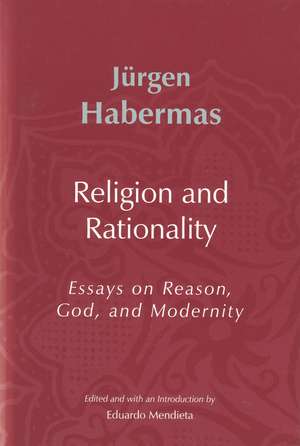
Religion and Rationality
Autor Jurgen Habermas Editat de Eduardo Mendietaen Limba Engleză Paperback – 17 iun 2002
In a new introduction written especially for this volume, Eduardo Mendieta places Habermas′ engagement with religion in the context of his work as a whole. Mendieta also discusses Habermas′ writings in relation to Jewish Messianism and the Frankfurt School, showing how the essays in Religion and Rationality, one of which is translated into English for the first time, foreground an important, yet often neglected, dimension of critical theory. The volume concludes with an original extended interview, also in English for the first time, in which Habermas develops his current views on religion in modern society.
This book will be of great interest to students and scholars in theology, religious studies and philosophy, as well as to all those already familiar with Habermas′ work.
Preț: 142.71 lei
Carte disponibilă
Livrare economică 15-29 mai
Livrare express 30 aprilie-06 mai pentru 22.42 lei
Specificații
ISBN-10: 0745624871
Pagini: 184
Dimensiuni: 154 x 229 x 17 mm
Greutate: 0.28 kg
Editura: John Wiley and Sons Ltd
Locul publicării:Chichester, United Kingdom
V-ar putea interesa
-
 God in the Age of Science?: A Critique of Religious ReasonHerman Philipse-16%Preț: 159.56 lei189.92 lei
 -
 Oxford Studies in Philosophy of Religion Volume 5Jonathan Kvanvig-15%Preț: 265.75 lei310.90 lei
 -
 The Fall and HypertimeHud Hudson-31%Preț: 457.25 lei661.86 lei
 -
 -18%Preț: 346.11 lei419.88 lei
 -
 Religious Faith and Intellectual VirtueLaura Frances Callahan-34%Preț: 599.64 lei902.43 lei
 -
 Destiny and Deliberation: Essays in Philosophical TheologyJonathan L. Kvanvig-10%Preț: 265.15 lei294.27 lei
 -
 -34%Preț: 871.17 lei1318.54 lei
 -
 The Theory of Communicative ActionJurgen HabermasPreț: 172.43 lei
 -
 The Future of Human NatureJürgen HabermasPreț: 111.12 lei
 -
 Europe – The Faltering ProjectJ HabermasPreț: 166.70 lei
 -
 The Lure of TechnocracyJürgen HabermasPreț: 165.63 lei
 -
 How (Not) to Be SecularJames K. A. SmithPreț: 101.76 lei
 -
 A2 Philosophy Revision Guide for EdexcelBrian PoxonPreț: 131.45 lei
 -
 As Philosophy Revision Guide for Aqa (Unit D)Brian PoxonPreț: 69.94 lei
 -
 A2 Philosophy Revision Guide for OCRBrian PoxonPreț: 131.55 lei
Public țintă
This book will be of great interest to students and scholars in theology, religious studies and philosophy, as well as to all those already familiar with Habermas′s workDescriere
This important new volume brings together Habermas′ key writing on religion and religious belief. Habermas explores the relations between Christian and Jewish thought, on the one hand, and the Western philosophical tradition on the other. In so doing, he examines a range of important figures, including Benjamin, Heidegger, Johann Baptist Metz and Gershom Scholem.
In a new introduction written especially for this volume, Eduardo Mendieta places Habermas′ engagement with religion in the context of his work as a whole. Mendieta also discusses Habermas′ writings in relation to Jewish Messianism and the Frankfurt School, showing how the essays in Religion and Rationality, one of which is translated into English for the first time, foreground an important, yet often neglected, dimension of critical theory. The volume concludes with an original extended interview, also in English for the first time, in which Habermas develops his current views on religion in modern society.
This book will be of great interest to students and scholars in theology, religious studies and philosophy, as well as to all those already familiar with Habermas′ work.
Cuprins
Acknowledgments. Introduction.
Chapter 1: The German Idealism of the Jewish Philosophers.
Chapter 2: On the Difficulty of Saying No.
Chapter 3: Transcendence from Within, Transcendence in this World.
Chapter 4: To Seek to Salvage an Unconditional Meaning Without God is a Futile Undertaking: Reflections on a Remark of Max Horkheimer.
Chapter 5: Communicative Freedom and Negative Theology: Questions for Michael Theunissen.
Chapter 6 Israel or Athens: Where does Anamnestic Reason Belong? Johannes Baptist Metz on Unity amidst Multicultural Plurality.
Chapter 7: Tracing the Other of History in History: Gershom Scholem′s Sabbati Sevi.
Chapter 8: A Conversation About God and the World: Interview with Eduardo Mendieta.
Index
Notă biografică
Jürgen Habermas is Professor of Philosophy Emeritus at the University of Frankfurt.