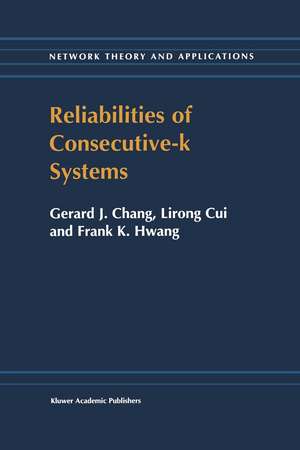
Reliabilities of Consecutive-k Systems: Network Theory and Applications, cartea 4
Autor Chung In-Hang, F. K. Hwang, Lirong Cuien Limba Engleză Paperback – 17 sep 2011
Din seria Network Theory and Applications
- 20%
 Preț: 999.51 lei
 - 18%
 Preț: 951.78 lei
 - 20%
 Preț: 994.40 lei
 - 20%
 Preț: 665.53 lei
 - 20%
 Preț: 669.27 lei
 - 20%
 Preț: 1237.95 lei
 - 20%
 Preț: 640.88 lei
 - 18%
 Preț: 1002.35 lei
 - 20%
 Preț: 645.64 lei
 - 15%
 Preț: 635.95 lei
 - 15%
 Preț: 649.09 lei
 - 20%
 Preț: 995.70 lei
 - 20%
 Preț: 1139.71 lei
 - 20%
 Preț: 948.82 lei
 - 20%
 Preț: 948.32 lei
Preț: 646.13 lei
Preț vechi: 807.66 lei
-20%
Puncte Express: 969
Carte tipărită la comandă
Livrare economică 19 noiembrie-03 decembrie
Livrare prin curier în România Termenul estimat este afișat lângă disponibilitate.
Transport gratuit pentru acest produs Plată online sau ramburs, în funcție de opțiunile comenzii.
Retur gratuit în 14 zile Comandă securizată și suport în română.
Specificații
ISBN-13: 9781461379720
ISBN-10: 1461379725
Pagini: 224
Ilustrații: X, 212 p.
Dimensiuni: 160 x 240 x 13 mm
Greutate: 0.37 kg
Ediția:2000
Editura: Springer Us
Colecția Network Theory and Applications
Seria Network Theory and Applications
Locul publicării:New York, NY, United States
ISBN-10: 1461379725
Pagini: 224
Ilustrații: X, 212 p.
Dimensiuni: 160 x 240 x 13 mm
Greutate: 0.37 kg
Ediția:2000
Editura: Springer Us
Colecția Network Theory and Applications
Seria Network Theory and Applications
Locul publicării:New York, NY, United States
V-ar putea interesa
-
 Reliability Engineering in the CloudCarlos RojasPreț: 313.93 lei
 -
 Concrete MathematicsRonald Graham-20%Preț: 558.72 lei698.40 lei
 -
 -15%Preț: 619.12 lei728.38 lei
 -
 MeditationsMarcus AureliusPreț: 33.79 lei
 -
 Twenty-Four Hours a DayANONYMOUS-42%Preț: 91.42 lei156.90 lei
 -
 -20%Preț: 377.89 lei472.36 lei
 -
 Applied ReliabilityPaul A. TobiasPreț: 439.45 lei
 -
 Structural and System ReliabilityArmen der Kiureghian-9%Preț: 658.75 lei723.90 lei
 -
 Practical Reliability EngineeringAndre V. Kleyner-23%Preț: 815.99 lei1059.74 lei
 -
 -20%Preț: 457.81 lei572.26 lei
 -
 Preț: 123.51 lei
 -
 Distributions in Stochastic Network ModelsG Sh Tsitsiashvili-27%Preț: 833.47 lei1134.59 lei
 -
 -23%Preț: 958.75 lei1245.13 lei
 -
 -20%Preț: 1037.42 lei1296.77 lei
 -
 Applied OSS Reliability Assessment Modeling, AI and ToolsYoshinobu Tamura-20%Preț: 471.01 lei588.76 lei
 -
 -18%Preț: 1123.42 lei1370.02 lei
 -
 Statistics for ScientistsUmberto Michelucci-20%Preț: 275.88 lei344.84 lei
 -
 Components Operationally: Reversibility and System EngineeringClaudio Antares Mezzina-20%Preț: 389.32 lei486.66 lei
 -
 Networked SystemsSalem Lahlou-20%Preț: 996.76 lei1245.95 lei
 -
 Reliability Assessment of Tethered High-altitude Unmanned Telecommunication PlatformsVladimir M. Vishnevsky-20%Preț: 1049.60 lei1312.01 lei
Public țintă
ResearchCuprins
1. Introduction.- 1.1 The consecutive system and generalizations.- 1.2 The problems and the methodologies.- 1.3 Notation.- 2. Computation of Reliability.- 2.1 Recursive equations.- 2.2 The matrix approach.- 2.3 The combinatorial approach.- 2.4 Bounds and approximations.- 3. Design of Optimal Consecutive Systems.- 3.1 Optimal consecutive-2 systems.- 3.2 Invariant consecutive-k systems.- 3.3 The Birnbaum importance.- 3.4 Half-line importance.- 3.5 The combinatorial importance and the rare-event importance.- 3.6 Consecutive-k G system.- 4. The Lifetime Distribution.- 4.1 Mean time to failure.- 4.2 Estimation of Parameters.- 4.3 Increasing failure rate preservation.- 4.4 IFR property for k ? 4.- 5. Asymptotic Analysis.- 5.1 Elementary method.- 5.2 Generating function method.- 5.3 Poisson convergence method.- 5.4 The dependence models.- 5.5 Distribution for exchangeable lifetimes.- 6. Window Systems.- 6.1 The k-within-consecutive-m-out- of-n system.- 6.2 The (2, m, n) system.- 6.3 b-Fold-window systems.- 6.4 Asymptotic analysis.- 7. The Network Model.- 7.1 The linear consecutive-2 network system.- 7.2 Connectivity and hamiltonian reliability.- 7.3 The reversible model.- 7.4 The k ? 3 case.- 8. Consecutive-2 Graphs.- 8.1 Reliabilities of consecutive-2 graphs.- 8.2 Optimal consecutive-2 graphs: general theory.- 8.3 Invariant d-nary trees.- 8.4 Other consecutive-2 graphs.- 8.5 The 2-dimensional case.- 9. Some Related Systems.- 9.1 Consecutively connected systems.- 9.2 Multi-failure consecutive systems.- 9.3 Redundant consecutive-k systems.- 9.4 Weighted consecutive systems.- 10. Applications.- 10.1 Examples of modelings.- 10.2 Application examples with computations.- References.