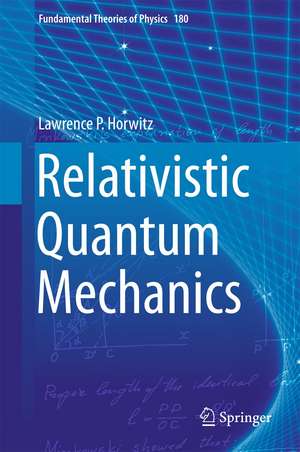
Relativistic Quantum Mechanics: Fundamental Theories of Physics, cartea 180
Autor Lawrence P. Horwitzen Limba Engleză Hardback – 22 aug 2015
Din seria Fundamental Theories of Physics
-
 Preț: 442.47 lei
- 18%
 Preț: 997.97 lei
- 18%
 Preț: 809.77 lei
- 18%
 Preț: 990.83 lei
- 18%
 Preț: 985.37 lei
- 18%
 Preț: 976.47 lei
- 18%
 Preț: 1182.53 lei
- 18%
 Preț: 1276.06 lei
- 18%
 Preț: 908.76 lei
-
 Preț: 399.61 lei
- 18%
 Preț: 989.70 lei
- 18%
 Preț: 1280.68 lei
- 18%
 Preț: 984.47 lei
- 18%
 Preț: 967.29 lei
- 18%
 Preț: 977.93 lei
- 15%
 Preț: 670.97 lei
- 18%
 Preț: 1270.88 lei
- 18%
 Preț: 962.19 lei
- 18%
 Preț: 950.63 lei
- 20%
 Preț: 623.48 lei
- 15%
 Preț: 662.49 lei
-
 Preț: 394.22 lei
- 18%
 Preț: 753.83 lei
-
 Preț: 380.05 lei
- 15%
 Preț: 627.14 lei
-
 Preț: 386.04 lei
- 24%
 Preț: 639.70 lei
- 15%
 Preț: 623.88 lei
- 18%
 Preț: 1265.43 lei
- 18%
 Preț: 954.64 lei
- 15%
 Preț: 669.04 lei
-
 Preț: 381.51 lei
- 18%
 Preț: 983.40 lei
Preț: 724.21 lei
Preț vechi: 852.01 lei
-15%
Puncte Express: 1086
Carte tipărită la comandă
Livrare economică 07-21 decembrie
Livrare prin curier în România Termenul estimat este afișat lângă disponibilitate.
Transport gratuit pentru acest produs Plată online sau ramburs, în funcție de opțiunile comenzii.
Retur gratuit în 14 zile Comandă securizată și suport în română.
Specificații
ISBN-13: 9789401772600
ISBN-10: 9401772606
Pagini: 224
Ilustrații: VIII, 214 p. 5 illus.
Dimensiuni: 160 x 241 x 18 mm
Greutate: 0.45 kg
Ediția:1st edition 2015
Editura: Springer
Colecția Fundamental Theories of Physics
Seria Fundamental Theories of Physics
Locul publicării:Dordrecht, Netherlands
ISBN-10: 9401772606
Pagini: 224
Ilustrații: VIII, 214 p. 5 illus.
Dimensiuni: 160 x 241 x 18 mm
Greutate: 0.45 kg
Ediția:1st edition 2015
Editura: Springer
Colecția Fundamental Theories of Physics
Seria Fundamental Theories of Physics
Locul publicării:Dordrecht, Netherlands
V-ar putea interesa
-
 QedRichard P Feynman-31%Preț: 63.29 lei92.00 lei
-
 Quantum Mechanics: An Empiricist ViewBas C. van Fraassen-27%Preț: 485.15 lei663.90 lei
-
 Philosophical Foundations of Quantum Field TheoryHarvey R. Brown-29%Preț: 402.66 lei564.42 lei
-
 -27%Preț: 537.41 lei740.75 lei
-
 Angular MomentumD. M. Brink-18%Preț: 368.60 lei451.66 lei
-
 Introduction to Quantum MechanicsA. C. PhillipsPreț: 435.08 lei
-
 Quantum PhysicsStephen Gasiorowicz-27%Preț: 1506.43 lei2063.59 lei
-
 -23%Preț: 468.88 lei608.93 lei
-
 Lectures on Quantum MechanicsPaul A M Dirac-19%Preț: 56.98 lei70.70 lei
-
 Elementary Particles and the Laws of PhysicsRichard P. FeynmanPreț: 93.97 lei
-
 The Quantum Theory of Fields v2Steven Weinberg-11%Preț: 509.02 lei571.94 lei
-
 Quantum Statistical MechanicsWilliam C. Schieve-11%Preț: 700.17 lei786.70 lei
-
 Quantum Field TheoryMark Srednicki-8%Preț: 570.66 lei620.28 lei
-
 Physics of Atoms and MoleculesBrian H. Bransden-9%Preț: 585.28 lei643.17 lei
-
 DecoherenceMaximilian A. Schlosshauer-15%Preț: 677.28 lei796.80 lei
Public țintă
ResearchCuprins
Introduction and some problems encountered in the construction of a relativistic quantum theory.- Relativistic Classical and Quantum Mechanics.- Spin, Statistics and Correlations.- Gauge Fields and Flavor Oscillations.- The Relativistic Action at a Distance Two Body Problem.- Experimental Consequences of Coherence in Time.- Scattering Theory and Resonances.- Some applications: The Electron Anomalous Moment, Invariant Berry Phases and the Spacetime Lattice.- Hamiltonian Map to Conformal Modification of Spacetime Metric: Kaluza-Klein and TeVeS.- Relativistic Classical and Quantum Statistical Mechanics, and Covariant Boltzmann Equation.
Recenzii
“Relativistic Quantum Mechanics is highly recommended for such insight not only to all working theoretical and experimental physicists, but for any specialists interested in the eventual philosophical impact of a manifestly covariant quantum theory on the future of scientific advancement in general. This seminal work by Horwitz can perhaps lead the way towards this fresh understanding.” (Donald Reed, Foundations of Physics, Vol. 47, 2017)
Textul de pe ultima copertă
This book describes a relativistic quantum theory developed by the author starting from the E.C.G. Stueckelberg approach proposed in the early 40s. In this framework a universal invariant evolution parameter (corresponding to the time originally postulated by Newton) is introduced to describe dynamical evolution. This theory is able to provide solutions for some of the fundamental problems encountered in early attempts to construct a relativistic quantum theory. A relativistically covariant construction is given for which particle spins and angular momenta can be combined through the usual rotation group Clebsch-Gordan coefficients. Solutions are defined for both the classical and quantum two body bound state and scattering problems. The recently developed quantum Lax-Phillips theory of semigroup evolution of resonant states is described. The experiment of Lindner and coworkers on interference in time is discussed showing how the property of coherence in time provides a simple understanding of the results. The full gauge invariance of the Stueckelberg-Schroedinger equation results in a 5D generalization of the usual gauge theories. A description of this structure and some of its consequences for both Abelian and non-Abelian fields are discussed. A review of the basic foundations of relativistic classical and quantum statistical mechanics is also given. The Bekenstein-Sanders construction for imbedding Milgrom's theory of modified spacetime structure into general relativity as an alternative to dark matter is also studied.
Caracteristici
A lifetime's work written by a pioneer of relativistic quantum theory Fundamental questions arising in the development of relativistic quantum theory are analyzed and explained in a simple way in the framework of the Stueckelberg theory An invaluable source of references long forgotten Includes supplementary material: sn.pub/extras
Notă biografică
Martin Land was born in Brooklyn in 1953. He grew up in the New York City area, strongly influenced by his mother, a social worker who worked with Holocaust survivors, and his father, a second-generation engineer in small manufacturing businesses associated with the garment industry. In his school years he cleaned swimming pools and stables, worked as a carpenter on a construction site, and expedited orders in the garment center. In 1972, he entered Reed College in Portland, Oregon, where he received a Kroll Fellowship for original research which permitted him to devote an extra year to extensive study in the humanities along with his specialization in physics. After completing his BA in 1977, he returned to New York City where he received an M.S. in electrical engineering from Columbia University in 1979 as a member of the Eta Kappa Nu engineering honor society. He joined Bell Laboratories, developing specialized hardware for fiber optic communication with application in computer networks and video transmission. In 1982, he worked as a telecommunications engineer at a major Wall Street bank. Returning to theoretical physics at Hebrew University in Jerusalem, he worked with Eliezer Rabinovicci on supersymmetric quantum mechanics to receive a second M.S. in 1986. In 1985, he married Janet Baumgold, a feminist therapist and co-founder of the Counseling Center for Women. Following a year devoted to full-time fatherhood and another in compulsory national service, he began working toward a Ph.D. in high energy physics with Lawrence Horwitz at Tel Aviv University in 1988. He elaborated many aspects of the classical and quantum theories known as Stueckelberg-Horwitz-Piron (SHP) theory, producing a dissertation developing the SHP quantum field theory. Concurrently with his doctoral work, he was on the research faculty of the Computer Science Department at Hebrew University, developing specialized hardware for parallel computing. After submitting his dissertation in 1995, hetaught communications engineering for three years at the Holon Institute of Technology, before joining the Department of Computer Science at Hadassah College in Jerusalem, teaching computer architecture, microprocessors, embedded systems, and computer networking. He was a founding member of the International Association for Relativistic Dynamics (IARD) in 1998 and has served as IARD president since 2006. In parallel to his activities in physics and computer science, he has enjoyed a long collaboration with Jonathan Boyarin of Cornell University in various areas of the humanities, critical theory, and Jewish studies. This collaboration has allowed him to communicate contemporary thinking in physics, especially notions of time associated with SHP theory, to scholars in other fields as modern context for philosophical consideration of temporality.
Lawrence Paul Horwitz was born in New York City on October 14, 1930. He lived in Westchester County until 1934, then went to London wherehis father founded and managed a chain of womens wear shops, called the Richard Shops, and then returned to the United States in 1936. After a few years in Brooklyn, NY, his family moved to Forest Hills in Queens, NY, where he learned tennis and attended Forest Hills High School, a school dedicated to teaching students how to think, where he came to love physics. He then went to the College of Engineering, New York University, where he studied Engineering Physics and graduated summa cum laude with a Tau Beta Pi key and the S.F.B. Morse medal for physics. He met a young lady, Ruth Abeles, who arrived from Germany in the U.S. in 1939 and became his wife before moving on to Harvard University in 1952 with a National Science Foundation Fellowship. He received his doctorate at Harvard working under the supervision of Julian Schwinger in 1957. He then worked at the IBM Watson Research Laboratory where he met Herman Goldstine, a former assistant to Johnvon Neumann and, among other things, explo