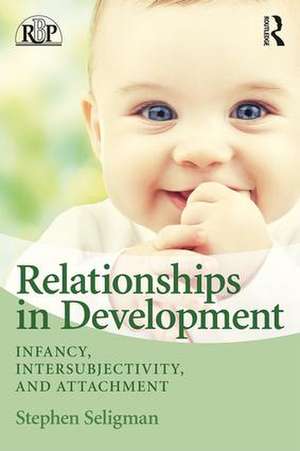
Relationships in Development: Infancy, Intersubjectivity, and Attachment: Relational Perspectives Book Series
Autor Stephen Seligmanen Limba Engleză Paperback – 8 noi 2017
Relationships in Development offers a new integration of ideas that updates established psychoanalytic models in a new context: "Relational-developmental psychoanalysis." Seligman integrates four crucial domains:
- Infancy Research, including attachment theory and research
- Developmental Psychoanalysis
- Relational/intersubjective Psychoanalysis
- Classical Freudian, Kleinian, and Object Relations theories (including Winnicott).
Relationships in Development will appeal to psychoanalysts, psychoanalytic psychotherapists, and graduate students in psychology, social work, and psychotherapy. The fundamental issues and implications presented will also be of great importance to the wider psychodynamic and psychotherapeutic communities.
Din seria Relational Perspectives Book Series
- 8%
 Preț: 443.57 lei
 - 18%
 Preț: 1527.92 lei
 - 15%
 Preț: 431.60 lei
 -
 Preț: 404.89 lei
 -
 Preț: 371.49 lei
 -
 Preț: 438.87 lei
 -
 Preț: 466.11 lei
 -
 Preț: 460.26 lei
 -
 Preț: 461.29 lei
 - 15%
 Preț: 421.30 lei
 -
 Preț: 484.44 lei
 - 15%
 Preț: 529.57 lei
 -
 Preț: 433.81 lei
 -
 Preț: 475.90 lei
 - 15%
 Preț: 428.96 lei
 -
 Preț: 450.66 lei
 -
 Preț: 473.34 lei
 - 15%
 Preț: 431.57 lei
 - 15%
 Preț: 456.05 lei
 -
 Preț: 432.48 lei
 -
 Preț: 465.13 lei
 -
 Preț: 475.90 lei
 -
 Preț: 432.71 lei
 -
 Preț: 363.67 lei
 -
 Preț: 456.74 lei
 -
 Preț: 447.07 lei
 -
 Preț: 466.11 lei
 - 18%
 Preț: 1360.57 lei
 -
 Preț: 493.06 lei
 - 18%
 Preț: 1292.75 lei
 - 15%
 Preț: 453.89 lei
 - 15%
 Preț: 484.32 lei
 -
 Preț: 477.69 lei
 -
 Preț: 440.20 lei
 -
 Preț: 455.18 lei
Preț: 382.02 lei
Puncte Express: 573
Carte disponibilă
Livrare economică 12-26 noiembrie
Livrare express 29 octombrie-04 noiembrie pentru 37.89 lei
Livrare prin curier în România Termenul estimat este afișat lângă disponibilitate.
Transport gratuit de la 400.00 lei Plată online sau ramburs, în funcție de opțiunile comenzii.
Retur gratuit în 14 zile Comandă securizată și suport în română.
Specificații
ISBN-13: 9780415880022
ISBN-10: 0415880025
Pagini: 358
Ilustrații: 30 b/w images
Dimensiuni: 156 x 234 x 26 mm
Greutate: 0.52 kg
Ediția:1
Editura: Taylor & Francis
Colecția Routledge
Seria Relational Perspectives Book Series
Locul publicării:Oxford, United Kingdom
ISBN-10: 0415880025
Pagini: 358
Ilustrații: 30 b/w images
Dimensiuni: 156 x 234 x 26 mm
Greutate: 0.52 kg
Ediția:1
Editura: Taylor & Francis
Colecția Routledge
Seria Relational Perspectives Book Series
Locul publicării:Oxford, United Kingdom
V-ar putea interesa
-
 Introduction to Infant DevelopmentAlan Slater-20%Preț: 476.65 lei597.82 lei
 -
 -5%Preț: 332.70 lei350.22 lei
 -
 Playing and RealityD. W. Winnicott-5%Preț: 217.39 lei228.84 lei
 -
 A Secure BaseJohn BowlbyPreț: 175.25 lei
 -
 The Development of Emotional Intelligence: A Case StudyNadja ReisslandPreț: 438.82 lei
 -
 Preț: 495.83 lei
 -
 The Evolving SelfRobert KeganPreț: 268.43 lei
 -
 Treating Huckleberry FinnDavid NylundPreț: 303.86 lei
 -
 Preț: 311.77 lei
 -
 Nature via NurtureMatt RidleyPreț: 92.14 lei
Public țintă
Postgraduate, Professional, and Professional Practice & DevelopmentCuprins
What to Expect from This Book; Introduction: Why Developmental Psychoanalysis? Part I: How We Got Here: A Roadmap to Psychoanalytic Theories of Childhood and Development 1. Childhood Has Meaning of Its Own: Freud and the Invention of Psychoanalysis 2. Theory I: Foreshadowings: Core Themes and Controversies in the Early Freudian Theories 3. The Baby at the Crossroads: The Structural Model, Ego Psychology, and Object Relations Theories 4. Theory II: What Is a "Robust Developmental Perspective?" 5. The Postwar Diversification and Pluralization of Psychoanalysis in the United States: Interdisciplinary Expansion, the Widening Clinical Scope and the New Developmentalism Part II: The Relational Baby: Intersubjectivity and Infant Development 6. Infancy Research: Toward a Relational-Developmental Psychoanalysis 7. Clinical Implications of Infancy Research: Affect, Interaction and Non-Verbal Meaning in the Dyadic Field 8. Theory III: The Relational Baby: Psychoanalytic Theory and Technique 9. Continuities from Infancy to Adulthood: The Baby is Out of the Bathwater 10. Theory IV: The Move to the Maternal: Gender, Sexualities, and the Oedipus Complex in Light of Intersubjective Developmental Research Part III: Attachment and Recognition in Clinical Process: Reflection, Regulation and Emotional Security 11. Intersubjectivity Today: The Orientation and Concept 12. Attachment Theory and Research in Context: Clinical Implications 13. Recognition and Mentalization in Infancy and Psychotherapy: Convergences of Attachment Theory and Psychoanalysis 14. Mentalization and Metaphor, Acknowledgement and Grief: Forms of Transformation in the Reflective Space 15. Infant-Parent Interactions, Phantasies, and an "Internal Two-Person Psychology": Projective Identification and the Intergenerational Transmission of Early Trauma in Kleinian Theory and Intersubjective Infant Research Part IV: Vitality, Activity, and Communication in Development and Psychotherapy 16. Coming to Life in Time: Temporality, Early Deprivation, and the Sense of a Lively Future 17. Forms of Vitality and Other Integrations: Daniel Stern’s Contribution to the Psychoanalytic Core Part V: Awareness, Confusion and Uncertainty: Nonlinear Dynamics in Everyday Practice 18. Feeling Puzzled While Paying Attention: The Analytic Mindset as an Agent of Therapeutic Change 19. Dynamic Systems Theories as a Basic Framework for Psychoanalysis: Change Processes in Development and Therapeutic Action 20. Searching for Core Principles: Louis Sander’s Synthesis of Biological, Psychological, and Relational Factors and Contemporary Developmental Psychodynamics
Notă biografică
Stephen Seligman is Clinical Professor of Psychiatry at the University of California, San Francisco; Joint Editor-in-Chief of Psychoanalytic Dialogues; Training and Supervising Analyst at the San Francisco Center for Psychoanalysis and Psychoanalytic Institute of Northern California; and Clinical Professor at the New York University Postdoctoral Program in Psychoanalysis. He is also co-editor of the American Psychiatric Press’ Infant and Early Childhood Mental Health: Core Concepts and Clinical Practice.
Recenzii
"Stephen Seligman’s new book is a valuable contribution to the psychoanalytic dialogue concerning developmental theory and its implications for analytic practice. His discussion of "relational-developmental psychoanalysis" is without parallel. It seems to me to pick up where Greenberg and Mitchell’s 1983 classic, Object Relations in Psychoanalytic Theory, leaves off. He presents in a highly readable way a multi-disciplinary approach that includes direct infant observation, experience with patients in psychoanalysis, as well as social, historical and biological contributions. The result is a compelling study of twenty-first century psychoanalysis, which will enrich the perspectives of psychoanalysts and infant observers, as well as students of any field that takes as its object of study the human condition in all of its complexity."-Thomas H. Ogden, author most recently of Reclaiming Unlived Life: Experiences in Psychoanalysis and Creative Readings: Essays on Seminal Analytic Works.
"This is an outstanding book. It provides a masterly account of developments in psychoanalysis particularly in relation to its theories of childhood and development. The account leads toward relational analysis yet takes off in highly original directions in its discussion of the importance of puzzled and open attention and the implications for the development of the sense of time and of the future in patients filled with a sense of futility. The chapters on the link between temporality and intentionality are fascinating and need urgently to be read by all clinicians. The whole book is wonderfully clear in the way it links infant observation and psychoanalysis. It is also a great read."- Anne Alvarez, Consultant Child and Adolescent Psychotherapist; retired Co-Convener of the Autism Service, Child and Family Dept., Tavistock Clinic, London; Honorary Member of the Psychoanalytic Centre of California.
"This is an outstanding book. It provides a masterly account of developments in psychoanalysis particularly in relation to its theories of childhood and development. The account leads toward relational analysis yet takes off in highly original directions in its discussion of the importance of puzzled and open attention and the implications for the development of the sense of time and of the future in patients filled with a sense of futility. The chapters on the link between temporality and intentionality are fascinating and need urgently to be read by all clinicians. The whole book is wonderfully clear in the way it links infant observation and psychoanalysis. It is also a great read."- Anne Alvarez, Consultant Child and Adolescent Psychotherapist; retired Co-Convener of the Autism Service, Child and Family Dept., Tavistock Clinic, London; Honorary Member of the Psychoanalytic Centre of California.
Descriere
The recent explosion of new research about infants, parental care, and infant-parent relationships has shown conclusively that human relationships are central motivators and organizers in development. Relationships in Development examines the practical implications for dynamic psychotherapy with both adults and children, especially following trauma.