
Redundancy in Mathematical Programming: Lecture Notes in Economics and Mathematical Systems, cartea 206
Autor M. H. Karwan, V. Lotfi, J. Telgen, S. Ziontsen Limba Engleză Paperback – apr 1983
Din seria Lecture Notes in Economics and Mathematical Systems
-
 Preț: 368.38 lei
 -
 Preț: 365.65 lei
 -
 Preț: 428.35 lei
 -
 Preț: 478.67 lei
 -
 Preț: 365.90 lei
 -
 Preț: 398.93 lei
 -
 Preț: 384.48 lei
 - 15%
 Preț: 646.64 lei
 -
 Preț: 364.71 lei
 -
 Preț: 437.64 lei
 -
 Preț: 370.76 lei
 - 15%
 Preț: 618.65 lei
 -
 Preț: 363.99 lei
 -
 Preț: 331.98 lei
 -
 Preț: 409.58 lei
 -
 Preț: 363.18 lei
 - 18%
 Preț: 778.82 lei
 -
 Preț: 377.68 lei
 -
 Preț: 405.53 lei
 - 15%
 Preț: 620.72 lei
 -
 Preț: 367.23 lei
 -
 Preț: 363.18 lei
 - 15%
 Preț: 611.54 lei
 - 15%
 Preț: 621.61 lei
 -
 Preț: 363.41 lei
 -
 Preț: 430.76 lei
 - 15%
 Preț: 618.65 lei
 -
 Preț: 371.37 lei
 - 15%
 Preț: 629.18 lei
 -
 Preț: 399.23 lei
 -
 Preț: 395.12 lei
 -
 Preț: 383.75 lei
 -
 Preț: 383.75 lei
 -
 Preț: 377.40 lei
 - 15%
 Preț: 610.96 lei
 - 20%
 Preț: 628.32 lei
 -
 Preț: 365.45 lei
 -
 Preț: 476.60 lei
 -
 Preț: 363.14 lei
 - 15%
 Preț: 611.04 lei
 -
 Preț: 371.20 lei
 -
 Preț: 364.19 lei
 - 15%
 Preț: 640.81 lei
 -
 Preț: 364.48 lei
 - 15%
 Preț: 611.19 lei
 -
 Preț: 365.09 lei
 - 15%
 Preț: 613.62 lei
 - 15%
 Preț: 612.55 lei
 -
 Preț: 432.70 lei
Preț: 616.83 lei
Preț vechi: 725.67 lei
-15%
Puncte Express: 925
Carte tipărită la comandă
Livrare economică 28 noiembrie-12 decembrie
Livrare prin curier în România Termenul estimat este afișat lângă disponibilitate.
Transport gratuit pentru acest produs Plată online sau ramburs, în funcție de opțiunile comenzii.
Retur gratuit în 14 zile Comandă securizată și suport în română.
Specificații
ISBN-13: 9783540115526
ISBN-10: 3540115528
Pagini: 300
Ilustrații: VIII, 290 p.
Dimensiuni: 170 x 244 x 17 mm
Greutate: 0.52 kg
Ediția:Softcover reprint of the original 1st ed. 1983
Editura: Springer
Colecția Lecture Notes in Economics and Mathematical Systems
Seria Lecture Notes in Economics and Mathematical Systems
Locul publicării:Berlin, Heidelberg, Germany
ISBN-10: 3540115528
Pagini: 300
Ilustrații: VIII, 290 p.
Dimensiuni: 170 x 244 x 17 mm
Greutate: 0.52 kg
Ediția:Softcover reprint of the original 1st ed. 1983
Editura: Springer
Colecția Lecture Notes in Economics and Mathematical Systems
Seria Lecture Notes in Economics and Mathematical Systems
Locul publicării:Berlin, Heidelberg, Germany
V-ar putea interesa
-
 -23%Preț: 395.42 lei516.41 lei
 -
 Rethinking Rational Choice TheoryJan De Jonge-15%Preț: 651.09 lei765.99 lei
 -
 Making Negotiations PredictableDavid De CremerPreț: 437.46 lei
 -
 Foresight and InnovationE. Hiltunen-18%Preț: 755.06 lei920.80 lei
 -
 Managing Service OperationsBill Hollins-18%Preț: 744.01 lei907.34 lei
 -
 Introduction to Stochastic ProgrammingJohn R Birge-15%Preț: 604.81 lei711.53 lei
 -
 Newton-Type Methods for Optimization and Variational ProblemsAlexey F. Izmailov-18%Preț: 831.28 lei1013.75 lei
 -
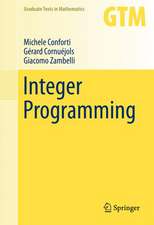 Integer ProgrammingMichele Conforti-43%Preț: 244.72 lei429.70 lei
Public țintă
ResearchCuprins
1. An Introduction to Redundancy.- 1.1 Redundancy.- 1.2 Causes of Redundancy.- 1.3 Consequences of Redundancy.- 1.4 Dealing with Redundancy.- 1.5 A Survey of the Literature.- 1.6 Objective and Plan of the Study.- 2. Mathematical Foundations and Notation.- 2.1 Notation.- 2.2 Terminology.- 2.3 A Categorization of Methods.- 2.4 Some Common Theory.- 3. A Method for Identifying Redundant Constraints and Extraneous Variables in Linear Programming.- 3.1 An Intuitive Exposition of the Approach.- 3.2 The Algorithm.- 3.3 Theory.- 3.4 An Example.- 3.5 Conclusion.- 4. A Method for Determining Redundant Constraints.- 4.1 An Intuitive Exposition of the Method.- 4.2 The Algorithm.- 4.3 Theoretical Background.- 4.4 An Illustrative Example.- 4.5 Conclusion.- 5. Identifying Redundancy in Systems of Linear Constraints.- 5.1 Introduction.- 5.2 Intuitive Exposition of the Approach.- 5.3 Description of the Algorithm.- 5.4 Mathematical Theory.- 5.5 Special Aspects of the Approach.- 5.6 Example.- 6. Finding Redundant Constraints in Sets of Linear Inequalities.- 6.1 Introduction.- 6.2 Intuitive Exposition of the Approach.- 6.3 The Algorithm.- 6.4 Mathematical Theory.- 6.5 Special Aspects of the Approach.- 6.6 An Example.- 6.7 Conclusion.- 7. A Method for Finding Redundant Constraints of a System of Linear Inequalities.- 7.1 An Intuitive Exposition of the Approach.- 7.2 Description of the Algorithm.- 7.3 Mathematical Theory.- 7.4 Special Aspects of the Approach.- 7.5 An Example.- 7.6 Conclusion.- 8. Some Reduction of Linear Programs Using Bounds on Problem Variables.- 8.1 Introduction.- 8.2 An Intuitive Exposition of the Approach.- 8.3 Description of the Algorithm.- 8.4 Mathematical Theory.- 8.5 Special Aspects of the Approach.- 8.6 An Example.- 8.7 Conclusion.- 9. A Reduction Procedure for Linear and Integer Programming Models.- 9.1 Introduction.- 9.2 Primal and Dual Observations.- 9.3 The Tests.- 9.4 Applying the Tests.- 9.5 Implementation Considerations.- 9.6 Numerical Examples.- 9.7 Conclusions.- 10. Preduce — A Probabilistic Algorithm Identifying Redundancy by a Random Feasible Point Generator (RFPG).- 10.1 Introduction.- 10.2 An Intuitive Exposition of Algorithm PREDUCE.- 10.3 Description of Algorithm PREDUCE.- 10.4 Mathematical Theory.- 10.5 Special Aspects of PREDUCE.- 10.6 A Numerical Example.- 11. The Noncandidate Constraint Method.- 11.1 Introduction.- 11.2 An Intuitive Explanation of the Method.- 11.3 Description of the Algorithm.- 11.4 Special Aspects of the Noncandidate Method.- 11.5 Solution of an Example.- 11.6 Conclusions.- 12. Structural Redundancy in Large-Scale Optimization Models.- 12.1 Introduction.- 12.2 Overview of the Analysis.- 12.3 Details of the Analysis.- 12.4 Extensions to Mixed Integer and Nonlinear Models.- 12.5 Conclusion.- 12.6 Acknowledgments.- 13. Programming the Methods and Experimental Design.- 13.1 Programming the Methods.- 13.2 Performance Monitoring.- 13.3 Test Problems.- 13.4 Summary.- 14. Results of the Sign Test Methods.- 14.1 Results for the Randomly Generated Problems.- 14.2 Problem Differences.- 14.3 Method Efficiencies Versus Time.- 14.4 Efficiency of the Various Tests.- 14.5 Results for the Structured Problems.- 15. Results of the Other Methods.- 15.1 Boneh’s Method.- 15.2 Mattheiss’ Method.- 15.3 Klein and Holm’s Method.- 15.4 Williams’ Method.- 15.5 The Method of Sethi and Thompson.- 15.6 Summary.- 16. Improvements and Extensions.- 16.1 The Extended Sign Test Method.- 16.2 The Hybrid Method.- 16.3 The Reduce Method.- 17. Results of the Improvements and Extensions.- 17.1 The Extended Sign TestMethod.- 17.2 The Hybrid Method.- 17.3 The Reduce Method.- 18. Conclusions.- 18.1 Summary of the Test Results.- 18.2 Other Developments and Conclusions.- References.