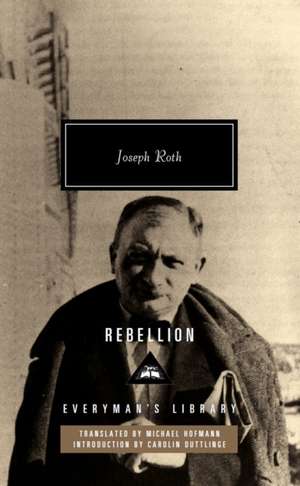
Rebellion
Autor Joseph Roth Traducere de Michael Hofmannen Limba Engleză Hardback – 21 apr 2022
When Andreas Pum returns from World War I, he has lost a leg but gained a medal. But unlike his fellow sufferers, Pum maintains his unswerving faith in God, Government, and Authority. Ironically, after a dispute, Pum is imprisoned as a rebel, and all that he believed in is now thrown into upheaval. Moving along at a breakneck clip, "Rebellion" captures the cynicism and upheavals of a postwar society. Its jazz-like cadences mix with social commentary to create a wise parable about justice and society.
Preț: 69.87 lei
Preț vechi: 85.76 lei
-19%
Puncte Express: 105
Carte disponibilă
Livrare economică 10-16 septembrie
Livrare express 21-27 august pentru 39.80 lei
Livrare prin curier în România Termenul estimat este afișat lângă disponibilitate.
Transport gratuit de la 400.00 lei Plată online sau ramburs, în funcție de opțiunile comenzii.
Retur gratuit în 14 zile Comandă securizată și suport în română.
Specificații
ISBN-13: 9781841594071
ISBN-10: 1841594075
Pagini: 168
Dimensiuni: 134 x 211 x 20 mm
Greutate: 0.3 kg
Editura: Hera
ISBN-10: 1841594075
Pagini: 168
Dimensiuni: 134 x 211 x 20 mm
Greutate: 0.3 kg
Editura: Hera
V-ar putea interesa
-
 The Blue FlowerPenelope FitzgeraldPreț: 78.00 lei
 -
 EverymanPhilip Roth-20%Preț: 55.96 lei69.99 lei
 -
 The PenitentIsaac Bashevis Singer-22%Preț: 70.77 lei90.52 lei
 -
 Keep the Aspidistra FlyingGeorge Orwell-27%Preț: 51.35 lei70.39 lei
 -
 IndignityLea Ypi-29%Preț: 99.48 lei140.03 lei
 -
 -25%Preț: 91.14 lei122.19 lei
 -
 AnthemAyn RandPreț: 52.07 lei
 -
 God's Little AcreErskine CaldwellPreț: 129.02 lei
 -
 Lives of Bitter Rain: A Tyrant Philosophers NovellaAdrian Tchaikovsky-27%Preț: 87.33 lei119.91 lei
 -
 The Pilgrim's ProgressJohn BunyanPreț: 44.52 lei
 -
 Library for the War-WoundedMonika Helfer-27%Preț: 51.00 lei70.17 lei
 -
 GinsterSiegfried KracauerPreț: 103.20 lei
 -
 PerfectionVincenzo LatronicoPreț: 84.70 lei
 -
 The Man Without QualitiesRobert MusilPreț: 88.39 lei
 -
 Berlin ShuffleUlrich Alexander BoschwitzPreț: 134.35 lei
 -
 Who Will Tell My Story?AnonymousPreț: 93.35 lei
 -
 Flight Without EndJoseph RothPreț: 70.33 lei
 -
 A Shadow of MyselfPeter FlammPreț: 105.86 lei
 -
 The MartinsDavid FoenkinosPreț: 85.06 lei
 -
 They Were CountedMiklos BanffyPreț: 96.39 lei
 -
 Drei Geschichten und eine BetrachtungPatrick SüskindPreț: 76.96 lei
 -
 Sämtliche Werke in zwanzig BändenRobert WalserPreț: 78.06 lei
 -
 Preț: 79.55 lei
Notă biografică
Joseph Roth, Austrian-Jewish novelist, was born in 1894 near Lemberg in Galicia, then part of the Austro-Hungarian empire, now in Ukraine. He studied at Vienna University and in the years following World War I worked in Vienna, Berlin and Munich as a journalist, mostly for left-wing publications, which involved him in extensive European travel. He also began to write novels. For most of his life he had no fixed abode, preferring hotel rooms and writing at café tables. In 1932 his masterpiece, The Radetzky March, was published. In 1933 when Hitler came to power his position became dangerous and he moved to Paris; his books were amongst those burnt by the Nazis that year. He continued to travel and to write, but began to suffer poor health - partly as a result of alcoholism. He died prematurely in 1939.