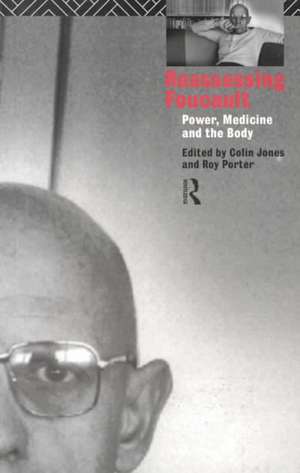
Reassessing Foucault: Power, Medicine and the Body: Routledge Studies in the Social History of Medicine
Editat de Colin Jones, Roy Porteren Limba Engleză Paperback – 30 apr 1998
Focusing on the social history of medicine, successive chapters deal with his historiographical, methodological and philosophical writings, his ideas about prisons, hospitals, madness and disease, and his thinking about the body.
The book also suggests ways in which Foucault's influence will continue to dominate cultural history and the social sciences.
Din seria Routledge Studies in the Social History of Medicine
- 5%
 Preț: 529.61 lei
 - 5%
 Preț: 514.02 lei
 -
 Preț: 468.81 lei
 -
 Preț: 469.94 lei
 -
 Preț: 462.43 lei
 - 5%
 Preț: 1303.68 lei
 -
 Preț: 487.31 lei
 -
 Preț: 467.12 lei
 - 15%
 Preț: 476.94 lei
 -
 Preț: 475.50 lei
 -
 Preț: 486.40 lei
 - 5%
 Preț: 513.29 lei
 - 5%
 Preț: 1638.95 lei
 - 5%
 Preț: 388.70 lei
 - 5%
 Preț: 390.71 lei
 - 5%
 Preț: 453.59 lei
 -
 Preț: 472.93 lei
 - 8%
 Preț: 428.17 lei
 - 5%
 Preț: 441.74 lei
 - 15%
 Preț: 434.24 lei
 - 5%
 Preț: 298.27 lei
 - 18%
 Preț: 1305.96 lei
 - 5%
 Preț: 286.38 lei
 -
 Preț: 449.81 lei
 -
 Preț: 478.24 lei
 -
 Preț: 439.07 lei
 -
 Preț: 467.54 lei
 - 5%
 Preț: 448.61 lei
 - 5%
 Preț: 1288.84 lei
Preț: 410.44 lei
Puncte Express: 616
Carte tipărită la comandă
Livrare economică 07-21 decembrie
Livrare prin curier în România Termenul estimat este afișat lângă disponibilitate.
Transport gratuit pentru acest produs Plată online sau ramburs, în funcție de opțiunile comenzii.
Retur gratuit în 14 zile Comandă securizată și suport în română.
Specificații
ISBN-13: 9780415183413
ISBN-10: 0415183413
Pagini: 240
Dimensiuni: 138 x 216 x 14 mm
Greutate: 0.44 kg
Ediția:Revised
Editura: Taylor & Francis
Colecția Routledge
Seria Routledge Studies in the Social History of Medicine
Locul publicării:Oxford, United Kingdom
ISBN-10: 0415183413
Pagini: 240
Dimensiuni: 138 x 216 x 14 mm
Greutate: 0.44 kg
Ediția:Revised
Editura: Taylor & Francis
Colecția Routledge
Seria Routledge Studies in the Social History of Medicine
Locul publicării:Oxford, United Kingdom
V-ar putea interesa
-
 Preț: 392.11 lei
 -
 The Magic of the StateMichael TaussigPreț: 420.97 lei
 -
 -15%Preț: 440.88 lei518.68 lei
 -
 -18%Preț: 1115.87 lei1360.82 lei
 -
 French Hegel: From Surrealism to PostmodernismBruce BaughPreț: 451.67 lei
 -
 Romanticism in National ContextRoy PorterPreț: 395.47 lei
 -
 Fin de Siecle and Its LegacyMikulas TeichPreț: 264.35 lei
 -
 The National Question in Europe in Historical ContextMikulas TeichPreț: 357.73 lei
 -
 The Renaissance in National ContextRoy PorterPreț: 220.59 lei
 -
 Preț: 323.02 lei
 -
 The Industrial Revolution in National ContextMikulas TeichPreț: 410.93 lei
 -
 The Reformation in National ContextBob ScribnerPreț: 349.06 lei
 -
 Nature and Society in Historical ContextMikulas TeichPreț: 403.62 lei
 -
 -18%Preț: 1112.48 lei1356.68 lei
 -
 Nietzsche and ScienceThomas H. Brobjer-18%Preț: 1118.30 lei1363.78 lei
 -
 Evil Beyond BeliefJames PetrikPreț: 541.08 lei
 -
 Film as ReligionJohn C LydenPreț: 200.12 lei
 -
 Reasonable Pluralism: Philosophy of RawlsHenry Richardson-15%Preț: 449.33 lei528.63 lei
 -
 Preț: 408.74 lei
 -
 Questions on Wittgenstein (Routledge Revivals)Rudolf Haller-15%Preț: 437.28 lei514.45 lei
 -
 Wittgenstein's Intentions (Routledge Revivals)Stuart ShankerPreț: 484.28 lei
 -
 Wittgenstein and Moral Philosophy (Routledge Revivals)Paul JohnstonPreț: 480.02 lei
 -
 Spinoza's Philosophy of Divine OrderBen Stahlberg-23%Preț: 606.59 lei787.79 lei
 -
 Apology to a Whale: Words to Mend a WorldCecile PinedaPreț: 97.25 lei
 -
 Walking Inside Out: Contemporary British PsychogeographyTina Richardson-29%Preț: 345.71 lei484.07 lei
 -
 -29%Preț: 343.17 lei482.74 lei
Public țintă
Postgraduate and ProfessionalCuprins
David Armstrong, Guy's Hospital Medical School; Nikolas Rose, Goldsmiths'; Martin Dinges, Stuttgart; Felix Driver, Royal Holloway; Dieter Freundlieb, Griffith University, Brisbane, Randall McGowan, University of Oregon; Sarah Nettleton, Newcastle Polytechnic
Notă biografică
Colin Jones is Professor of History at the University of Warwick. Roy Porter is Professor of Social History of Medicine a the Wellcome Institute in London.
Descriere
Though Foucault is now widely taught in universities, his writings are notoriously difficult. This vital guide critically examines the implications of his work for students and researchers across the range of social sciences.