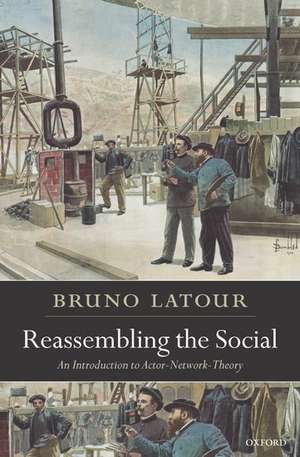
Reassembling the Social: An Introduction to Actor-Network-Theory: Clarendon Lectures in Management Studies
Autor Bruno Latouren Limba Engleză Hardback – 28 iul 2005




Preț: 963.44 lei
Preț vechi: 1433.02 lei
-33%
Puncte Express: 1445
Carte tipărită la comandă
Livrare economică 27 noiembrie-08 decembrie
Livrare prin curier în România Termenul estimat este afișat lângă disponibilitate.
Transport gratuit pentru acest produs Plată online sau ramburs, în funcție de opțiunile comenzii.
Retur gratuit în 14 zile Comandă securizată și suport în română.
Specificații
ISBN-13: 9780199256044
ISBN-10: 0199256047
Pagini: 312
Ilustrații: 1 b/w line illustration, 8 half tones
Dimensiuni: 163 x 242 x 23 mm
Greutate: 0.59 kg
Editura: OUP OXFORD
Colecția OUP Oxford
Seria Clarendon Lectures in Management Studies
Locul publicării:Oxford, United Kingdom
ISBN-10: 0199256047
Pagini: 312
Ilustrații: 1 b/w line illustration, 8 half tones
Dimensiuni: 163 x 242 x 23 mm
Greutate: 0.59 kg
Editura: OUP OXFORD
Colecția OUP Oxford
Seria Clarendon Lectures in Management Studies
Locul publicării:Oxford, United Kingdom
V-ar putea interesa
-
 Preț: 198.49 lei
 -
 -28%Preț: 461.37 lei642.91 lei
 -
 -28%Preț: 551.95 lei766.11 lei
 -
 -11%Preț: 349.42 lei391.64 lei
 -
 The Ideology of GenreThomas O. BeebeePreț: 238.47 lei
 -
 The Production of SpaceHenri LefebvrePreț: 302.48 lei
 -
 Ugly FeelingsSianne NgaiPreț: 248.40 lei
 -
 OUR AESTHETIC CATEGORIESSianne NgaiPreț: 166.03 lei
 -
 We Have Never Been ModernBruno LatourPreț: 232.43 lei
 -
 An Inquiry into Modes of ExistenceBruno LatourPreț: 186.64 lei
 -
 Late modernist poeticsAnthony MellorsPreț: 215.85 lei
 -
 Preț: 181.03 lei
 -
 Dust: The Archive and Cultural HistoryCarolyn Kay SteedmanPreț: 311.74 lei
 -
 American Literary MinimalismRobert C. ClarkPreț: 364.90 lei
 -
 Preț: 465.03 lei
 -
 PostmodernismFredric JamesonPreț: 160.03 lei
 -
 Misplaced IdeasRoberto SchwarzPreț: 142.46 lei
 -
 Preț: 479.44 lei
 -
 The American Biographical NovelProfessor Michael Lackey-17%Preț: 207.60 lei249.15 lei
 -
 A Singular ModernityFredric JamesonPreț: 123.85 lei
 -
 The Antinomies of RealismFredric JamesonPreț: 213.35 lei
 -
 The Ancients and the PostmodernsFredric JamesonPreț: 127.24 lei
 -
 The Modernist PapersFredric JamesonPreț: 259.19 lei
 -
 Preț: 189.83 lei
 -
 Power and LiteratureFlorin Oprescu-9%Preț: 740.66 lei813.91 lei
 -
 -22%Preț: 259.42 lei334.17 lei
Recenzii
This book makes ANT accessible and therefore a great resource for any student wishing to learn the language and ways of ANT.
Notă biografică
Bruno Latour is a Professor at the Centre de Sociologie de l'Innovation, Ecole Nationale Supérieure des Mines de Paris. Having been trained as a philosopher, then an anthropologist, Bruno Latour specialized in the analysis of scientists and engineers at work, and published works on philosophy, history, sociology, and the anthropology of science. He is the author of Laboratory Life (Princeton University Press), We Have Never Been Modern (Harvard University Press), and Pandora's Hope: Essays in the Reality of Science Studies (Harvard University Press).
Cuprins
- Introduction: How to Resume the Task of Tracing Associations
- Part I: How to Deploy Controversies About the Social World
- 1: Learning to Feed from Controversies
- 2: First Source of Uncertainty: No Group, Only Group Formation
- 3: Second Source of Uncertainty: Action is Overtaken
- 4: Third Source of Uncertainty: Objects Too Have Agency
- 5: Fourth Source of Uncertainty: Matters of Fact vs. Matters of Concern
- 6: Fifth Source of Uncertainty: Writing Down Risky Accounts
- 7: On the Difficulty of Being an ANT - An Interlude in Form of a Dialog
- Part II: How to Render Associations Traceable Again
- 8: Why is it So Difficult to Trace the Social?
- 9: How to Keep the Social Flat
- 10: First Move: Localizing the Global
- 11: Second Move: Redistributing the Local
- 12: Third Move: Connecting Sites
- 13: Conclusion: From Society to Collective - Can the Social be Reassembled?